
A clinic group came to us wanting "AI for scheduling." Three weeks of digging showed the real problem sat somewhere else entirely. Front desk staff were retyping referral letters into the practice management system, one field at a time, about forty a day. The scheduling tool worked fine. The document handoff was the bottleneck, so we built a narrow extraction and routing flow instead, and the scheduling project never happened.
That gap between the AI people ask for and the AI that pays for itself is the real subject here. This guide covers how to build a vertical AI app in order, moving through scoping, data, the build, oversight, and the business model underneath it. The thesis is simple. A vertical AI app wins on the domain logic and the data access around the model, not on the model itself. The decisions that kill these projects are commercial ones made before a line of code gets written.
Pick Your Verticalization Strategy Before You Pick a Model
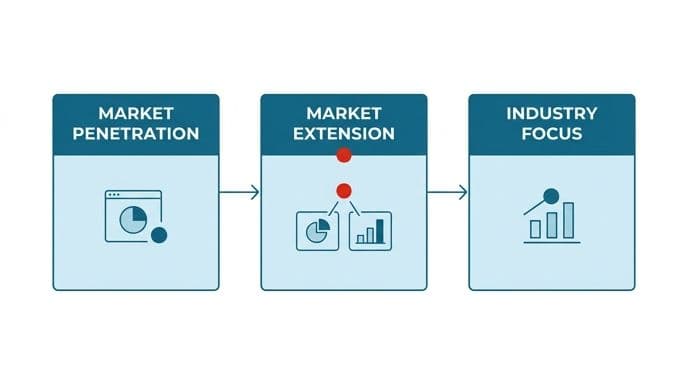
There are three ways to go vertical. Founders who skip this choice end up building a thin wrapper around a general model that any competitor can copy in a weekend.
Workflow depth. You take one painful multi-step process in the industry and own it end to end. Prior authorization. Lesson plan generation tied to a state curriculum. Markdown planning for a retail buyer. The model is a component. The moat is the twenty edge cases you handle that a general assistant doesn't know exist.
Proprietary data. You build on records nobody else can reach. Think historical claims, your own transcripts, or a labeled corpus you paid to produce. This is the strongest position and the slowest to reach.
System of record integration. You embed in the software the industry already runs on, so your output lands where the work happens instead of in a chat window. For retail that's the POS and inventory system, and for healthcare it's the EHR. This is where most of our AI software integration work sits, and it's usually the fastest route to something people actually use daily.
Most durable products combine two strategies. Pick your lead approach first, because it determines what you spend money on in month one. If you're still weighing whether a vertical build beats a horizontal tool, our overview of where AI fits inside industry software walks through the comparison.
Run the Unit Economics Before the Build
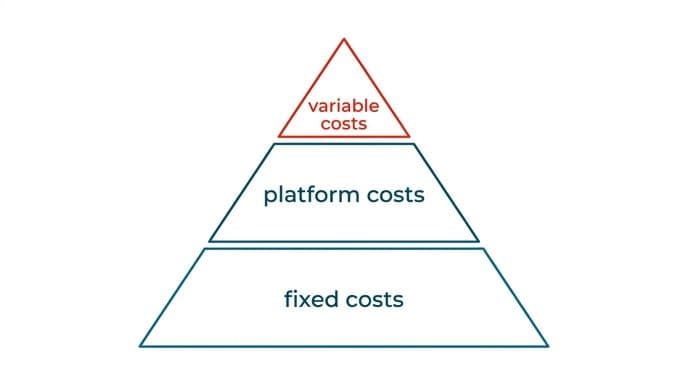
Vertical AI has a cost structure that traditional SaaS founders consistently model wrong. Your cost of goods sold isn't flat. It moves with usage, and heavy users cost more than light ones instead of less.
Model this per workflow completed, not per seat. Ask what a single unit of real work costs you. That means the tokens for the extraction, the retry when the first pass fails validation, the retrieval call, the storage, and the human minute spent reviewing output.
Then ask what happens when your busiest customer triples their volume. Seat pricing against usage-driven costs is how vertical AI startups find their gross margin going backwards as they grow.
A few things we see hold up in practice. Cache aggressively on anything repeated, because in most vertical workflows the same documents, policies and questions come around again and again. Route by difficulty rather than sending everything to your largest model. Price around outcomes where you can defend the number, for example per claim processed or per invoice cleared, so revenue scales with the same thing cost scales with.
One honest caveat on the "will model spend keep growing with usage" question: yes, it will, unless you design against it. The gap between a well-engineered vertical workflow and a naive one is large, and it compounds every month you operate. Build the measurement into the first release rather than bolting it on when finance asks.
Decide Whether You're Selling the Software or the Outcome
This is the fork most vertical AI founders hit around month six. It deserves a real decision rather than drift.
You've built internal tooling that produces consistent results. Now you can either keep it private and use it to run a service at better margins, or expose it as software customers operate themselves. The two paths want different companies.
Service delivery with AI underneath gets you revenue faster, keeps you close to the domain, and lets you fix failures before the customer sees them. The constraint is that growth costs people. Productizing gets you the margin curve investors like, but you now carry support, onboarding, permissions, and the reality that your customer will use the tool in ways you didn't test.
The deciding factor is usually who your buyer trusts. In regulated and high-stakes work, buyers often want a named human accountable for the result, and a visible interface actually reduces trust rather than building it. Those customers are buying certainty. In operational work where the buyer has their own technical team, hiding the system behind a service feels like a black box they can't audit, and they'll ask to see it.
There's a middle path worth considering. Deliver the outcome, but expose a read-only view of how the system reached it. Show the source documents, the checks that ran, the confidence flags. Customers get the audit trail without the burden of operating the software, and you keep the option to productize later.
Get the Data Right, Including the Awkward Options
Data is where vertical AI app development either gets real or stalls. Three routes exist and they're not equally honest about their timelines.
Build the pipeline. Slower, but you own it. Budget more time than feels reasonable for data loading specifically. The newer agent and training frameworks still lack a solid native answer here, so teams end up writing custom loaders or bridging out to external tools. That plumbing is unglamorous and it eats weeks.
Partner for access. Sign design partners who let you learn from their records under a clear agreement. Faster, but your early data looks like two or three customers rather than the market.
Acquire it. Buying a small firm in the vertical for its accumulated records and domain staff is a genuine strategy, not a stunt. You get representative data, labeled by people who did the work, plus the experts who can tell you when output is wrong. The costs are real: an acquisition is a company to run, and the data rights need checking before you sign anything.
Whichever route you take, settle the ownership question early. On enterprise endpoints with retention switched off, vendors don't train on your data. If your records genuinely cannot leave your infrastructure, that's an architecture decision, not a contract one. Private LLM fine-tuning and secure hosting exists for exactly that case.
Vertical AI Application Steps: From Slice to Working Software
Here's the sequence of vertical AI application steps we use, written as what you do rather than what you plan.
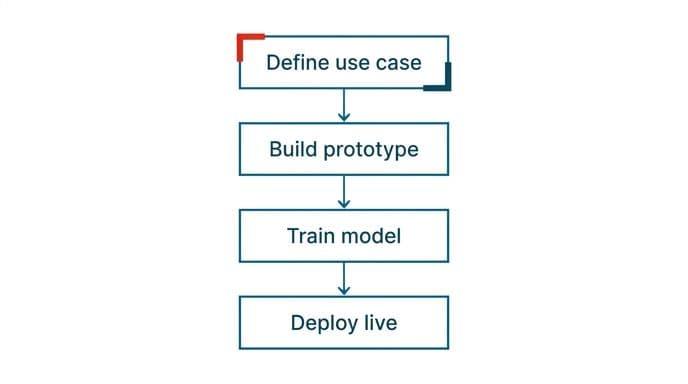
- Pick one workflow and one user. Not a department. One person's recurring task, with a countable volume.
- Define the supported slice precisely. Write down which operations are in scope, where data moves between systems, and who owns each output. Ambiguity here surfaces as rework later.
- Build the deterministic checks first. Before any model runs, know how you'll verify the answer. For invoice extraction that means line items summing to the subtotal, subtotal plus tax matching the total, and quantity times unit price matching each line. Model confidence scores are not validation. Math is.
- Pin your versions. Framework, runtime, model, toolchain. Start from a known-good working example rather than a blank project, and confirm the simplest possible case produces the right number before you add complexity.
- Wire in retrieval. Retrieval augmented generation (RAG) grounds answers in your documents instead of the model's general training, which is what makes an industry specific AI app cite a policy rather than invent one.
- Ship to real users in week three or four. A custom AI MVP for a niche industry earns its keep by being wrong in front of someone who can tell you why.
- Instrument everything, then expand to the second workflow.
That compresses the whole AI app development process into seven steps. The part people skip is step three, and it's the one that determines whether anyone trusts the output.
Build Observability Into the Workflow, Not Around It
Agentic systems fail quietly. A step runs, reports success, and produces something subtly wrong that nobody catches until a customer does.
Two distinctions fix most of this. First, separate task completion from execution evidence, since knowing a job finished tells you nothing. Log what actually happened. Record which checks ran, what they returned, which records changed, what the system chose not to do. Treat "done" as a claim that needs backing.
Second, distinct approved decisions from exploratory ones. On fast-moving builds, teams lose track of which architectural choices were actually signed off and which were merely floated in a conversation. Six weeks later nobody can say whether a given rule still applies. Keep a short, dated record of decisions that are binding, kept apart from the ideas still under discussion. It costs minutes a week and saves arguments.
This matters more than it sounds for compliance work. When a reviewer asks why your system did something, the answer needs to be retrievable, not reconstructed. Our secure AI and compliance architecture work starts from this assumption. We won't promise any submission clears review, because that decision isn't ours to make. An auditable trail is the difference between a hard conversation and an impossible one.
Where Humans Stay in the Loop
Full autonomy is a product decision disguised as a technical one. The line we hold is this: a person approves anything that touches money or a customer.
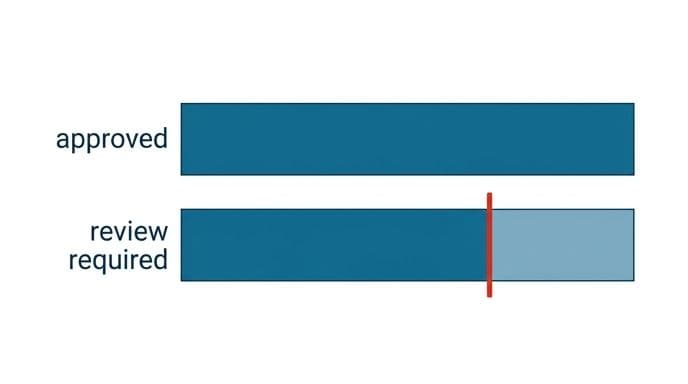
That's not a hedge against bad models. It's how the work gets accepted. Read-only analysis, drafting, classification and routing can run unattended with validation in code. Payments, clinical content, contract terms and anything that leaves your building to reach a customer goes through a human. When building AI apps for healthcare, the model drafts and a clinician checks every word, with no exceptions and no clinical judgment delegated to software.
Design the review step to be fast or people will route around it. Show the extracted value next to the source, highlight only what failed a check, and make approval one action. Review that takes longer than doing the task manually gets abandoned, and then you have autonomy by accident.
Expect to Switch Frameworks, and Build So It Doesn't Hurt
Vertical SaaS AI features built today will outlive the framework you're building them on. Tooling in this space turns over fast, and a rewrite triggered by a dependency change is pure lost time.
Keep your domain logic, validation rules and prompts in your own code, behind a thin interface. Treat model providers as swappable from day one, even if you only use one. Write tests against your business outcomes rather than against a specific library's API surface. When something better arrives, you change an adapter instead of the application.
The technical debt that actually hurts in vertical AI isn't messy code. It's business rules encoded inside prompts where nobody can find them, and model behavior that nothing tests. Pull the rules out, test the behavior, and the framework question becomes boring.
Your Next Step
Before committing budget, map one workflow end to end and count what it costs you today in hours. If the number is small, you might not need software built, and we'll tell you so.
If it's large, you have the business case and the first build target in the same document. Hitasoft has built this kind of system before, including an ABDM health platform integrated with India's national system. We name a fixed price before work starts, you own the code and the keys, and you get working software in month one rather than a quarter of discovery. If you want a view on how to build a vertical AI app in your specific niche, book a free automation audit or read how we run projects.
Frequently Asked Questions
What are the three ways to verticalize an AI app?
The three strategies are workflow depth (owning one painful multi-step process end to end), proprietary data (building on records nobody else can reach), and system of record integration (embedding in software the industry already runs on). Most durable products combine two of these strategies.
How should you price a vertical AI app?
You should model costs per workflow completed rather than per seat, since vertical AI has usage-driven costs where heavy users cost more. Price around outcomes where you can defend the number, such as per claim processed or per invoice cleared, so revenue scales with the same thing cost scales with.
Should I build vertical AI as software or as a service?
Service delivery gets you revenue faster and lets you fix failures before customers see them, but growth costs people. Productizing gets better margins but requires handling support, onboarding, and unpredictable customer usage. The deciding factor is usually who your buyer trusts—regulated buyers often want a named human accountable, while technical teams want to audit the system themselves.
What are the steps to build a vertical AI application?
Pick one workflow and one user, define the supported slice precisely, build deterministic checks first, pin your versions, wire in retrieval, ship to real users by week three or four, and instrument everything before expanding. The critical step people skip is building validation checks before the model runs.
Where should humans stay in the loop in an AI workflow?
A person should approve anything that touches money or a customer. Read-only analysis, drafting, classification and routing can run unattended with code validation, but payments, clinical content, contract terms, and anything that reaches a customer should go through human review. The review step should be designed to be fast or people will route around it.
Wondering what this would take against your own systems?
The audit costs nothing, and you keep the costed plan and the risks whether you go ahead or not.
Book a free automation auditCommon questions
What are the three ways to verticalize an AI app?
The three strategies are workflow depth (owning one painful multi-step process end to end), proprietary data (building on records nobody else can reach), and system of record integration (embedding in software the industry already runs on). Most durable products combine two of these strategies.
How should you price a vertical AI app?
You should model costs per workflow completed rather than per seat, since vertical AI has usage-driven costs where heavy users cost more. Price around outcomes where you can defend the number, such as per claim processed or per invoice cleared, so revenue scales with the same thing cost scales with.
Should I build vertical AI as software or as a service?
Service delivery gets you revenue faster and lets you fix failures before customers see them, but growth costs people. Productizing gets better margins but requires handling support, onboarding, and unpredictable customer usage. The deciding factor is usually who your buyer trusts—regulated buyers often want a named human accountable, while technical teams want to audit the system themselves.
What are the steps to build a vertical AI application?
Pick one workflow and one user, define the supported slice precisely, build deterministic checks first, pin your versions, wire in retrieval, ship to real users by week three or four, and instrument everything before expanding. The critical step people skip is building validation checks before the model runs.
Where should humans stay in the loop in an AI workflow?
A person should approve anything that touches money or a customer. Read-only analysis, drafting, classification and routing can run unattended with code validation, but payments, clinical content, contract terms, and anything that reaches a customer should go through human review. The review step should be designed to be fast or people will route around it.
Hitasoft
LinkedInHitasoft has built software since 2008, for companies that mostly do not have an IT department. These pieces are written by the people who do the integrations rather than by anybody in marketing.