
A product owner we spoke with last quarter had a working learning platform, 40,000 active students, and a board asking why there wasn't an AI tutor in it yet. She'd priced three options: a chatbot plug-in that could ship in two weeks, a full custom build quoted at nine months, and doing nothing. The plug-in demoed well. It also answered a question about her own course content by inventing a chapter that didn't exist.
That's the real decision behind AI in edtech apps. The question isn't whether to add AI, it's which version of it survives contact with actual students, actual teachers, and actual course material. This guide compares the honest options, including ours, and tells you where each one breaks.
Our short answer is this. Constrain the model to your own content, start with the one problem your staff genuinely can't scale by hand, and refuse to ship anything where a wrong answer reaches a student without a check. Everything below explains why.
What Most AI in EdTech Apps Actually Is Right Now
Open up most AI features shipping in learning products and you'll find a chatbot sitting on top of a general model, fed a prompt that says something like "you are a helpful tutor." That's it. Students notice fast. If the thing in your app gives the same answer they'd get from a free consumer assistant, they'll use the free one, and your feature becomes a line item nobody defends at renewal.
The products that hold up do something the general model can't. They know your syllabus, your grading rubric, and your institution's policies, and nothing else. When a student asks about assessment weighting, the answer comes from the actual course handbook, with a pointer to the page. That's retrieval augmented generation, or RAG, where the model has to pull from a defined set of documents before it answers rather than drawing on whatever it absorbed in training.
The difference matters commercially. A wrapper is easy to copy and hard to charge for. A system grounded in your material is harder to copy because the material is yours.
There's also a question nobody in this market answers well: will the approach you pick still make sense in five years? Model capabilities shift faster than curriculum cycles. The hedge is architectural. Keep the content layer, the permissions, and the review workflow as yours, and treat the model as a part you can swap. Teams that wire their entire product around one vendor's quirks end up rebuilding when that vendor changes course. Teams that build a clean boundary around the model change a config file instead.
Build, Buy, or Integrate: Comparing the Three Paths
Most teams evaluating edtech AI integration land on one of three paths. None is wrong in every case.
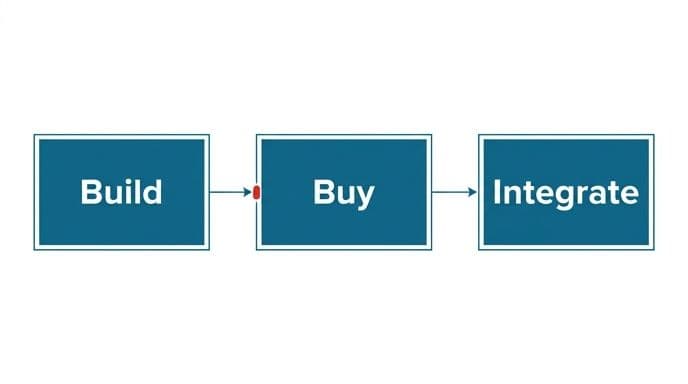
Buy a packaged AI feature. Fastest to ship, cheapest to start, no engineering load. You get what the vendor built for everyone, which means your competitors get it too. You can't ground it properly in your own content, your student data goes where the vendor's terms say it goes, and pricing usually scales with usage in a way that's hard to forecast. Reasonable if you're testing demand and plan to replace it later.
Build the whole thing in-house. You own everything and control the data path. You also need people who've shipped LLM integration for edtech before, not just backend engineers learning on your budget. Evaluation harnesses, prompt regression tests, and hallucination monitoring are their own discipline. If your team has that depth, build.
Integrate a custom layer onto what you already run. The model does the language work. Your platform keeps the content, the user records, and the rules. This is where most of our edtech work sits, because the hard part is almost never the model. It's connecting it to a learning management system that was built in 2019 with an API nobody documented.
We'll say the unhelpful-sounding thing: sometimes the honest answer is that you don't need a new build at all. If your support load is thirty repeated questions a term, a well-written FAQ and a search box solve it for a fraction of the cost. We've told clients that, and it costs us a project and saves them a year.
When AI Tutoring Software Earns Its Place
The clearest case for AI tutoring software is scale that humans physically can't cover. One instructor, four hundred students, questions arriving at eleven at night before a Monday deadline. No teaching assistant budget covers that. A grounded assistant that answers from the course material, flags what it can't answer, and routes those to a human, solves a problem that was previously just unsolved.
The weak case is replacing something that was already working. Discussion, accountability, and the pressure of a group that notices when you haven't done the reading are doing real work in a classroom. Optimizing them away in favor of a private, frictionless, always-available tutor removes the social machinery that made the learning stick. AI-powered learning platforms tend to measure what's simple to measure, and belonging isn't one of those things.
Three uses we've seen hold up well:
- Out-of-hours question answering grounded in course documents, with a confidence threshold that hands off to staff.
- Draft generation for teaching staff, where lesson plans, question banks, and feedback comments come back as drafts a teacher edits rather than as finished output.
- Translation and accessibility, taking existing material into more languages. We built listing publication across twelve languages for Japan Pro, and the same pattern works for course content.
The pattern across all three is that a person stays in the loop on anything a student sees. That's not a stylistic preference. It's the only version we'll build.
Skill Atrophy, Productive Struggle, and Designing for Difficulty
Here's the risk that sales decks skip. A tutor that answers instantly removes the struggle that produces learning, and students get stuck, ask, receive, move on, and retain very little. The engagement dashboard looks great. The exam results don't move.
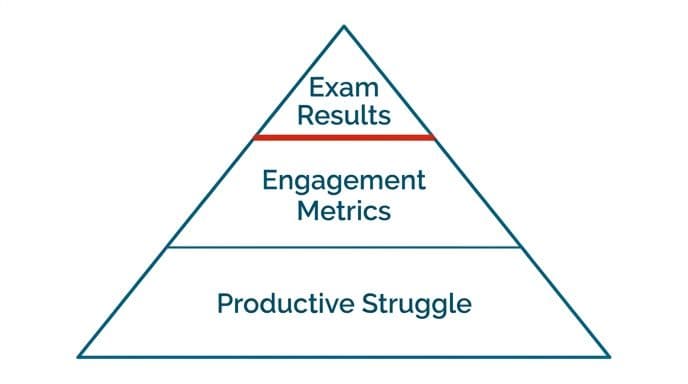
Productive struggle is the part of learning that feels bad and works. Content personalization in edtech works best when it holds answers back rather than smoothing every step, because a system tuned to remove friction everywhere ends up undermining the learning it's meant to support. Better designs hold answers back on purpose. Give a hint, then a stronger hint, then a worked example of a similar problem, and only then the solution. Make the student attempt something before the assistant will engage, and log how many steps a learner needed, then show that to the instructor rather than hiding it.
There's a related dependency question that applies to staff too. Teachers who generate test questions with a model and don't check the sources end up with plausible citations to papers that don't exist. This pattern shows up often enough that we now build source verification into any assessment-generation feature. Every generated item carries a link to the exact passage it came from, and items without a verifiable source get held for review rather than published.
Foundational knowledge turns out to be the prerequisite for using these tools well. A student who already understands the structure of an argument can push back on a generated essay. A student who doesn't will accept whatever arrives. That has a product consequence: AI assistance should probably unlock progressively, not greet a beginner on day one.
Student Privacy: The Part That Decides Your Architecture
Unauthorized data collection and sharing in K-12 apps is widespread, and it's the fastest way for an edtech product to lose a district contract. Minors' data carries obligations that adult consumer products don't face. "The vendor says it's fine" is not a defense you'll enjoy making.
Three questions to settle before any code is written. Where does a student's text go when they type it, who retains it, and for how long? Can it be used to train anyone's model?
On enterprise endpoints with retention switched off, the answer to the training question is no. That's worth confirming in writing with whichever provider you use, not assuming. For institutions whose records genuinely cannot leave their own infrastructure, the option is private LLM fine-tuning and hosting inside your own environment, where the model runs on hardware you control and nothing transits a third party. It costs more to run, but for some buyers it's the only version that passes procurement.
We build this layer deliberately rather than bolting it on, and our work on designing AI systems that satisfy compliance review follows the same approach we use in regulated healthcare builds. The parallels are close enough that our write-up on how clinical products handle model oversight is worth reading if you sell into schools.
We won't promise you'll pass a district security review or an app store check. Submission and the reviewer's decision stay with you. What we can do is build so that the answers to the hard questions are already documented.
Measuring Learning, Not Engagement
Time in app, sessions per week, and messages sent go up reliably when you add a conversational feature, and they tell you almost nothing about whether anyone learned. Schools have become reasonably skeptical of engagement charts, and buyers increasingly ask what changed in outcomes.
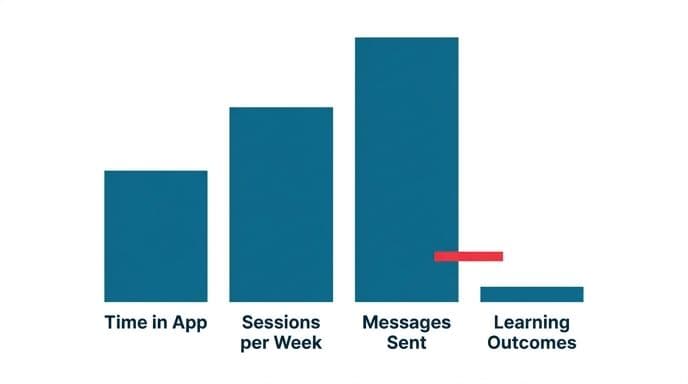
Portfolio and process-based assessment gives you better evidence than another round of data-driven testing. Capture the drafts, not just the final submission, and show the revision history. Record where a student asked for help and what happened after. A teacher looking at that sequence can tell the difference between a learner who worked through something and one who copied an answer, and no quiz score makes that distinction.
This changes what AI-powered learning platforms should instrument. Instead of scoring correctness alone, track attempt-before-help rates and the gap between a first attempt and a final answer. Also track whether a student can later solve a similar problem without assistance. Those signals are harder to collect and much more defensible in a renewal conversation.
The Cheap Options Worth Trying First
Not every problem in AI in education technology needs a model behind it. Before funding a build, run through the cheaper fixes.
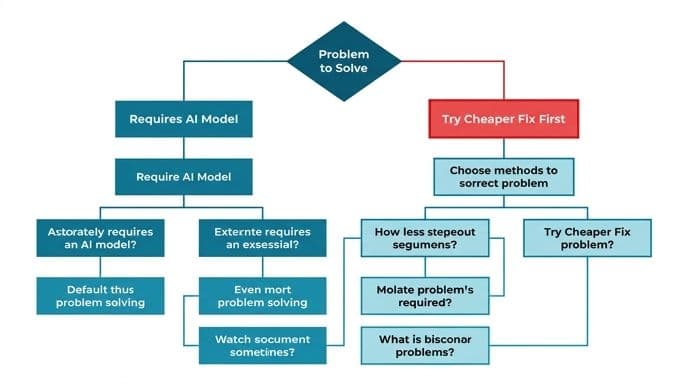
- Fix search first. A large share of student questions are navigational. Where's the deadline, which chapter, what's the policy. Decent search answers those for near nothing.
- Write the twenty answers down. If your support lead can list the repeated questions, a maintained knowledge base clears most of the volume before any AI touches it.
- Automate the back office instead. Enrollment paperwork, invoice handling, scheduling, and document processing often cost more staff hours than tutoring does. That work has clean rules and tolerates automation better than teaching does.
- Pilot on one course. Run a narrow version with one instructor who's willing, for one term, and see whether anything improves before committing the platform.
Teacher training belongs in this list too, because it's the implementation step most budgets skip. A tool nobody knows how to use becomes a tool nobody uses. Plan for a short, practical session on what the assistant can and can't do, a documented escalation path, and a named person who owns the thing. A content team we worked with cut a significant chunk of their production time once the workflow was redesigned around the new tools, and the reason it worked was that someone sat with them and redesigned how they worked, not just what software they opened.
How We'd Approach Your Build
Custom AI for edtech apps is what we do, and here's the shape of it. We name a fixed price before work starts. You get working software in month one, not a discovery phase that bills for a quarter.
You own the code, the cloud accounts, and the API keys at the end, so you can take the whole thing elsewhere if we disappoint you. Our builders travel to clients, and you talk to the people writing the code, not an account manager relaying messages. We've run that way for years, working with clients across multiple countries on projects spanning North America, the UK, and Europe. Our product division, Appkodes, has an active presence on Trustpilot where clients leave reviews of their experience.
For edtech specifically, we start with an automation audit: where your staff time actually goes, which of that a model can do, and which of it shouldn't be touched. Then a scoped AI integration into the platform you already run, with retrieval over your own course material, human approval on anything student-facing, and an evaluation set you can rerun when models change. If you want the broader picture across sectors, our guide to how AI plays out differently in each industry covers the comparison, and our regulated-sector consulting work shows how we handle data that can't move.
Pick the smallest feature your teaching staff can't do by hand. Ground it in your own material, and put a person in front of the student. Then book a free automation audit and we'll tell you honestly whether it's worth building.
Frequently Asked Questions
Should I add an AI tutor to my edtech platform?
The decision isn't whether to add AI, but which version survives contact with actual students, teachers, and course material. You should constrain the model to your own content, start with one problem your staff genuinely can't scale by hand, and refuse to ship anything where a wrong answer reaches a student without a check.
What's the difference between a chatbot wrapper and retrieval augmented generation in edtech?
Most AI features in learning products are just chatbots on top of a general model with a "be helpful" prompt, which students will abandon for free consumer alternatives. The products that hold up use retrieval augmented generation (RAG), where the model pulls from your defined course documents—syllabus, rubrics, and policies—making it harder to copy and justifying a price premium.
What are the three ways to add AI to an edtech app?
You can buy a packaged AI feature (fastest and cheapest but limited to what vendors built for everyone), build it in-house (requires specialized LLM integration expertise), or integrate a custom layer onto your existing platform where the model handles language work while your platform keeps content and user records. The hardest part is usually connecting to legacy learning management systems, not the model itself.
How does productive struggle affect learning in AI tutoring software?
A tutor that answers instantly removes the struggle that produces learning, causing students to get stuck, ask, receive, and move on with little retention. Better designs hold answers back on purpose by giving hints progressively before showing solutions, and they log how many steps a learner needed so instructors can see the work.
What should I measure to know if AI in my edtech app actually improves learning?
Don't rely on engagement metrics like time in app or messages sent, which tell you almost nothing about whether anyone learned. Instead measure attempt-before-help rates, the gap between first and final attempts, and whether students can solve similar problems later without assistance using portfolio and revision history data.
Wondering what this would take against your own systems?
The audit costs nothing, and you keep the costed plan and the risks whether you go ahead or not.
Book a free automation auditCommon questions
Should I add an AI tutor to my edtech platform?
The decision isn't whether to add AI, but which version survives contact with actual students, teachers, and course material. You should constrain the model to your own content, start with one problem your staff genuinely can't scale by hand, and refuse to ship anything where a wrong answer reaches a student without a check.
What's the difference between a chatbot wrapper and retrieval augmented generation in edtech?
Most AI features in learning products are just chatbots on top of a general model with a "be helpful" prompt, which students will abandon for free consumer alternatives. The products that hold up use retrieval augmented generation (RAG), where the model pulls from your defined course documents—syllabus, rubrics, and policies—making it harder to copy and justifying a price premium.
What are the three ways to add AI to an edtech app?
You can buy a packaged AI feature (fastest and cheapest but limited to what vendors built for everyone), build it in-house (requires specialized LLM integration expertise), or integrate a custom layer onto your existing platform where the model handles language work while your platform keeps content and user records. The hardest part is usually connecting to legacy learning management systems, not the model itself.
How does productive struggle affect learning in AI tutoring software?
A tutor that answers instantly removes the struggle that produces learning, causing students to get stuck, ask, receive, and move on with little retention. Better designs hold answers back on purpose by giving hints progressively before showing solutions, and they log how many steps a learner needed so instructors can see the work.
What should I measure to know if AI in my edtech app actually improves learning?
Don't rely on engagement metrics like time in app or messages sent, which tell you almost nothing about whether anyone learned. Instead measure attempt-before-help rates, the gap between first and final attempts, and whether students can solve similar problems later without assistance using portfolio and revision history data.
Hitasoft
LinkedInHitasoft has built software since 2008, for companies that mostly do not have an IT department. These pieces are written by the people who do the integrations rather than by anybody in marketing.