
Many dental practices lose calls every week without realizing it. Not dropped calls. These ring out while the front desk is checking in a patient, processing a payment, and answering the fax machine all at once. Half of those callers are existing patients rescheduling. Maybe four are new patients who then call the practice down the road.
That gap is the reason most practices start looking at dental AI voice agent development. The pitch sounds simple. An AI phone agent for dental practices answers every call, books into open slots, and texts a confirmation. The reality is less uncomplicated. Voice is the easy part now. The hard part is writing a confirmed appointment back into Open Dental or Dentrix without creating a double booking, and proving to an auditor that nothing about that call leaked protected health information.
Most projects in this space fail for the same handful of reasons, and this guide is built around avoiding them.
Start With Call Types, Not With the Voice
The first instinct is to pick a voice vendor and start writing prompts. That gets you a demo in two days and a mess in two months, because the agent has no idea which conversations it's allowed to finish on its own.
Pull your last 500 inbound calls and sort them by reason. Most practices end up with something close to this distribution: new patient intake, existing patient scheduling, reschedules and cancellations, insurance and cost questions, post-op or pain calls, billing questions, and vendor or spam calls. The percentages vary, but the shape rarely does.
Now mark each one with what the agent is permitted to do. Three buckets work well:
- Complete it. Hours, location, parking, accepted plans, confirming an existing appointment, booking a standard hygiene recall into a predefined slot type.
- Collect and hand off. New patient intake where the caller has a complex history, insurance verification questions, treatment plan cost estimates. The agent gathers name, callback number, reason, and preferred time, writes a task, and tells the caller when someone will call back.
- Transfer immediately. Pain, swelling, bleeding, trauma, anything the caller frames as an emergency. During hours this rings the front desk. After hours it follows your on-call path.
That third bucket is where governance matters most. The agent should never assess urgency or offer any guidance about a clinical symptom. It recognizes keywords and escalation phrasing, then routes. Any symptom description it captures gets logged verbatim for a human to read, not interpreted. We build healthcare systems on that principle across every engagement. The software drafts and routes. A clinician or a trained staff member decides.
Getting this triage map agreed before a single prompt is written is what separates dental front-desk automation that staff trust from a system they quietly route around after three bad weeks.
Choosing Telephony and Voice Infrastructure Without Locking Yourself In
Vendor choice drives three things you'll feel daily: latency, cost per minute, and how much control you have when something breaks at 8:40 a.m.
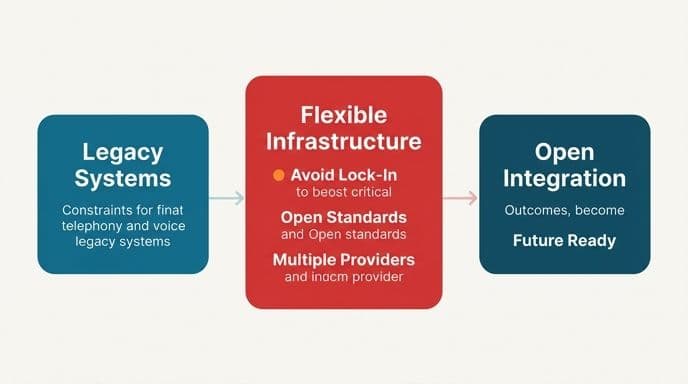
Telephony layer. Twilio and Telnyx both carry calls reliably. Telnyx generally comes in cheaper per minute at volume and gives you direct SIP control, which matters if you're forwarding an existing practice line rather than issuing new numbers. Twilio has broader documentation and easier SMS compliance tooling in the US. For a single practice, the cost difference is noise. For a DSO running 30 locations, it's a real line item. Either way, port or forward rather than replacing the number patients already have.
Voice orchestration. Retell and Vapi both handle the speech pipeline, turn-taking, and interruption handling that would otherwise take months to build. They're worth using. What you should insist on is that your prompts, your tool definitions, your call logs, and your integration code live in your repositories and your database, not only inside the vendor dashboard. Switching orchestrators then becomes a two week job instead of a rebuild.
Speech and language models. Deepgram for transcription, ElevenLabs or a comparable engine for the voice, and a reasoning model behind the conversation. The combination you pick should be measured, not assumed. Run the same 50 recorded calls through two configurations and compare word error rate on names, insurance carriers, and procedure terms. Dental vocabulary breaks generic models more than people expect. "Aetna," "prophy," "crown seat," and most patient surnames are where accuracy goes.
Latency is what callers notice most, even if they can't name it. If the agent's reply lags noticeably after the caller finishes speaking, people start talking over it and the conversation degrades fast.
One honest note on cost. Model spend scales with minutes, and anyone telling you otherwise is selling. You control it by keeping prompts tight, caching the static practice information instead of re-sending it every turn, and using a smaller model for classification steps with a larger one reserved for actual reasoning. Our work on custom AI API integration and AI wrappers usually cuts per-call token volume substantially just by restructuring how context is assembled.
Dental PMS Integration Is the Project
Everything above is commodity. Dental PMS integration is where the real engineering sits, and where most voice agent projects stall.
Open Dental is the friendliest case. It offers a documented API, and for on-premise installs you can work against the database directly with appropriate controls. Appointment creation, operatory assignment, provider schedules, and patient lookup are all reachable. Dentrix is harder. Depending on version and whether the practice is on Dentrix Ascend, you might be working through a partner API program, a middleware connector, or a supported integration layer. Eaglesoft similarly tends to require vendor-sanctioned access, while Curve, being cloud-native, is generally more cooperative.
Before scoping anything, confirm three facts. Which PMS version the practice runs, whether it's hosted or on-premise, and whether the practice already has an active integration agreement with the vendor. A quote for Open Dental integration or Dentrix integration given without those answers is a guess.
The write-back problem deserves its own attention. A caller agrees to Tuesday at 10. Four things must then happen in order: re-check live availability, create the appointment with the correct provider, operatory, and appointment type length, read the record back to confirm it exists, and only then tell the caller it's booked and fire the SMS confirmation. Skip the read-back and you will eventually tell a patient they're confirmed when nothing was written.
Failures need defined behavior, not a stack trace. If the write fails, the agent should say a human will confirm shortly, create a task in a queue the front desk actually watches, and send itself an alert. Silent failures are worse than no automation at all, because staff stop checking once they've been burned.
Slot logic is its own discipline. A hygiene recall, a crown seat, and a new patient exam have different durations, different provider requirements, and sometimes different operatory constraints. Real dental appointment scheduling automation respects those rules rather than dropping everyone into generic 30 minute blocks. Build the rules with the office manager who currently holds them in her head, and write them down.
Building HIPAA-Compliant Voice AI Into the Architecture
Compliance isn't a review you pass at the end. It's a set of decisions made at the start that are expensive to retrofit.
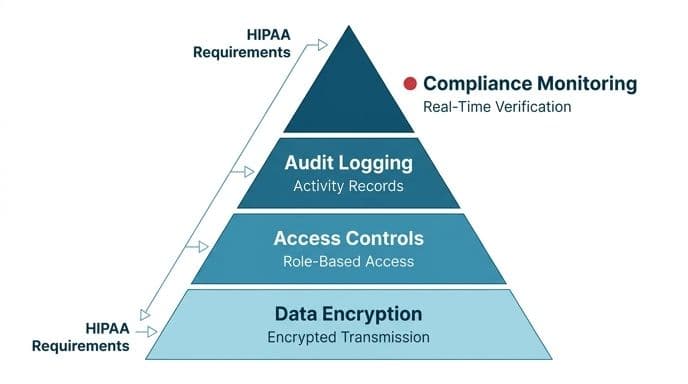
Start with Business Associate Agreements. Any vendor touching call audio, transcripts, or patient identifiers needs one. Your telephony provider, your orchestration layer, your transcription service, your model provider, and your database host all qualify. If a vendor won't sign a BAA, it cannot be in the path. That single rule eliminates a surprising number of otherwise appealing tools.
On the question clients ask most: no, model providers do not train on your data when you're on enterprise endpoints with zero data retention configured and a BAA in place. That configuration is a deliberate choice someone has to make and document. The default consumer tier is not that.
Practical controls for HIPAA-compliant voice AI in this context:
- Minimum necessary by design. The agent needs enough to find a patient record and book a slot. It does not need medical history, and it should never ask for a card number. Payment links go out by SMS, handled by a payment processor, never spoken aloud.
- Encryption and secrets. TLS in transit, encryption at rest for recordings and transcripts, API credentials in a managed secrets store rather than environment files in a repo.
- Role-based access. The front desk sees call summaries and bookings. Engineers see logs with identifiers redacted. Nobody has standing production database access they don't need daily.
- Audit logging. Every read and write against patient data, with user, timestamp, and action. This is what makes an audit survivable.
- Retention. Decide how long you keep audio and transcripts, usually far shorter than people assume, and enforce deletion automatically.
- Incident response. A written path for a suspected disclosure, tested at least once.
SOC 2 controls overlap heavily with the above.
If you expect to sell into DSOs or partner with larger groups, build to them now. Retrofitting evidence trails is miserable work. Our secure AI and compliance architecture practice exists mostly because of projects that skipped this step and had to rebuild. We've also worked at national scale on this problem, including an ABDM health platform connected to India's national digital health system, where identity handling and consent were not negotiable.
What nobody can promise you is approval or breach-proof systems. We can build to the controls, document them clearly, and hand you evidence an auditor will accept. The audit outcome stays with you.
Writing Call Templates Your Staff Will Actually Maintain
A prompt is not a script. It's an operating procedure with constraints, and it should be versioned like code.
Build a template per call type rather than one enormous prompt. Each template specifies the objective, the facts the agent may state, the information it must collect, the tools it can call, the conditions for transfer, and the exact wording for anything legally sensitive. Separate templates keep changes contained. When the practice adds Saturday hours, you edit one file.
Two things improve conversion more than clever phrasing. First, offer specific times instead of asking open questions. "I have Thursday at 2:15 or Friday at 9:30" books far more often than "when works for you?" Second, confirm by repeating back the name spelling, the date, and the appointment type before writing anything.
Insurance deserves a tight boundary. The agent can confirm which plans the practice is in network with. It should not estimate coverage, quote a patient portion, or interpret benefits. Those become callbacks.
After-hours behavior needs its own template. Overnight callers are disproportionately urgent or anxious, and the agent should identify emergencies fast, route them on the on-call path, and for everything else take a clear message with a stated callback window. Nothing is worse than an agent cheerfully booking a routine cleaning while someone describes facial swelling.
Give the office manager a readable view of every template and a way to request changes. The practices that get the most from dental front-desk automation are the ones where staff own the language. A sidebar worth noting: much of the gain here is time, not headcount. We've written elsewhere about cutting staffing costs with custom automation, and the honest version is that the front desk gets its attention back rather than disappearing.
Testing, Monitoring, and the Numbers Worth Watching
Test with recorded calls from your own practice, not scripted happy paths. Include the caller with a thick accent, the one calling from a car, and the one who changes their mind twice.
Build a staging environment pointed at a test PMS instance. Nobody tests appointment writes against live production.
Run end-to-end checks on every release: call connects, intent classified, slot offered, appointment written, read-back confirmed, SMS delivered, log recorded.
Watch these weekly:
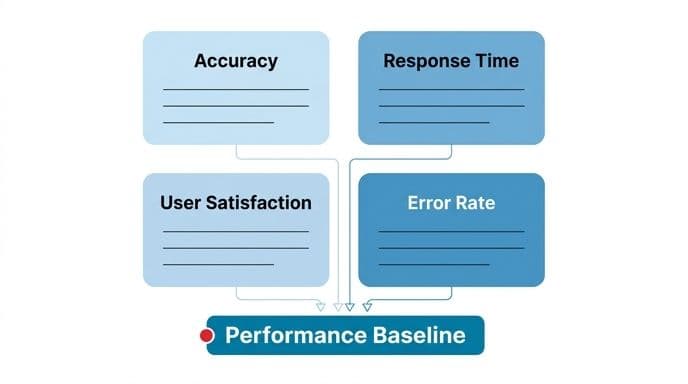
- Containment rate. Calls resolved without transfer, broken out by call type. A falling rate in one category tells you exactly which template to fix.
- Booking conversion. Of calls where the caller wanted an appointment, how many got one.
- Write-back failure rate. Should be near zero. Any sustained figure above that means a PMS issue, not a voice issue.
- Latency distribution. Watch the slowest 5 percent, not the average.
- Cost per booked appointment. More useful than cost per minute.
- Transfer accuracy. How often AI call routing for dental clinics got the caller to the right place on the first try.
Sample real call recordings every week, at least twenty, with a staff member listening. Automated metrics tell you what happened. People tell you how it sounded.
When a Dental AI Voice Agent Is the Wrong Answer
Some practices don't need this. A single-dentist office taking 25 calls a day with a stable front desk person may get more value from better reminder texts and an online booking page than from a voice system that costs real money to maintain.
Call volume below roughly 40 a day, or a PMS with no viable integration path, usually means the economics don't work yet, and we'll say so. Telling a client not to build is cheaper for everyone than building something that gets switched off in month four.
The practices where this pays are the ones leaking after-hours calls, running multiple locations, or watching hygiene recall lists go stale because nobody has time to work the phones.
Your Next Step
Map your call types before you talk to any vendor. Pull a month of call logs, categorize them, and mark each one as complete, collect, or transfer. Then confirm your PMS version and integration path. Those two documents turn a vague project into a scoped one, and they'll save you more money than any vendor negotiation.
We build these systems with fixed pricing named before work starts, working software in the first month, and the code, accounts, and keys in your name. Our AI voice and telephony automation work sits alongside broader healthcare technology engagements and custom voice model development for teams with unusual vocabulary requirements.
Book a free automation audit and we'll tell you honestly whether your numbers support building one.
Frequently Asked Questions
How do I integrate a dental AI voice agent with my practice management system?
Dental PMS integration is the core engineering challenge of voice agent projects. You need to confirm which PMS version you run, whether it's hosted or on-premise, and whether you have an active integration agreement with the vendor. The critical process is the write-back: re-check availability, create the appointment with correct provider and operatory, read the record back to confirm it exists, and only then confirm to the caller and send SMS.
What should a dental practice do before building an AI voice agent?
Start by pulling your last 500 inbound calls and sorting them by reason, then mark each one with what the agent is permitted to do: complete it, collect and hand off, or transfer immediately. Getting this triage map agreed before writing any prompts is what separates automation staff will trust from a system they route around.
How do I make a dental AI voice agent HIPAA compliant?
Ensure all vendors touching call audio, transcripts, or patient identifiers sign Business Associate Agreements. Collect only minimum necessary information for booking, encrypt data in transit and at rest, implement role-based access controls, maintain audit logs of all patient data access, enforce automatic deletion of recordings and transcripts, and establish a written incident response plan.
Which telephony and voice providers should I choose for a dental voice agent?
Twilio and Telnyx both carry calls reliably, with Telnyx generally cheaper at volume and offering direct SIP control. For voice orchestration, Retell and Vapi are worth using, but insist that your prompts, tools, call logs, and integration code live in your own repositories and database. For speech recognition, run the same recorded calls through configurations and compare accuracy on dental vocabulary like procedure terms and insurance carriers.
How should I handle emergency calls in a dental AI voice agent?
The agent should recognize keywords and escalation phrasing for pain, swelling, bleeding, and trauma, then route immediately to the front desk during hours or to your on-call path after hours. The agent should never assess urgency or offer clinical guidance; it should log symptom descriptions verbatim for a human to interpret.
Wondering what this would take against your own systems?
The audit costs nothing, and you keep the costed plan and the risks whether you go ahead or not.
Book a free automation auditCommon questions
How do I integrate a dental AI voice agent with my practice management system?
Dental PMS integration is the core engineering challenge of voice agent projects. You need to confirm which PMS version you run, whether it's hosted or on-premise, and whether you have an active integration agreement with the vendor. The critical process is the write-back: re-check availability, create the appointment with correct provider and operatory, read the record back to confirm it exists, and only then confirm to the caller and send SMS.
What should a dental practice do before building an AI voice agent?
Start by pulling your last 500 inbound calls and sorting them by reason, then mark each one with what the agent is permitted to do: complete it, collect and hand off, or transfer immediately. Getting this triage map agreed before writing any prompts is what separates automation staff will trust from a system they route around.
How do I make a dental AI voice agent HIPAA compliant?
Ensure all vendors touching call audio, transcripts, or patient identifiers sign Business Associate Agreements. Collect only minimum necessary information for booking, encrypt data in transit and at rest, implement role-based access controls, maintain audit logs of all patient data access, enforce automatic deletion of recordings and transcripts, and establish a written incident response plan.
Which telephony and voice providers should I choose for a dental voice agent?
Twilio and Telnyx both carry calls reliably, with Telnyx generally cheaper at volume and offering direct SIP control. For voice orchestration, Retell and Vapi are worth using, but insist that your prompts, tools, call logs, and integration code live in your own repositories and database. For speech recognition, run the same recorded calls through configurations and compare accuracy on dental vocabulary like procedure terms and insurance carriers.
How should I handle emergency calls in a dental AI voice agent?
The agent should recognize keywords and escalation phrasing for pain, swelling, bleeding, and trauma, then route immediately to the front desk during hours or to your on-call path after hours. The agent should never assess urgency or offer clinical guidance; it should log symptom descriptions verbatim for a human to interpret.
Hitasoft
LinkedInHitasoft has built software since 2008, for companies that mostly do not have an IT department. These pieces are written by the people who do the integrations rather than by anybody in marketing.