
A founder came to us last year with a twenty-two item feature list. His pitch deck promised all of it, and he had nine months of runway. The list was good, but the problem was the order. Six of those features depended on one piece of logic nobody had tested yet, and that piece was scheduled for month five. If it didn't work, everything built before it was scrap.
That ordering problem is what SaaS AI MVP development is really about. It's not how fast you can write code. It's which code you write first, and what you learn the week after it ships.
Most teams do it the other way round. They build the whole product, then show it to people. By the time real users arrive, most of what got built is sitting unused. The one thing that needed changing was decided in week one, buried under everything stacked on top of it.
Our argument here is simple. Pick the single feature your business model stands or falls on. Build that feature properly on infrastructure you'd be happy to keep, and put it in front of a closed group of real users before you build anything else.
The expensive way to find out your roadmap was wrong
Three patterns show up again and again, and all three cost months.
The first is the roadmap written before the testing. Features get locked in a planning document, the build follows the document, and nothing in the document gets challenged until launch. Then the usage data arrives. A large share of the feature set turns out to be dead weight in year one. Not broken. Just never opened.
The second is the submission surprise. A team finishes the build, submits to an app store or hands the product to a compliance reviewer, and discovers that how they collect, store and route user data doesn't hold up. Data handling isn't a screen you add at the end. It's a schema decision made in week one, and unpicking it means touching everything.
The third is the prototype you can't build on. Something gets thrown together fast to demo to investors. It works, and then the team tries to add the second feature. The shortcuts taken on the data model or the permission structure turn out to be load-bearing. The rebuild costs more than the original build did.
We see the same thing from the inside too. Engineers enjoy building. Given a loose brief, they'll produce more than anyone asked for. Then the team spends a sprint pulling features back out to find the actual product underneath. Discipline about scope isn't a personality trait. It has to be written into the plan.
The thin slice: one feature, built properly
An MVP isn't a half-built version of the full product. A half-built product does ten things badly and proves nothing. The thin slice does one thing properly, on real infrastructure, in front of real people.
The slice exists to answer one question: does the core idea work when someone who isn't you tries to use it? Everything else gets written down and parked. Written down matters. Parked features aren't cancelled, they're sequenced, and the sequence changes once you have evidence.
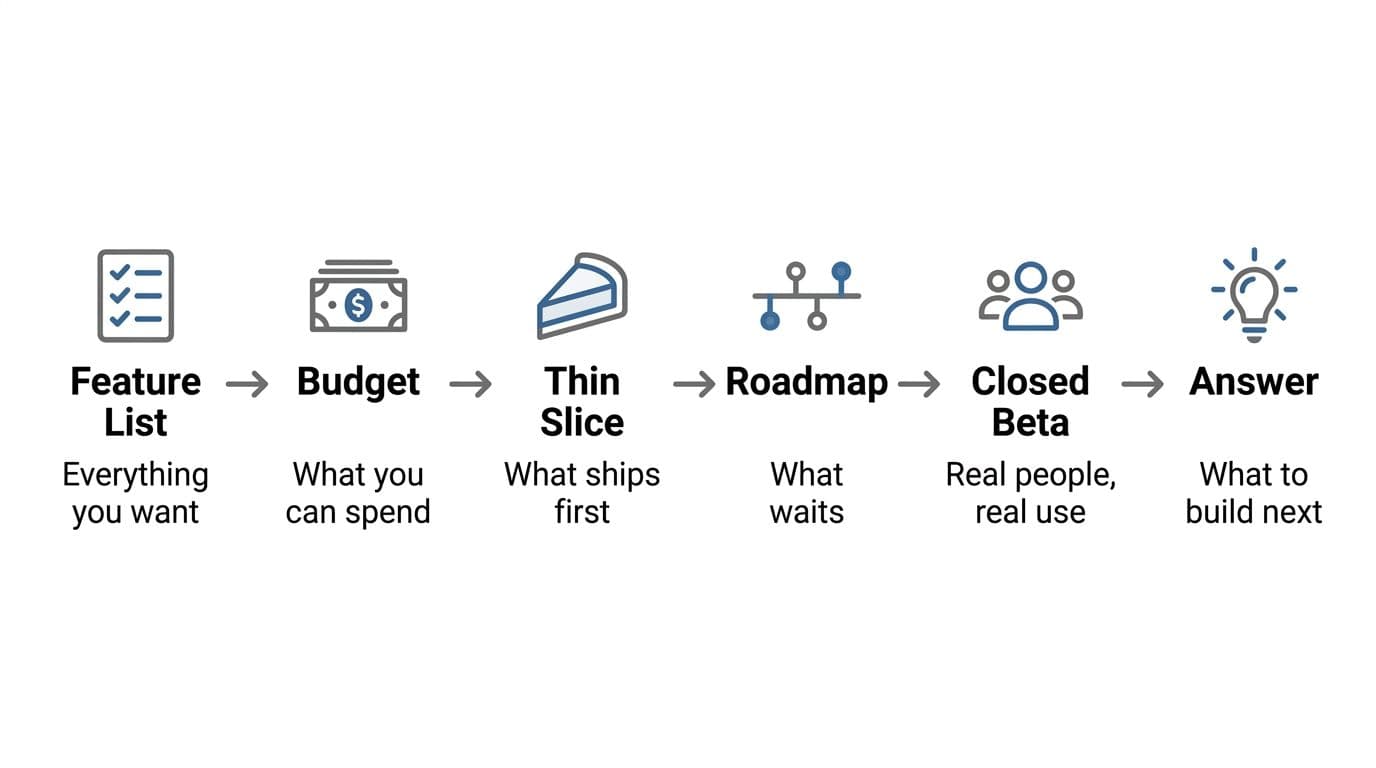
Six things make up the decision, and they're worth keeping on one page:
- The feature list. Everything you eventually want, unfiltered.
- The budget. What you can actually spend before you need more money or revenue.
- The thin slice. The one feature that ships first, chosen because the business model depends on it.
- The roadmap. What waits, in what order, with the reason attached.
- The closed beta. A small group of real users with real work to do, not friends clicking around.
- The answer. What they did with it, and what that tells you to build next.
This framework only holds if you defend it against feature creep.. Founders who can explain MVP principles fluently still add three items during the build, because each one feels necessary at the time. The defence is the budget and the calendar, both fixed before work starts. When someone proposes an addition, the question isn't whether it's a good idea. It's what comes out to make room.
How to pick what ships first in SaaS AI MVP development
Week one is a thinking week, and the thinking is narrow. What does this product stand or fall on?
A diagnostic tool for higher education stands on the diagnostic pipeline: student sign-up, the assessments, the scored analysis, and a human expert checking the output before it goes back. If the assessment logic doesn't produce results an academic will sign their name to, no dashboard saves it. So the dashboards wait.
A marketing assistant for home-service contractors stands on the audit engine. It has to look at a plumber's website, find what's wrong, and suggest keywords a non-marketer can act on. That's the product. Rank tracking and lead attribution are for customers who are already paying, and you don't have any yet.
A financial product stands on the calculation layer. Numbers have to be right before anything else is worth building, and the way you prove they're right is by running real cases through it with a person reviewing every result. Reporting screens and compliance exports come after the math holds.
The rule underneath all three: ship the slice that proves the business model, not the slice that makes the product feel complete. Completeness is a feeling. Evidence is what you're buying.
This is also the point where we sometimes tell people not to build. If the core question can be answered with a spreadsheet, a shared inbox and a week of manual work, do that instead. Some ideas need software to test. Plenty don't, and finding out costs a conversation rather than a quarter.
What to leave out of version one
Exclusions are where the budget actually gets made. Five of them come up in almost every lean AI product development plan we write.
Proprietary models. Training your own model is a research project with an unknown end date. Commercial APIs handle the first version, and they handle it now. If your data or your margins later justify private LLM fine-tuning and secure hosting, you'll make that call with usage data in hand rather than a hunch. Skipping it early saves eight to twelve weeks.
Native mobile apps. Web-responsive first. Two native builds plus store submission add cost and review risk and closed beta testers are perfectly content in a browser.
Advanced features. Recommendation engines, rank tracking, behavioral scoring. All reasonable. None of them prove the core.
Integrations that don't carry the slice. One connector might be essential because the product can't work without it. The other six are v2. Third-party connectors age badly when the product around them is still changing shape.
Polished dashboards. Build enough interface that a tester can use the thing without you sitting next to them. Genuine polish waits until users have told you which numbers they actually look at, which is rarely the set you'd have guessed.
There's a live argument that the traditional MVP is outdated, and that founders should ship something closer to a complete product using low-code tools. There's something to it. Low-code gets you to market quickly when the product is a workflow. It stops helping when the product is the AI logic itself, because that's where custom work lives and where a generic builder hits its ceiling.
Three architecture decisions that don't trap you
All three get made in week one, when they cost nothing extra. Fixing any of them with live users on the system costs a rebuild.
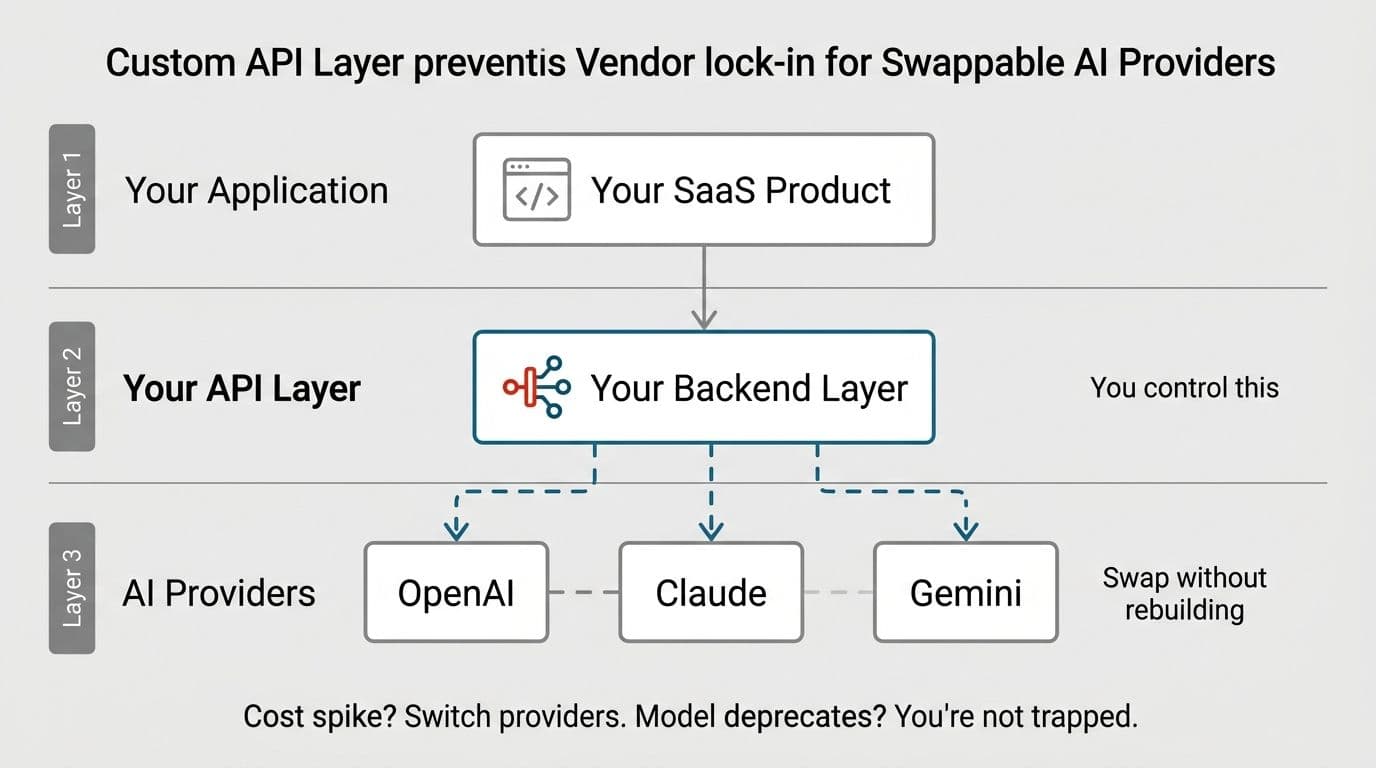
Your own API layer, not a vendor's. Every model call goes through a layer you control. The application talks to your backend, your backend talks to whichever provider you're using. When a provider raises prices, deprecates a model, or gets beaten on quality, you change one service. We've had a marketing product switch providers mid-build on a cost spike without touching the application code. That's what a custom AI API integration and wrapper layer buys you.
Data model and security before screens. Multi-tenant separation designed into the schema rather than bolted on. Model endpoints configured so the provider doesn't train on customer inputs, with zero retention requested where the provider offers it.. Permission rules settled before anyone builds a login page. For regulated work, secure AI and compliance architecture decisions belong in the same week as the schema.
Production infrastructure from day one, scaled down. The MVP runs on the same hosting the full product will run on, just with a smaller configuration. Same architecture, fewer resources. You grow into it rather than out of it, and there's no migration project waiting behind your first hundred users.
We also fix one behavioral rule at this stage. Anything that touches money or reaches a customer gets a human approval step. Model output is drafted, a person confirms, and the action happens. That holds through the MVP and it holds after.
What the weeks actually cost
Weeks 1 and 2. Architecture and security mapping. One or two engineers work this stage. The data pipeline gets drawn before any code exists. Multi-tenant structure decided. Model endpoints chosen and retention settings confirmed. The deliverable is a costed plan that names the slice, names what's excluded, and states the team and timeline the build needs.
You should be able to walk away at the end of these two weeks with a document that's useful even if you hire someone else.
Week 3 onward. Build the slice. Core logic and backend first, because that's where the risk is. AI integration comes on top, then just enough interface that a closed tester can use it unaided. No polish.
Where the savings come from, plainly:
- API-first instead of a proprietary model: eight to twelve weeks off the schedule.
- One feature built properly instead of ten half-built: usually 40 to 50 percent of the scope gone.
- Data handling settled upfront: no rewrite when a reviewer asks how records are stored.
- Closed beta before public launch: the serious problems surface in front of twenty people, not two thousand.
A thin slice typically lands between $40,000 and $100,000 depending on how much logic sits behind it. It's a wide range, and the honest reason is that a document-analysis pipeline and a financial calculation engine are not the same amount of work. We name the team size and duration before the build starts, so the number is known before you commit. You own the code, the accounts and the keys throughout, which means the number you're agreeing to is the whole number.
Non-technical founders often spend six months and a lot of money with a development partner before working out that a smaller first step was available. A working slice in front of testers within the first quarter is a reasonable expectation now, and it's the standard we build to.
What shipped first: three examples
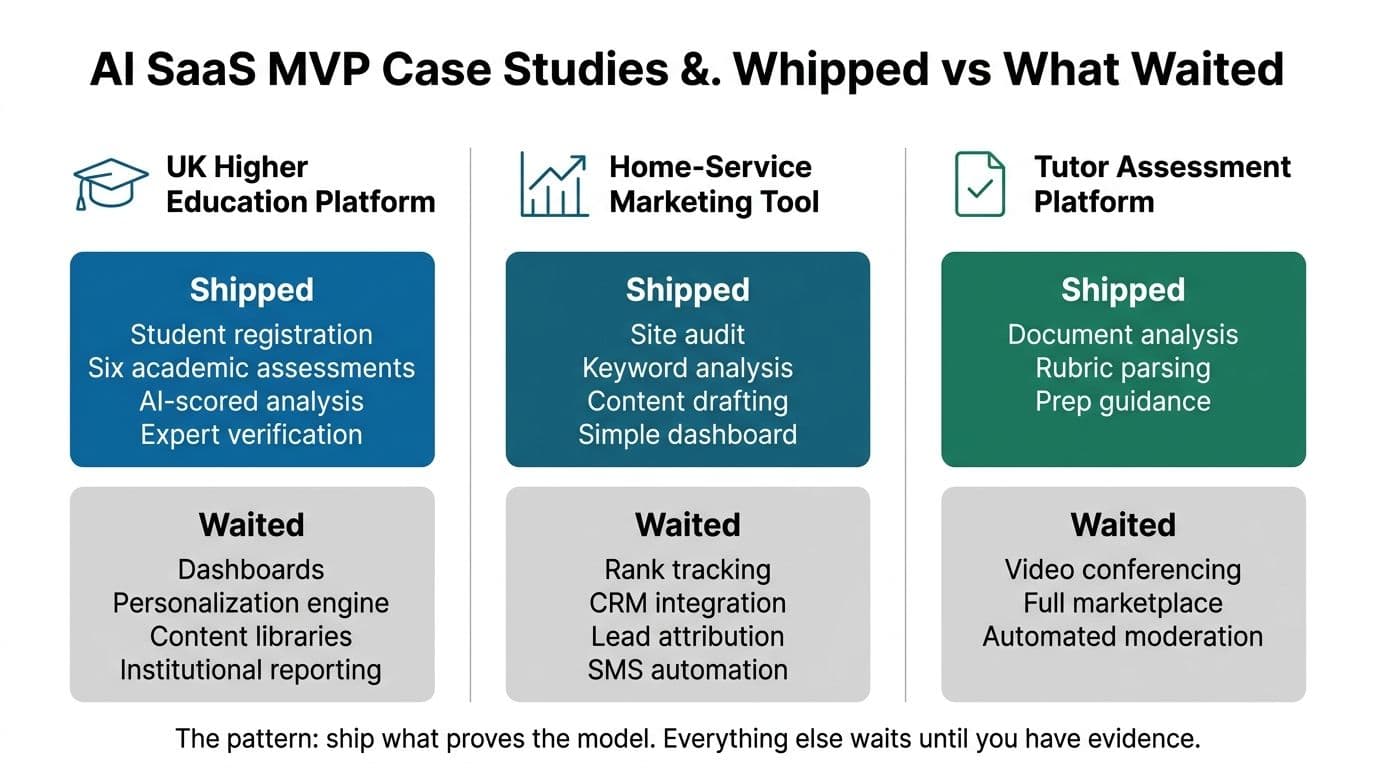
A diagnostic platform for UK higher education. Shipped: registration, six academic assessments, AI-scored analysis, and expert verification before results were released. Waited: dashboards, the personalization engine, content libraries, institutional reporting. The methodology was the product. Until the scoring held up under academic review, nothing built on top of it had value.
A marketing assistant for home-service businesses. Shipped: site audit, keyword analysis, content drafting, and a plain dashboard. Waited: rank tracking, CRM connection, lead attribution, SMS follow-up. The audit and keyword work prove the tool solves the problem a contractor actually has. Attribution matters once there's revenue to attribute.
An assessment-support tool for tutors. Shipped: document analysis, rubric parsing, and prioritized prep guidance. Waited: video conferencing, a full marketplace, automated moderation. The analysis and the feedback loop are the thing people pay for. Everything else was infrastructure around a product that hadn't been validated yet.
In all three, the first customers came from the founder selling directly, not from a launch campaign or paid acquisition. The founder talked to people who have the problem, watched them use the slice, and adjusted. That channel works better than anything else at this stage, and it's the fastest way to learn what version two should contain. Rapid AI prototyping exists to get you something real to put in those conversations.
What goes wrong when you skip the slice
Scope creep does more damage than bugs. Bugs get found and fixed. Scope creep pushes launch out by months while the team builds features that a real user would have told you to drop, and you only find out after you've paid for them.
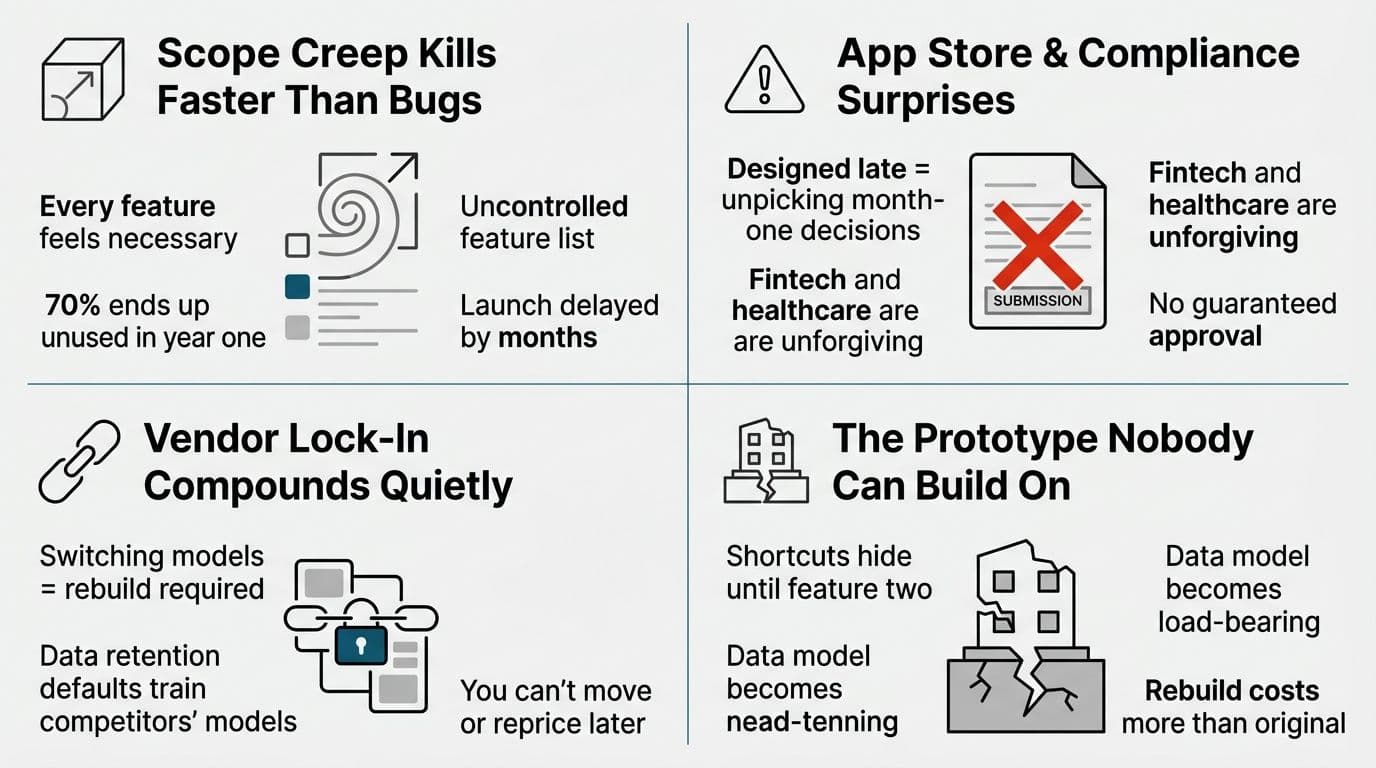
Data handling surprises land late and land hard. App stores and regulators look at collection, storage and transfer. Designing that at the end means unpicking week-one decisions. Fintech and healthcare are the least forgiving, and no one can guarantee you an approval. What you can control is whether your architecture survives the questions.
Vendor lock-in compounds quietly. One provider's SDK embedded through your codebase means switching costs a rebuild. Retention defaults you never changed mean customer inputs may sit on someone else's infrastructure. Hosting you don't control means you can't move or reprice when you need to.
The prototype nobody can build on stays the most expensive failure of the four, because it looks like success right up until you add the second feature.
Questions to ask before anyone writes code
Six questions. If you can answer these, your lean AI product development plan is most of the way written.
- Which single feature proves or kills the idea?
- Can you prove it with an API rather than a model you train yourself?
- Which data rules have to be right on day one rather than day ninety?
- Who uses version one, by name, and what are they trying to get done?
- Which integrations can genuinely wait until money is coming in?
- Who owns the code, the cloud accounts and the API keys when the build ends?
That last one gets skipped more than it should. If the answer isn't you, the rest of the plan doesn't matter much.
When to stop planning and start building
You won't have all the answers before you start. That's the point of building a slice rather than a product. Twenty real users doing real work will tell you more in a fortnight than another month of planning sessions, and they'll tell you things you wouldn't have thought to ask.
The tooling keeps changing, and AI coding assistants have made the build phase genuinely faster. That's real. What hasn't changed is the part that decides whether the money was well spent: choosing the right first feature, and building it on foundations you can keep. That's the whole discipline behind AI MVP development, and it's older than any of the current tools.
If you want help working out what your slice is, book a free automation audit. We'll map the one feature that proves your idea, cost the plan, and tell you plainly if you'd be better off not building it. You can also look at how our custom AI MVP builds are scoped and priced, or read how we work with clients before you get in touch.
Wondering what this would take against your own systems?
The audit costs nothing, and you keep the costed plan and the risks whether you go ahead or not.
Book a free automation audit
Arun Andiselvam
LinkedInI am a startup veteran who has built five brands. I sold the first, an SEO tool, for a six figure exit, and now build AI automation products for businesses. I bootstrapped every one of them from day one.