
A clinic director we spoke with last year had two options on the table. One was a general AI assistant that could summarize anything, priced per seat, live by Friday. The other was a narrower tool built around clinical documentation, slower to deploy and more expensive. She picked the general one, and six months later her staff had stopped using it. It didn't know what a prior authorization was. It couldn't read her EHR's export format either. It produced notes her clinicians rewrote by hand anyway.
That's the real shape of the vertical AI vs horizontal AI decision. It isn't a debate about model quality. It's a question of how much of your industry's specific knowledge you're willing to build, buy, or go without. Our short answer is this: start horizontal to find out what people actually use, then go deep in the one workflow where depth pays for itself. Most of the value sits in that second move, and most companies never make it.
What vertical AI vs horizontal AI actually means in practice
Horizontal AI platforms do one broad job across every industry: transcription, summarization, chat, search, code. They sell to everyone, so they can't assume anything about you. That's a strength when your problem is generic. It's a weakness the moment your problem has rules attached.
Vertical AI applications go the other way. They encode the jargon, the regulations, the forms, and the handoffs of a single industry. A vertical tool for medical billing knows what a denial code means. A vertical tool for school administration knows what a term report looks like in your country. That knowledge is unglamorous and costly to build. That's exactly why it holds its value.
The financial case for depth is no longer theoretical. Industry reports point to at least one vertical AI banking product that has reached meaningful annual recurring revenue, built on nothing more exotic than knowing one industry's paperwork better than a general platform ever could. That number matters less as a benchmark than as evidence. Specialization at scale is now a profitable category, not a niche bet.
Where this gets muddy is that the line keeps moving. Horizontal AI platforms ship industry templates. Vertical products expose general-purpose APIs. The useful question for choosing AI for business isn't which camp a vendor belongs to. It's whether the tool knows the twenty things your team would otherwise have to explain to it every single day.
Where the ROI actually comes from, and where it doesn't
Plenty of organizations genuinely can't tell whether their returns will come from broad coverage or deep specialization. The honest answer is that it depends on what your repetitive work looks like. Broad, shallow, and spread across many teams? Horizontal wins. Narrow, deep, and governed by rules nobody has written down? That's where vertical AI use cases earn out.
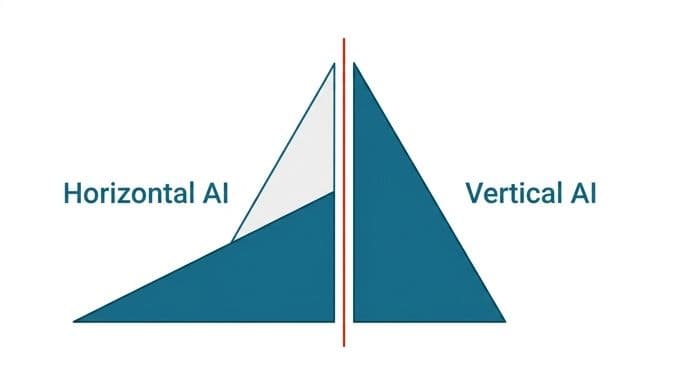
We run one test before quoting anything: count how multiple steps in the workflow require someone to know something that isn't in the document in front of them. If the answer is zero, a general tool works fine and we'll tell you so. If the answer is four or five, you're paying humans to supply context, and that context is what a vertical build captures.
The industry-specific AI vs general AI tradeoff shows up differently across sectors. In retail, product data and returns logic are messy but not regulated, so horizontal tools get further than you'd expect. In edtech, the pressure is on tone and curriculum alignment, which generic models handle poorly without heavy guardrails. In healthcare, the gap is widest, because an output that reads well and is clinically wrong is worse than no output.
Every healthcare draft we build passes to a clinician who checks every word before it reaches a patient record. We've written separately about how AI fits into clinical and patient-facing products if that's your sector.
One more thing worth saying plainly about AI for healthcare, retail, and edtech work: model spend rises with usage. If a vendor won't show you how cost scales as volume grows, assume it scales badly. We size this before work starts and name a fixed price, so the surprise lands with us rather than you.
How to move from a horizontal start to a profitable vertical
Launching horizontal first is underrated. It lets you validate demand across several niches cheaply, then verticalize into whichever segment pays most, while keeping the foundation flexible enough to enter another niche later. The companies that do this well treat the horizontal layer as infrastructure and the vertical layer as product.
In practice, three verticalization moves tend to work, and wrapping a model in a branded interface is not one of them.
- Own the data the industry can't get elsewhere. Denial patterns, curriculum mappings, supplier catalogs. Whatever your customers keep in spreadsheets because no system holds it properly.
- Own the workflow end to end, including the approval step and the system of record it writes back to. A tool that drafts but doesn't file is a demo.
- Own the compliance surface. Audit trails, explainability, retention rules. This is the hardest to copy and the easiest to sell.
The custom AI vs off-the-shelf AI decision usually resolves itself once you know which of those three you need. If none apply, buy the off-the-shelf tool and keep your money. We say that to prospects regularly, and it's cost us work we didn't want.
Geography complicates the picture for teams in smaller markets. If your total addressable population caps out well below what a US-sized market offers, verticalizing too early can leave you with a product nobody else needs. The workable pattern is to specialize the workflow but keep the integration layer portable, so the same depth sells into an adjacent country or adjacent industry without a rebuild.
There's also a third category worth knowing. Orthogonal tools cut across industries by owning a single function nobody wants to build themselves: payments, identity verification, e-signature. They're neither vertical nor horizontal, and they're often the cleanest business of the three. The function stays the same everywhere, while the compliance burden keeps competitors out.
Integration, legacy systems, and who does what
The hardest part of vertical AI applications is rarely the model. It's the join between a specialized agent and the general platform your company already runs. Permissions don't map. Identity doesn't carry across. The vertical agent needs write access to a system whose owner has never granted it to software before.
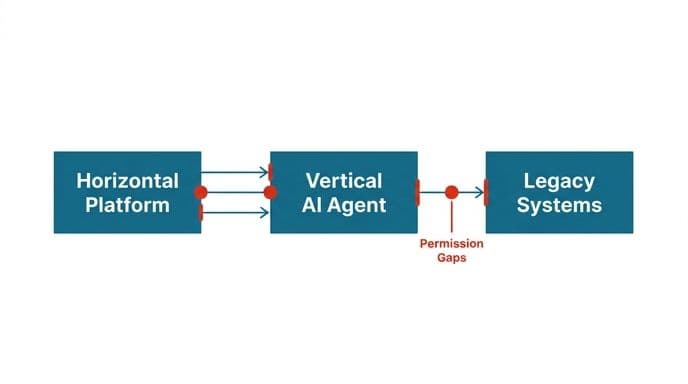
Banking shows this at its most extreme. Community banks are still running core systems designed in the 1960s and 70s, sitting on non-relational databases like IBM i, which can't realistically be replaced. Add poor data documentation, processes that live in one long-serving employee's head, and regulators who want explainability that current systems can't fully provide, and slow adoption stops looking like timidity. It looks like arithmetic.
What works against that backdrop is reading from legacy systems rather than replacing them, and writing back only through a step a person approves. That's the rule we hold to on anything touching money or a customer. Our AI integration work inside existing business systems is built on exactly that constraint. The alternative is a migration project nobody budgeted for.
Role division is the other thing teams get wrong. Product vendors should own the model behavior, the domain logic, and the upgrade path. Your implementation partner should own the integration, the data plumbing, and the handoff to your staff. When one party tries to own both, the thing that slips is whichever half isn't their core business. We're the second kind, and we'll tell you when the first kind already has what you need. On data: enterprise endpoints with retention turned off don't train on your inputs.
For records that can't leave your infrastructure at all, private LLM fine-tuning on your own hardware is the route. You keep the code, the accounts, and the keys either way.
Choosing AI for business without overbuilding
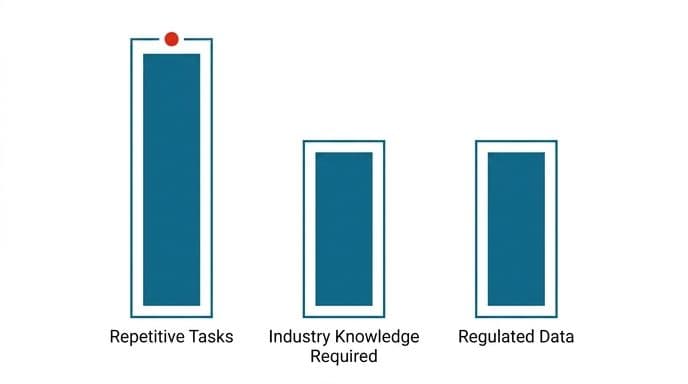
Before you commit to a build, run an automation audit on the work itself. List the repetitive tasks, mark which ones need industry knowledge, and mark which ones touch regulated data. If most tasks fall in the first column only, a horizontal subscription covers you. If the second and third columns are crowded, depth is worth paying for.
The ethical side deserves a straight answer too. Vertical automation at scale does displace work, and claiming otherwise is dishonest. What we've seen hold up is redeployment rather than reduction. One content team we worked with cut their production timeline dramatically, then used the recovered time on work they'd been deferring for years. That outcome isn't automatic. It's a decision leadership makes before the tool ships, not after.
For the fuller picture of how specialization plays out across sectors, our guide to building AI into industry software covers the build patterns in more detail. If you'd rather test the idea than read about it, our team builds AI products and working prototypes with a fixed price named before work starts and something running in month one.
Years of experience, a sizable team, and a long list of clients across many countries, and a standing habit of telling people when they don't need to build. Book a free automation audit and we'll tell you which side of vertical AI vs horizontal AI your workflow actually sits on.
Frequently Asked Questions
What is the difference between vertical AI and horizontal AI?
Horizontal AI platforms do one broad job across every industry like transcription, summarization, or chat, while vertical AI applications encode the jargon, regulations, forms, and handoffs of a single industry. Horizontal AI can't assume anything about your specific needs, while vertical AI holds value by knowing industry-specific knowledge that's costly to build.
When should you choose vertical AI over horizontal AI?
You should choose vertical AI when your work is narrow, deep, and governed by rules, or when multiple steps in your workflow require someone to know something that isn't in the document in front of them. Horizontal AI wins when your work is broad, shallow, and spread across many teams.
How should you start building an AI solution for your business?
Start horizontal first to validate demand across several niches cheaply, then verticalize into whichever segment pays most while keeping the foundation flexible. This lets you treat the horizontal layer as infrastructure and the vertical layer as product, allowing you to enter another niche later if needed.
What are the three main ways to verticalize an AI solution?
Own the data the industry can't get elsewhere like denial patterns or supplier catalogs, own the workflow end to end including the approval step and system of record it writes back to, or own the compliance surface including audit trails and explainability. The custom versus off-the-shelf decision usually resolves itself once you know which of these three you need.
What is the hardest part of building vertical AI applications?
The hardest part is rarely the model itself, but rather the integration between a specialized agent and the general platform your company already runs, including issues with permissions, identity, and write access to systems that have never granted it to software before. Reading from legacy systems rather than replacing them and writing back only through a step a person approves is the approach that works against this backdrop.
Wondering what this would take against your own systems?
The audit costs nothing, and you keep the costed plan and the risks whether you go ahead or not.
Book a free automation auditHitasoft
LinkedInHitasoft has built software since 2008, for companies that mostly do not have an IT department. These pieces are written by the people who do the integrations rather than by anybody in marketing.