
A founder shows us a working prototype. Patients type symptoms, a model drafts a summary, a clinician reviews it before anything goes into the chart. The demo is good. Then we ask where the transcripts are stored, who can read them, and whether there's a log showing which staff account opened which record. The answer is a shrug. The app was scaffolded with one of the AI code generation tools and nobody asked those questions during the build.
AI healthcare app compliance isn't a certificate you obtain at the end. It's a set of design decisions you make at the start, and most of them are cheaper to make early than to retrofit after the first hospital security questionnaire lands in your inbox.
We build healthcare software for clients in the US, UK, Middle East and India, including an ABDM health platform integrated with India's national system. What follows is what we've found actually matters, stated plainly. None of it is legal advice, and none of it guarantees any regulator or app store will approve what you ship.
Prototypes Pass Demos, Not Audits
The tools founders use to get a healthcare app standing up fast are genuinely useful. They're also indifferent to protected health information. Generate a patient intake flow with v0, Lovable or Bolt and you get a database, an auth screen and a deployment. None of that comes with audit logging, role-based access control, or encryption configured for PHI. The app works, it just can't account for itself.
That distinction matters because the questions change the moment real patient data enters the system. A prototype has to answer "does it do the thing." A compliant system has to answer "who touched this record, when, from where, and under what authority." Those are different engineering problems. The second one needs an immutable audit trail. It needs access controls tied to actual job roles rather than a single admin account. It needs encryption both in transit and at rest, a documented retention policy, and a signed Business Associate Agreement with every vendor in the path, including your model provider.
Our practical test: pick a patient record at random and ask the system to produce a complete history of every read and write against it, including API calls from your AI pipeline. If you can't generate that report in a few minutes, you have a prototype.
The transition from test data to real patient data is where most of the risk concentrates. According to the U.S. Department of Health and Human Services' breach portal, healthcare data breaches affecting large numbers of patients are reported in the hundreds every year, a reminder that exposure usually comes from ordinary gaps rather than exotic attacks. Before you flip that switch, we'd want a written cutover plan. Which environments hold real data, who has credentials to them, how test data gets purged, and what happens in the first hour if something leaks. We don't promise any system is breach-proof. Nobody honest does.
What a HIPAA Compliant AI App Actually Requires
HIPAA was written long before generative models, so the mapping takes some thought. The Security Rule's administrative, physical and technical safeguards still apply, and an AI feature adds new places where they bite.
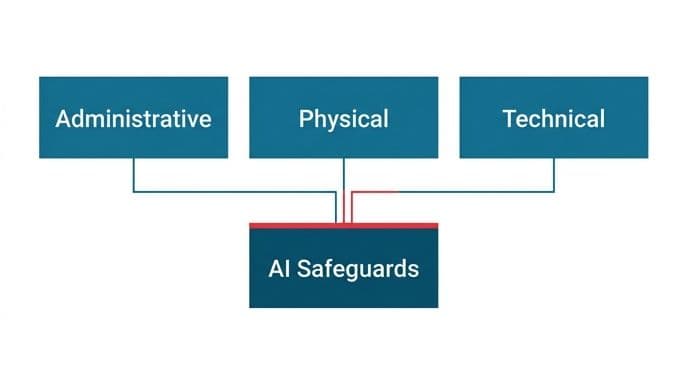
Start with the model call itself. If your app sends a clinical note to a general-purpose API, that note has left your boundary. On enterprise endpoints with zero-retention configured and a BAA in place, that's a defensible architecture. On a consumer tier with default retention, it isn't, and no amount of policy writing fixes it. This is the question we get asked most often: will the vendor train on our data? On enterprise endpoints with retention switched off, no. Get it in the contract, not in a blog post.
Then there's the minimum necessary principle. A retrieval augmented generation (RAG) setup that pulls context from your record store will happily retrieve more than the current user is entitled to see unless you scope retrieval by that user's permissions. Permission-aware retrieval is one of the more commonly missed pieces of secure AI architecture healthcare teams need, because the vector index sits outside the application's normal access layer and inherits none of its rules.
For organizations handling records that genuinely can't leave their infrastructure, private LLM healthcare data handling is the alternative. Fine-tuning and hosting an open-weight model inside your own environment, or inside a tenancy you control, removes the third-party processor from the equation entirely.
It costs more to run and needs real operations discipline. For some clients it's the only option that gets past their board, and we'll say so when that's the case. Our work on running fine-tuned models inside your own environment exists for exactly this situation.
Beyond HIPAA: GDPR, the EU AI Act, CCPA and 21 CFR Part 11
HIPAA is only one piece of the AI regulatory requirements healthcare apps face, and treating it as the whole picture is a common and expensive mistake. Privacy rules written for AI products often differ substantially from the ones governing traditional providers, which leaves gaps neither framework clearly covers.
If you have European users, GDPR applies regardless of where your servers sit. Health data is a special category, which means you need an explicit lawful basis, a Data Protection Impact Assessment for most AI processing, and a real answer to deletion requests. "The model was trained on it" is not an answer. Data residency matters here too. Several of our European and Middle East clients require processing to stay inside a named region, which constrains which model providers you can use before you write a line of code.
The EU AI Act layers risk classification on top. Software intended to inform clinical decisions tends to land in the high-risk tier, which brings obligations around technical documentation, logging, human oversight and post-market monitoring. Build the documentation as you go. Reconstructing it later from commit history is miserable work.
CCPA and the state privacy laws following it add consumer rights around access and opt-out that reach data HIPAA doesn't cover, often for wellness apps sitting outside the covered-entity perimeter. If your product touches clinical trials or regulated records, 21 CFR Part 11 brings requirements for electronic signatures, versioned audit trails and system validation that are stricter than anything else on this list.
| Framework | What triggers it | What it mainly demands |
|---|---|---|
| HIPAA | PHI handled by a covered entity or business associate | Safeguards, BAAs, audit logs, minimum necessary |
| GDPR | EU residents' data, anywhere in the world | Lawful basis, DPIA, deletion, residency controls |
| EU AI Act | AI systems placed on the EU market | Risk tier, documentation, human oversight |
| CCPA and state laws | Consumer data outside HIPAA's reach | Access, deletion, opt-out rights |
| 21 CFR Part 11 | Regulated electronic records and signatures | Validation, versioned audit trails, signature controls |
Consent, Clinical Review and Staff Who Weren't Asked
Patient consent for AI tools is frequently handled as a formality. A line added to an intake form, a flyer in the waiting room, no realistic way to decline, and no record kept when someone does. That's not informed consent. It's the kind of thing that looks bad under scrutiny long before it becomes a legal problem.
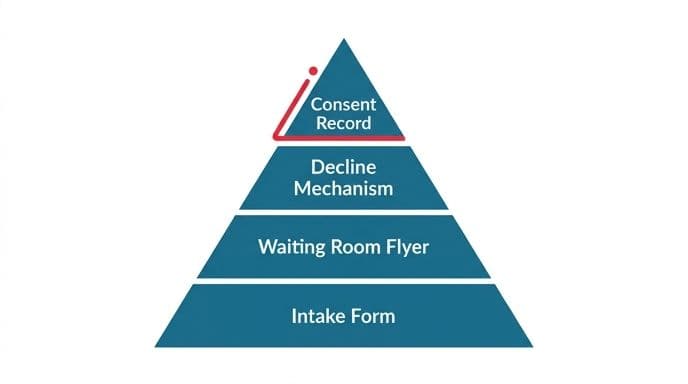
Build consent as data: a timestamped record per patient, per purpose, revocable, queryable. If a patient declines AI-assisted note-taking, the system should enforce that automatically rather than relying on a staff member remembering. Being able to produce consent status on demand is worth more than the strongest wording on the form.
Clinical AI validation requirements are the second half of this. Any output that reaches a patient or a chart needs a clinician who reviewed it and whose review is recorded. We build healthcare AI so the model drafts and a qualified person checks every word before it goes anywhere. That isn't a limitation of current models, it's the design, and it stays the design. The same principle covers AI customer support automation in healthcare settings. A bot answers scheduling and billing questions, but anything clinical routes to a human.
Staff training gets skipped and shouldn't be. A 2023 KLAS Research survey of healthcare workers found many felt pushed to adopt AI tools while their concerns about privacy and consent went unaddressed, which produces quiet workarounds rather than adoption. Train people on what the tool does with data, what it must never be pasted into, and how to report something that looks wrong.
Our full breakdown of how AI features get built into clinical products goes deeper on where human review belongs in each workflow.
Procurement, EHR Integration and App Store Review
Hospital procurement will ask for SOC 2 Type II, cyber insurance at a named limit, a completed security questionnaire, penetration test results and a signed BAA. Startups routinely lose quarters to this because they began the evidence work after the first sales conversation instead of before it.
EHR connections are the other bottleneck. Use the standard rails, FHIR APIs and the vendor's sanctioned integration program, and scope the data you pull to what the feature genuinely needs. Good exchange infrastructure can feed AI applications from multiple sources while keeping access controls and data quality checks intact, but only where governance was part of the integration design. We handle this under compliance-first system architecture rather than treating it as a later hardening pass.
Apple and Google both scrutinize medical claims, data handling disclosures and AI-generated content in health contexts, and that scrutiny is what AI app store compliance healthcare products face. Describe the product as assistive, document your review process, and keep privacy labels accurate. Submission and the decision stay with you, and no one can guarantee approval. Anyone who does is selling something.
No-code platforms with HIPAA plans can carry simple internal tools well. They tend to run short on custom audit granularity, permission-aware retrieval and private model hosting, which is usually where healthcare AI ends up.
Where to Start
Begin by mapping your data flows: every point where patient information enters, moves, gets processed by a model, and leaves. Most compliance gaps become obvious on that diagram before anyone writes code.
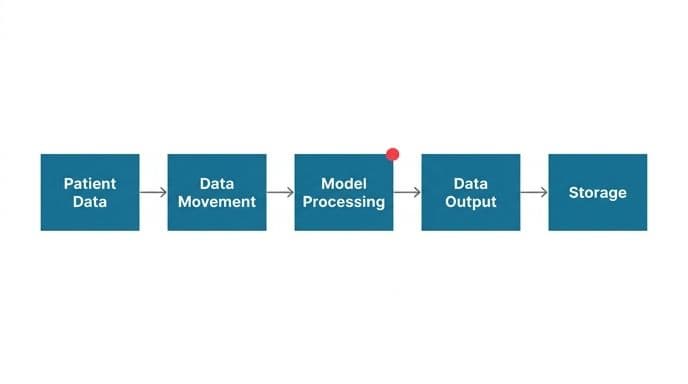
If you want a second pair of eyes, we run a free automation audit that looks at your workflows and tells you where AI fits and where it doesn't, including when the honest answer is that you don't need to build. Fixed price named before work starts, you own the code and the keys. See more about our healthcare and consulting work, or how AI compliance questions play out across other regulated verticals.
Wondering what this would take against your own systems?
The audit costs nothing, and you keep the costed plan and the risks whether you go ahead or not.
Book a free automation auditHitasoft
LinkedInHitasoft has built software since 2008, for companies that mostly do not have an IT department. These pieces are written by the people who do the integrations rather than by anybody in marketing.