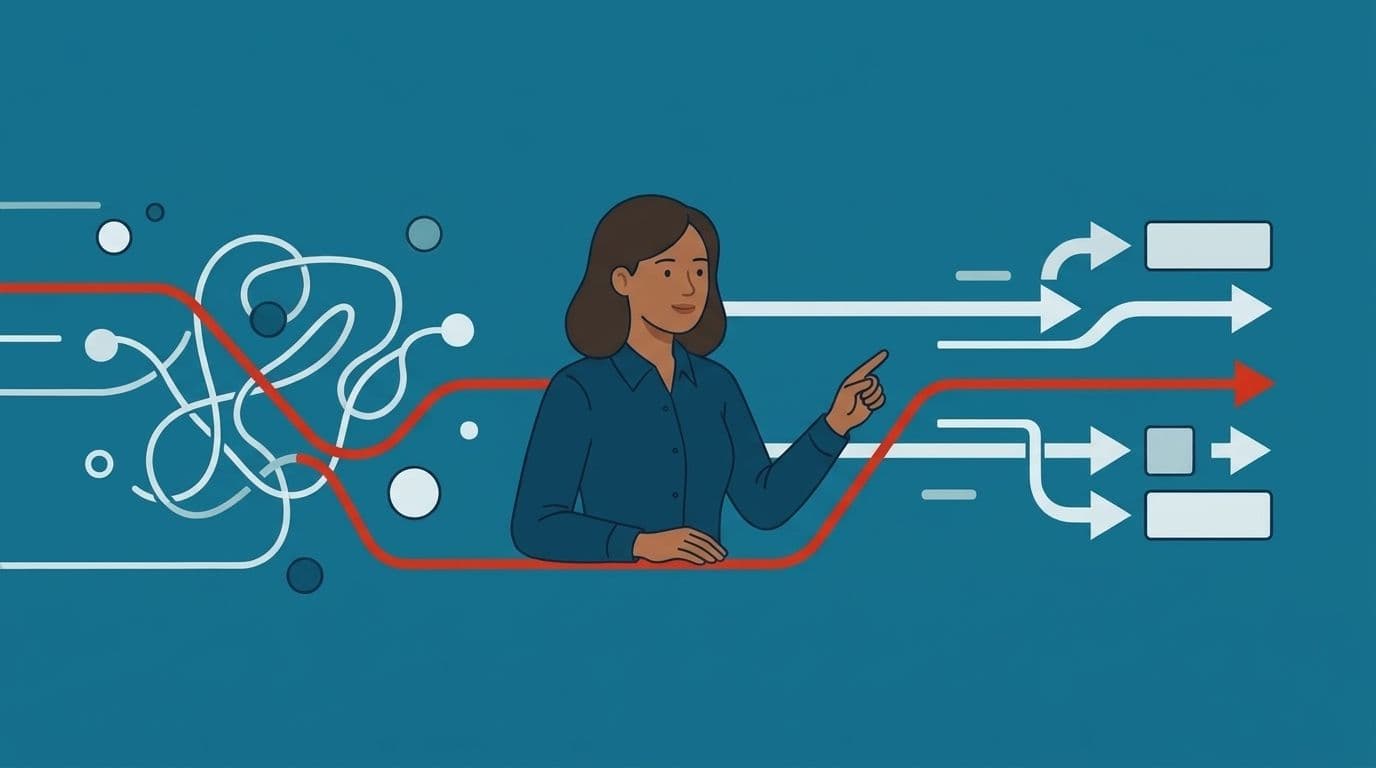
A finance lead in Rotterdam sent us a spreadsheet last month. Forty-one tabs, one per entity, all reconciled by hand every month-end by two people who used to do analysis. She didn't want an AI strategy. She wanted the last week of every month back.
That's the shape of most first conversations. Somebody has a specific, boring, expensive problem. They're trying to work out whether a custom AI app development company can fix it for a price they can defend to a board. What they usually get instead is a discovery workshop, a deck full of maturity models, and a quote with a range wide enough to drive a truck through.
Here's what the process looks like when it works, and how a build gets scoped before anyone opens your systems. What a first month of working software actually contains, where costs come from, and the questions worth asking a vendor that most would rather you didn't. We build these systems for a living, so we have opinions. We'll also tell you where we think you shouldn't build at all.
The first decision isn't which vendor, it's whether you need software
Plenty of teams come to us with a problem that doesn't need a new application. It needs a report scheduled, a field made required, or two systems connected that already have an integration sitting unused.
We say so when that's the case, and it costs us a project and saves you a year. A good test before you call anyone: write down the job in one sentence. Name the trigger that starts it and the result that ends it, then count how many times a week it happens. If it happens twice a month and takes an hour, you're not looking at a build. You're looking at a checklist.
The jobs that justify custom AI app development share a profile. They repeat daily or hourly. They involve reading or writing language, not just moving numbers between fields. They touch two or more systems that don't talk. A person currently does them in a way that's consistent enough to describe but varied enough that a rules engine chokes on it. Invoice coding across suppliers who each format differently is one example. Support replies that depend on account history are another.
There's a related question that gets skipped. Does the work suit a fixed workflow with known steps, or does it genuinely need an agent that decides its own next move? Most office work in services firms is the first kind. The model handles the reading or the writing, the workflow handles the sequence. That distinction changes your budget more than any other choice you'll make, because open-ended agent logic is where projects go to become research projects.
Should you productize your internal AI tool or keep it for margin?
This one comes up more than the ranking pages admit, and it deserves answering straight.
Say you're an agency, an accounting firm, or a logistics operator. You've built something internal that reads documents or drafts client updates, and it works. Margin improved. Now somebody on the leadership team says the obvious thing: we should sell this.
Hold on. Selling software is a different business from the one you're in. You'd be taking on support, onboarding, versioning, uptime, and security questionnaires, plus a roadmap that competitors reset every few months. The internal tool that makes your delivery cheaper carries none of that.
The harder truth is what your clients actually value. In most service relationships, clients pay for trust and a person who answers the phone. Asking them to learn a new interface often adds friction to a relationship that was working fine without it.
Keep it internal when the tool's value depends on your people operating it, and when your clients buy outcomes rather than access. Keep it internal too when your margin improvement is already material. There's a middle path worth considering: keep the tool internal, but let clients see enough of its output that they understand why your service got faster. That's where the related question lands.
Show clients the interface, or deliver the outcome?
Teams building AI-powered delivery genuinely don't know whether to expose the software or present it as a black box that simply produces results. Both choices have costs.
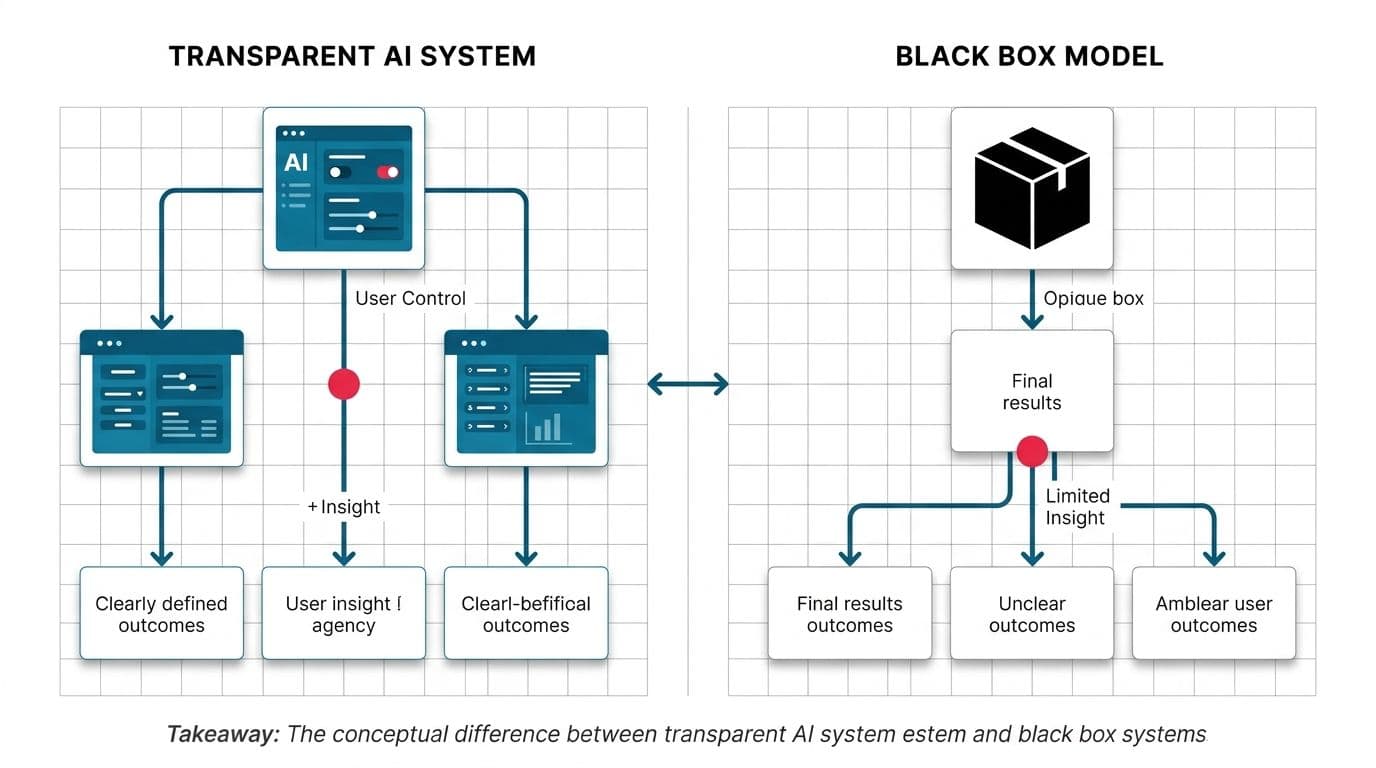
Show the interface and you invite questions you may not want. Why did it categorize that one wrong? Can we change this rule? You've turned a service conversation into a product support conversation.
Hide it completely and you lose the credibility that comes from visible machinery. Clients in regulated sectors increasingly want to know what touched their data and what checked the output. "We use AI" means nothing to a compliance officer. "A model drafts the classification, a reviewer approves it, and here's the log" means something.
Our practical answer: show the audit trail, not the control panel. Give clients visibility into what happened and who approved it. Keep the configuration, the prompts, and the tuning on your side, which gives you explainability without handing over a product you haven't built support for.
How a custom AI app development company scopes and quotes before touching your systems
Here's the part most buyers find frustrating. You ask for a price. The vendor says they need a discovery phase to give you one. The discovery phase costs money. You're paying to find out what you'll pay.
We quote a fixed price before work starts, which means we have to scope accurately from the outside. That's possible more often than the industry pretends, and it works like this.
Name the job, not the system. We ask you to describe one repeatable task with a clear trigger and a straightforward result. Not "automate accounts payable." Instead: "when an invoice arrives in this mailbox, extract supplier, amount, and cost center, match it to a purchase order, and queue it for approval." That sentence tells us roughly how multiple integration points exist, how much variation we'll hit, and whether a human sits in the loop.
Count the systems it reads. Each system is a connector, a credential, and a failure mode. Three systems is a different project from seven. You can tell us this in ten minutes.
Establish the volume and the variation. A hundred documents a day in four formats is a manageable build. A hundred documents a day in forty formats is a different estimate, and we'd rather know before quoting than discover it in week three.
Define what "right" looks like and who checks it. If every output gets reviewed by a person, the accuracy bar sits in one place. If outputs post straight to a ledger, it sits somewhere much higher and costs considerably more to reach. Anything touching money or a customer gets a person's approval in the systems we build, which is both a safety position and a scoping one.
With those four answers we can price a first build, though we can't price everything. We say which parts are genuinely unknown rather than padding the whole number to cover them. Where something depends on a system we haven't seen, we scope it as a separate piece with its own price after we've looked.
Pricing: time and materials, fixed price, or value-based?
Three models dominate custom AI application development services, and the differences matter to your budget more than anyone's hourly rate.
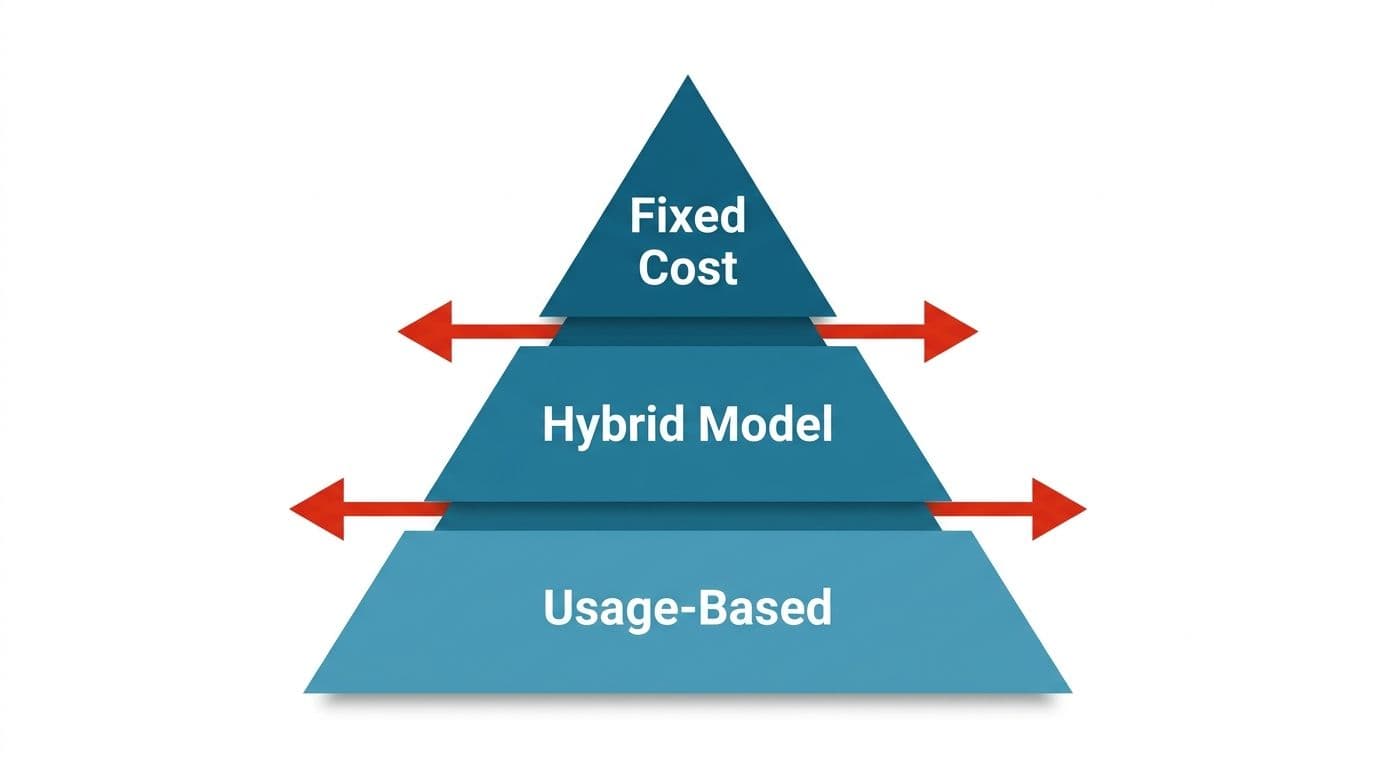
Time and materials shifts all discovery risk to you. The vendor has no reason to finish quickly. You'll hear it defended as "flexibility," and sometimes that's honest, but on a well-scoped first build it usually means the scope wasn't done.
Fixed price puts the risk on the builder. It requires real scoping discipline up front, and it also means the vendor has to say no to changes that blow the estimate. We use it because it makes the conversation honest in both directions. You know the number before you commit. We know we have to scope properly or we eat the difference.
Value-based pricing gets talked about constantly in AI services and works in narrower circumstances than its advocates suggest. The pitch: charge a share of the savings or revenue the system produces. The problem is attribution. If reconciliation time drops, how much was the software and how much was the process cleanup that happened alongside it?
Where value framing genuinely helps is in deciding whether to build at all. Work out what the manual process costs you in salary hours per month. Compare it to a build price plus running costs. If the payback period is longer than the shelf life of the process, don't build it. That arithmetic belongs in your decision regardless of how the contract is structured.
Where AI project costs actually come from
Model API calls are rarely the big number, which surprises people who've been warned about runaway token spend. Most of the cost sits in the plumbing.
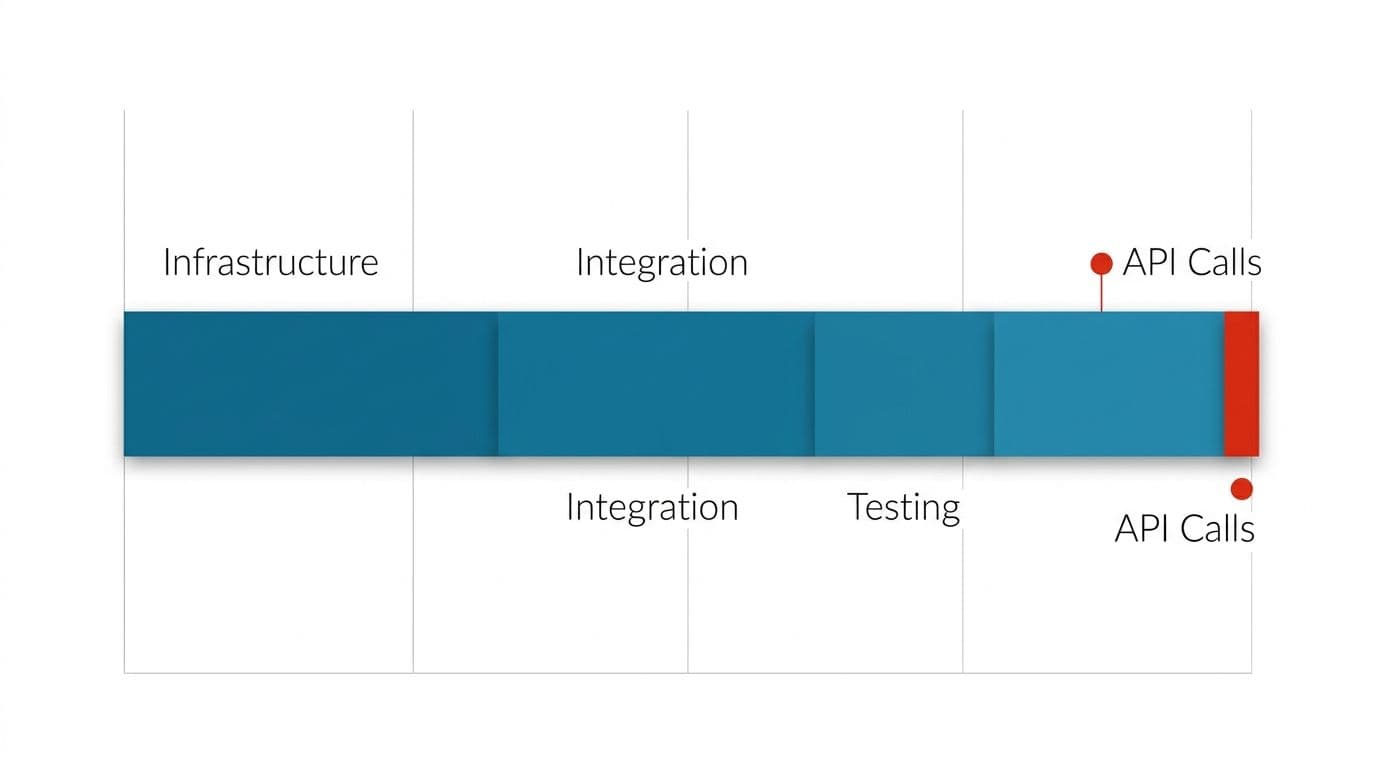
Integrations cost the most. Every system you connect needs authentication, error handling, rate limiting, and a plan for what happens when it goes down mid-process. Legacy systems with no proper API cost more than modern ones, sometimes several times more.
Data preparation comes second. Review and correction tooling is the cost nobody budgets. If a person approves outputs, that person needs a screen that shows the source, the proposed answer, and a fast way to fix it. Build that poorly and your team's review time eats the savings the automation created.
On running costs, the honest answer about model spend is that it does scale with usage, but the curve is manageable if you design for it. Smaller models handle classification and extraction perfectly well. Caching removes repeat calls. Retrieval keeps prompts short by sending only relevant context instead of entire documents. We size these choices during the build rather than after the first invoice shocks someone. For workloads where cost or data residency makes hosted models impractical, private LLM fine-tuning on infrastructure you control changes the economics entirely, with its own trade-offs in setup effort.
What "ships in weeks" means, and what it doesn't
The phrase ai-native development shops that ship in weeks has become a positioning line, so it's worth saying what it does and doesn't cover.
It means working software against your real data in month one. Not a clickable prototype. Not a slide showing a roadmap. Something that reads actual documents or answers actual questions, running in draft mode where nothing it produces takes effect until a person says so.
It does not mean the whole system is finished in a month. It means the first useful slice is, and you can judge the build from evidence rather than promises.
That last step matters. Opening every action path on day one is how teams end up with an agent that emailed forty customers before anyone noticed. Read-only first, draft second, write access last, one path at a time.
Genuine ai-native development shops that ship in weeks are structured for this. Where it breaks down: if your data access requires six weeks of internal approvals, no vendor ships in month one. That clock is yours, not ours, and it's worth sorting out before you sign anything.
Managing agency and autonomy risk in custom AI agents
Excessive agency is the failure mode that gets least attention and causes the most damage. It means giving a system more permission or more decision-making latitude than its job requires.
It happens quietly. Someone gives an agent write access to a CRM because read-only made testing awkward. Someone lets it decide which of six actions to take rather than specifying the sequence. Someone connects it to an email account for convenience. Each choice is small. Together they produce a system that can do considerable damage from a single bad inference.
How we constrain it in practice:
- Least privilege by default. Each integration gets the narrowest scope that lets the job run. Read-only unless writing is the point.
- Fixed workflows over open-ended agents. The model decides what to write or how to classify. The code decides what happens next. This covers the overwhelming majority of business processes and removes an entire class of failure.
Security here extends beyond permissions. A model with broad tool access can be manipulated through content it reads, not just instructions it's given directly. Conventional perimeter security doesn't catch it because nothing about the traffic looks wrong. We design to reduce this exposure, though nobody can promise it's eliminated, and we'd be careful with anyone who does. Our work on architecting AI systems for regulated data and compliance review starts from that assumption.
Explainability and auditability when a regulator asks
Compliance-bound buyers need more than a working system. They need to show their work.
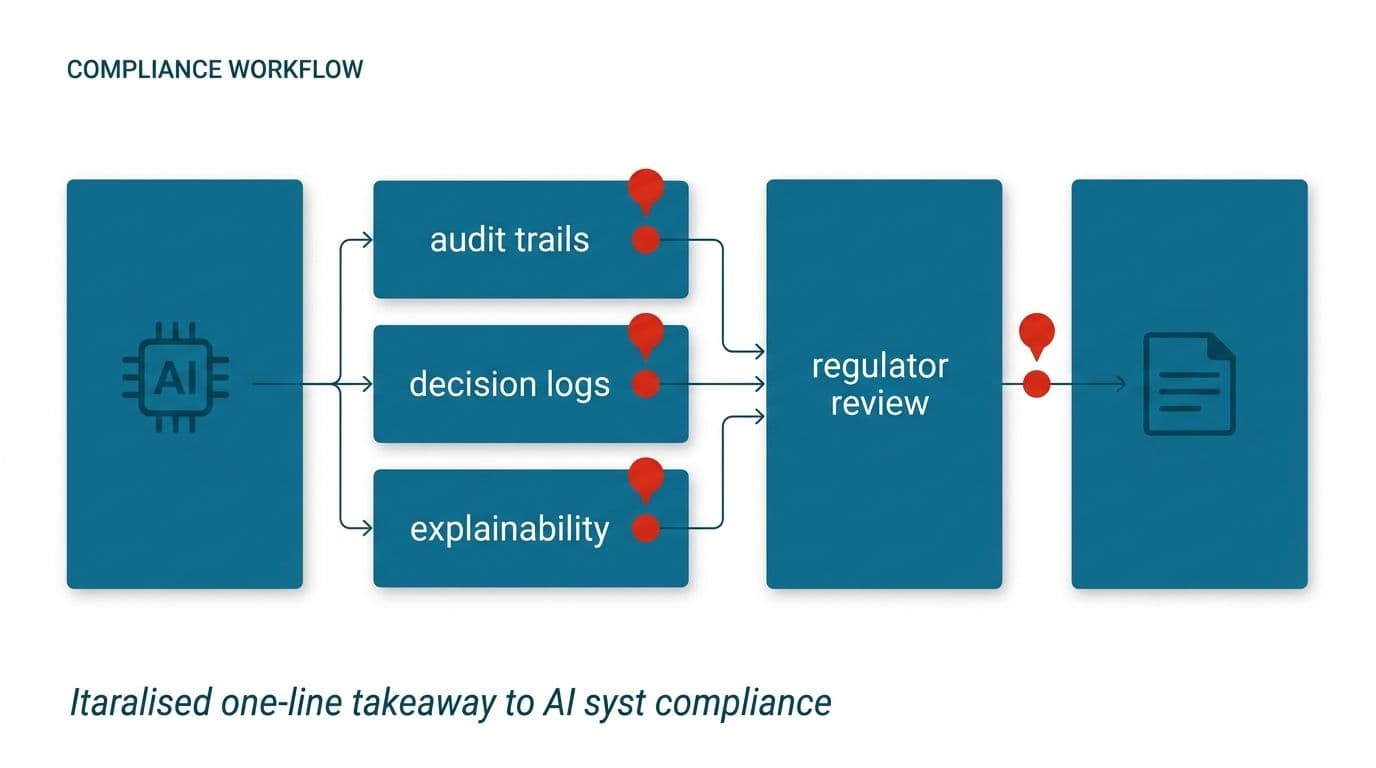
What satisfies a reviewer, in our experience across fintech and healthcare builds, is a record that reconstructs any single decision.
Design decisions that make this possible:
Retrieval beats recall. When a system answers from documents it fetched, you can show the documents. When it answers from training data, you can't. Retrieval augmented generation is an explainability feature as much as an accuracy one, and it's why we use it for support agents that answer from your own documentation rather than fine-tuning a model on policy text.
Deterministic steps stay deterministic. Calculations, thresholds, and routing rules belong in code, where they're readable and testable. Don't ask a model to do arithmetic you can audit.
Version everything. Prompts, model versions, retrieval indexes, and business rules all change behavior. If you can't say which version produced a given output, your audit trail has a hole.
The human approval is part of the record. Who looked, what they saw, what they changed.
Two things we won't say: that any system guarantees regulatory approval, or that it guarantees app store approval. Submission and the decision belong to you. What we can do is make sure that when the questions come, the answers exist and are retrievable.
Diagnosing failures when the model gets it wrong
Large language models fail in ways that traditional debugging doesn't catch. There's no stack trace. Behavior that looks fine across a hundred samples degrades on the hundred and first for reasons that aren't visible from outside. The core difficulty is plain enough: you can't directly observe why the model did what it did.
What we do instead of guessing:
A held-out set of real examples with known correct answers, drawn from your actual data rather than synthetic cases, gets kept and run on every change. When accuracy drops, you know which change caused it.
Log inputs and outputs in full, including retrieved context. Most failures turn out to be retrieval failures. The model answered reasonably given what it was handed, and what it was handed was wrong. That's fixable in a way that "the model is bad" isn't.
Categorize errors rather than counting them. Ten mistakes of one type is a fix. Ten mistakes of ten types is a scoping problem, and it might mean the job needs splitting.
Watch the review queue. The corrections your team makes are your best signal about where the system is weak, and they're free. Teams that instrument their review screen to capture corrections get a training and tuning dataset without running a distinct project.
Set a floor you can defend. Define what accuracy the process needs before you build, in terms the business understands. Below it, the system drafts and a person approves. At or above it, specific low-risk paths can run unattended. We don't promise accuracy without human review, because output always gets validated in code or by a person.
Is buying a firm for its data a sensible way to get training data?
Representative data is the real constraint in customized ai application development, and the question of acquiring a company primarily for its dataset comes up more often now than it used to.
It can work. It usually doesn't, for reasons worth knowing before you spend acquisition money.
Data acquired this way is frequently less usable than it looks in diligence. It's structured for how that business operated, not for training. Labels are inconsistent or absent. Context lives in the heads of people who may not stay. The legal question is sharp too: do the original contracts and privacy terms permit use for model training? Customer data collected under one purpose doesn't automatically become training data under another. That's a question for counsel, early.
The cheaper alternatives get skipped too readily. You probably have more usable data than you think, sitting in ticket histories, approved documents, and past corrections. Starting with retrieval over your existing records requires no training data at all. A system running in draft mode with human review generates labeled examples as a byproduct of normal operation, which is the least expensive dataset anyone ever builds.
If you do buy, buy the team along with the data. The people who know why records look the way they do are worth more than the records.
Avoiding lock-in when you commission custom AI app development
Lock-in in AI builds comes in forms that aren't obvious at signing.
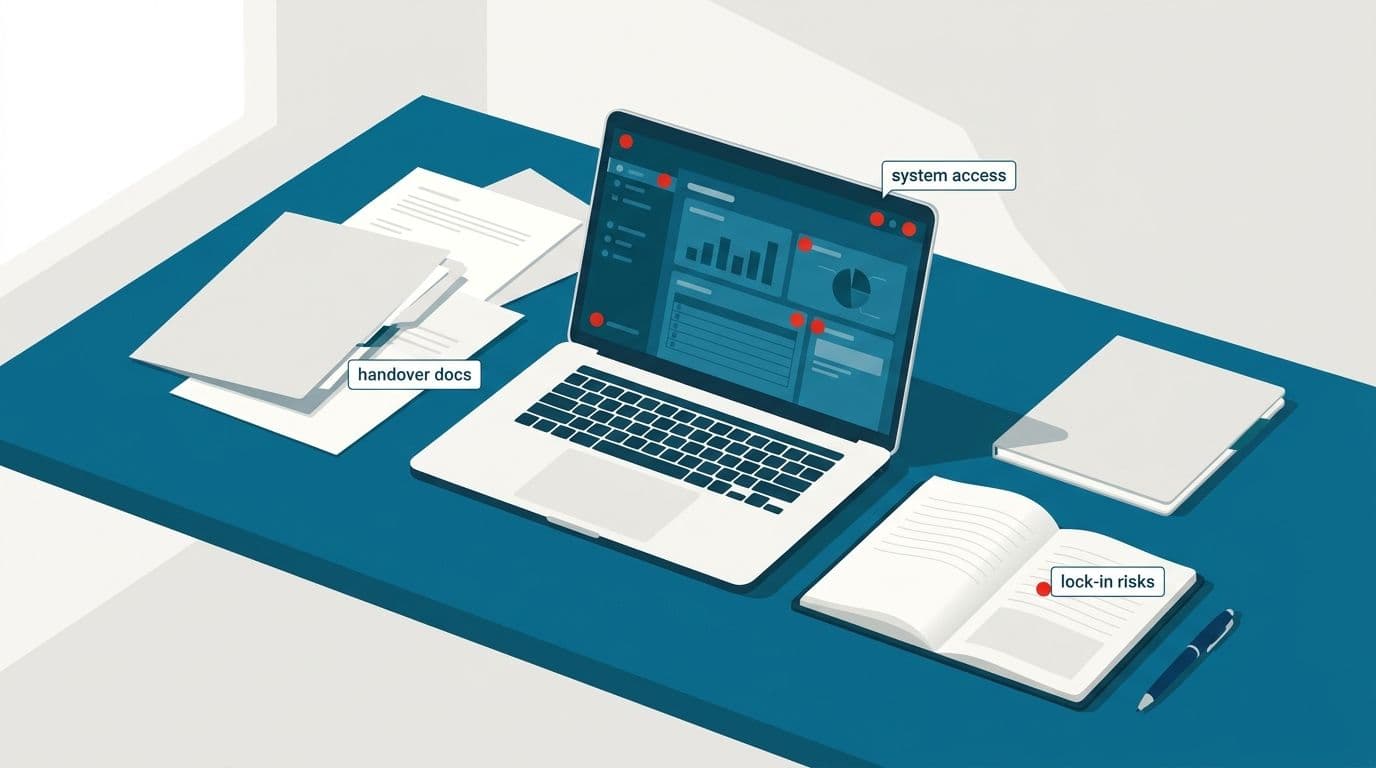
Vendor-owned accounts. If the model provider account, cloud account, and repository sit under the builder's name, leaving means rebuilding. That's a contract term, not a favor.
Model coupling. Prompts tuned hard to one provider's quirks don't move. An abstraction layer between your application and the model costs little up front and lets you switch when pricing or capability changes, which it does regularly.
Platform dependency. Building inside a vendor's agent framework means your logic lives in their product. Good instinct. Keep business logic in code you control, use platforms for the parts that genuinely benefit.
Undocumented work. A system nobody but the original builder understands is locked in by ignorance. Ask what documentation comes with handover and whether your own developers could extend it.
There's an adjacent trap: off-the-shelf software that nearly fits. Sometimes buying still wins. We'll tell you when it does.
Picking between a custom AI app development business and the alternatives
The small-employer picture is instructive. Teams planning to start with AI tend to cite finding tools that fit the business as a major obstacle. Teams already using AI tend to describe adapting tools to the business as the harder ongoing challenge. The problem doesn't go away after purchase. It changes shape.
That gap is the case for ai custom app development, and also its limit. Custom makes sense when your process is a authentic differentiator, and when no product fits without workflow surgery. It also makes sense when your data can't leave your infrastructure. It doesn't make sense for problems a mature product already solves well.
When you're comparing a custom AI app development business against vendors, the questions that matter are these:
- What's the fixed price, and what specifically is excluded?
- What runs in month one, against our real data?
- Who owns the code, the accounts, and the keys?
- Which parts touch money or customers, and who approves those?
- What happens when the model gets it wrong, and how do we find out?
- What does running it cost per month at our volume?
An overseas supplier raises a reasonable trust question, and the answer is evidence rather than reassurance. We publish numbers rather than requiring a demo to hear them.
On the training data question that every procurement team now asks: on enterprise endpoints with retention switched off, providers don't train on your data. For records that genuinely cannot leave your infrastructure, private deployment is the answer, and we build that way when the situation calls for it.
Starting small enough to learn something
Pick one job with a clear trigger and a clear result, one that happens often enough that the arithmetic works. Give the build read-only access to the systems it needs. Run it in draft mode against real data for long enough that you've seen its mistakes, not just its wins. Open one action path, watch it, then open the next.
That's the method behind our approach to AI MVP development and prototyping, and it's the same method whether the end state is a reconciliation engine, a support agent, or a document extraction pipeline feeding your ERP. Start narrow, prove it with your own data, expand from evidence.
If you're still working out whether a custom AI app development company is the right call at all, a short conversation usually settles it. We'll look at the work your team repeats and tell you honestly whether it's worth building, what it would cost, and what the first month would produce. Sometimes the answer is that you don't need us. That's a valuable answer too.
Book a free automation audit and bring the process that's costing you the most hours. Or see how we work first, if you'd rather read before you talk.
Wondering what this would take against your own systems?
The audit costs nothing, and you keep the costed plan and the risks whether you go ahead or not.
Book a free automation auditHitasoft
LinkedInHitasoft has built software since 2008, for companies that mostly do not have an IT department. These pieces are written by the people who do the integrations rather than by anybody in marketing.