
They'd each priced a different product. The brief left room for three different products, and nobody had said so out loud. That gap is where most confusion about ai mvp development cost lives, and it isn't usually dishonesty. It's scope that was never pinned down, model behavior nobody tested, and a review step one team included while the others assumed it away.
Our position, stated up front: a serious partner can name a fixed figure for a defined scope before work begins. If they can't, the scope is the problem, not the pricing.
How much does an AI MVP cost? The short answer
The number comes down almost entirely to one question: how many decisions does the product make without a person watching?
A tool that drafts something a person then approves is the cheapest shape there is. The model does the first pass, a human signs off, and if the model is wrong, nothing breaks. A tool that writes to a ledger, sends money, replies to a customer unsupervised, or files something with a regulator costs multiple times more for the same visible feature set. The work moves from the screen into evaluation, permissions, audit trails and rollback.
The second question is where your data lives. If the knowledge your product needs is already in clean tables with an API in front of it, the build is short. If it's in scanned PDFs, five years of email, or a system whose vendor charges for export, you're paying for data engineering before you pay for anything that looks like AI.
What drives AI MVP development cost
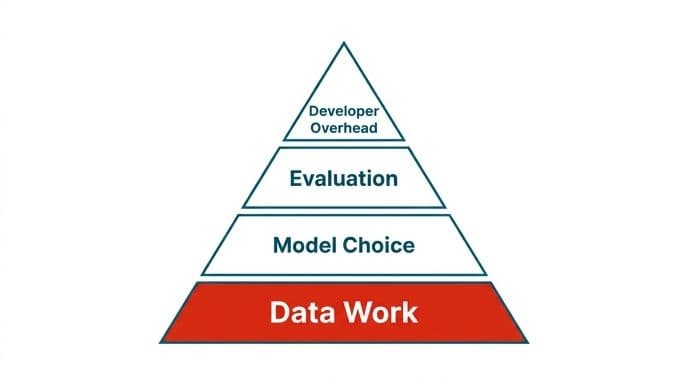
Most quote variance traces back to four lines. Founders tend to assume the model work dominates. In practice, it rarely does.
Data work and access
This is usually the biggest line, and the one absent from the original brief. Getting at your own data costs money, and that means extracting it from a system that resists export, cleaning records that three people entered three ways, mapping entities that don't quite match across subsidiaries, and deciding what the AI is allowed to see.
If the MVP reads documents, the cost sits in the variety of those documents rather than the volume. A thousand invoices in one layout is a small job. Two hundred in forty layouts, some photographed at an angle, is a real document processing and OCR build with its own test set. Ask any partner to quote after seeing twenty real samples, not after hearing a description of them.
Model choice and the layer around it
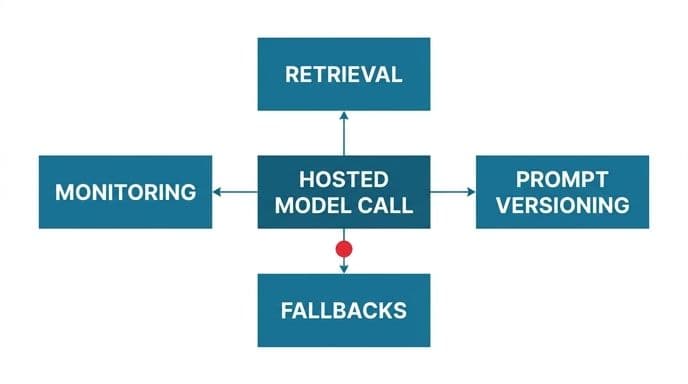
Calling a hosted model is cheap and fast. The expense is everything wrapped around that call. You need retrieval so the model answers from your content rather than its memory, prompt versioning so last week's behavior is reproducible, fallbacks for when the provider is slow, and cost controls so a loop doesn't run up a bill overnight. That layer is where custom AI API integration and wrappers earn their keep.
Fine-tuning or private hosting raises the figure. For a first version, it's often unnecessary. Retrieval augmented generation gets you most of the way, and you can revisit training later with real usage behind the decision.
Evaluation and the human approval step
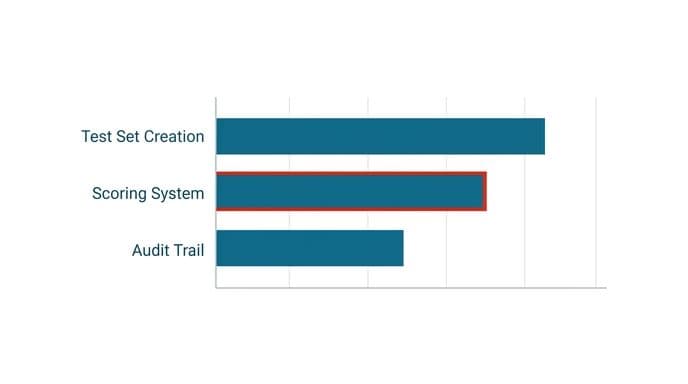
Nobody budgets for evaluation and everybody needs it. You need a test set of real inputs with known correct outputs, a way to score changes against it, and a record of what the model did and why. Without that, every prompt change is a guess, and every bug report turns into an argument.
For anything touching money or a customer, a person approves the output before it lands. That's a product decision with a cost attached. You need a queue, a reviewer interface, a reason for every rejection. We build that step in by default, because output that nobody validates isn't a feature, it's a liability.
Will model spend keep growing with usage?
Yes, and that's the part founders should model before they build, not after launch.
Token spend scales with how much context you push and how often you push it. The common pattern we see is a product that was affordable in testing and uncomfortable at a few thousand users. Every request stuffed an entire knowledge base into the prompt when a tight retrieval step would have sent three paragraphs.
Four things keep the curve flat. Retrieve narrowly instead of sending everything. Cache answers to the questions that repeat, which in support workloads is most of them. Route easy requests to a smaller, cheaper model and reserve the expensive one for the hard cases. And set a hard per-account ceiling so a bug or an abusive user can't drain the account overnight.
This matters for AI customer support automation more than anywhere else, because the same twenty questions arrive forever and there's no reason to pay full price for each one. Build the cost controls into version one. Retrofitting them means rewriting the request path, which is a second invoice for work you could have had the first time.
When you compare quotes, ask what the monthly running cost looks like at ten times your launch volume. A partner who hasn't thought about it will give you a vague answer, and that tells you something.
The hidden line: developer overhead and tech debt
The shortcuts a team takes to hit an MVP date don't disappear at launch. That doesn't mean gold-plating version one. It means knowing which corners are safe to cut and which aren't.
Developer overhead is the other quiet line. Hours get spent on environment setup, access requests that take a week, reviewing work, and rewriting a feature because the requirement changed after it was built. Those hours are real cost whether or not they appear as a line item. Fixed pricing pushes that risk onto the supplier, which is one of the reasons we price that way.
A practical test before you sign: ask what you'll own at handover. Repository, cloud accounts, API keys, model prompts and the evaluation set. If any of it stays with the supplier, your next change has only one possible bidder, and the quote will reflect that.
AI service companies vs SaaS platforms over three years
The comparison founders usually run is a one-month subscription against a one-time build fee, which makes the subscription look obvious. Run it over three years and the picture changes, especially once you count seats.
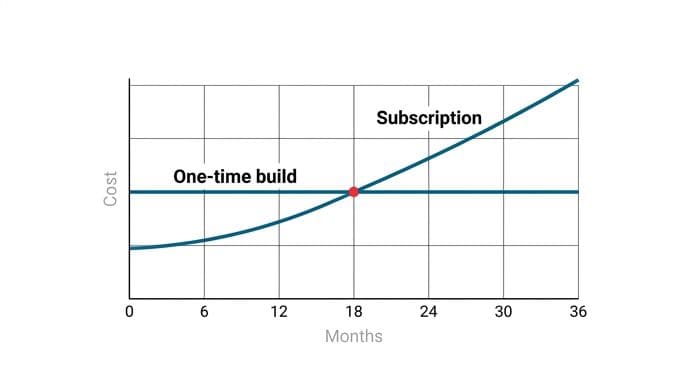
A single build that reads the documents, matches the entries, flags exceptions and writes the report replaces that stack. The recurring cost drops to hosting and model usage, both of which you control.
That's the honest argument for building. Here's the honest argument against: software that nearly fits is only a trap when the gap sits on your core workflow or when the vendor's pricing scales with a number you can't control. If you're renting four tools to cover one process, or paying per seat for admin work that doesn't need a seat, the math usually favors building.
Where to start is AI workflow automation on the one process that's eating the most hours, not a platform replacement. Replace one subscription, measure, then decide about the next.
No-code or custom for your first build
No-code is the right call more often than custom shops admit. If you're testing whether anyone wants the thing at all, a workflow builder wired to a hosted model and a form will tell you in two weeks for very little money. Nothing about a custom build makes that test more honest.
No-code stops working at four predictable points. The first is when per-run pricing on the platform passes what hosting would cost. The second is when you need a permission model more specific than "admin or not." The data leaving your infrastructure is the third, which rules out most of these platforms outright. The fourth is a customer asking for an export, an audit log or a security questionnaire answer the platform can't give you.
The expensive pattern is the middle path: a no-code prototype that quietly becomes production, accumulating logic across nine connected services that nobody can diagram. Migrating out of that costs more than building properly would have, because you're reverse-engineering behavior instead of implementing a spec.
So use no-code to validate demand, and set the trigger for moving off it before you start. Write it down: when we have this several active users, or when the platform bill passes this line, or when the first enterprise buyer asks about data residency, we rebuild. For founders scoping an MVP development budget for startups, that trigger is worth more than any feature list, because it converts a vague anxiety into a dated decision.
What comparing your budget to Perplexity really tells you
Founders often anchor to a known product. If you want something like that answer engine everyone uses, the cost question needs a different frame.
On your own content, for your own users, that pattern is a contained build. The cost to build an AI prototype in that shape is driven by how messy your sources are and how precise the citations need to be, not by how impressive the reference product looks.
Streaming responses, follow-up suggestions, a model picker and a mobile app are each a separate build. Version one needs one input box, one answer, one source list, and enough logging to see where it gets things wrong. Pick the single behavior that makes your product worth paying for and price that. Everything else on the reference product is what funding buys later.
Managing seed burn while the MVP is being built
Seed money has to cover the build, the months after the build, and the fundraise that follows. Teams that run out of road usually didn't overspend on development. They spent the full budget on version one, launched, learned something that required a change, and had nothing left to make it.
A reasonable split is to spend a minority of the raise getting to a working product, hold a similar amount for the iteration that follows real usage, and keep the rest as runway for the raise. The exact proportions depend on your sector, but the principle holds: the build is the cheap part, and learning is what costs.
This is where AI product development pricing structure matters more than the headline figure. A fixed scope with a fixed number lets you plan the other two buckets with confidence. Time and materials gives you a range, and ranges in a cash-flow model behave like the upper bound, because that's what you have to reserve against.
Three habits protect runway. Ship something real in month one, even if it only covers one workflow, so you're learning while you're still spending. Don't hire ahead of the product. And keep infrastructure simple, because an elaborate deployment setup for an MVP serving a few hundred users is runway spent on a problem you don't have. An MVP development budget for startups should look conservative on the build line and generous on the line marked "what we learn next."
Write the exclusion list before the spec
The single cheapest scope control we know costs nothing and takes an afternoon. Write down the features version one will not include, and put a date next to each one for when you'll reconsider.

Not a backlog. Admin dashboard: not in v1, revisit in March. Multi-currency: not in v1, revisit after the first ten customers. Mobile app: not in v1, revisit after retention data.
The reason this works is that scope creep almost never arrives as a new idea. It arrives as a feature someone already discarded, resurfacing in week six with the phrase "we always said we'd need this." A written exclusion list with a date ends that conversation in thirty seconds. Nobody has to argue about memory, and nobody feels dismissed, because the item has a scheduled return.
Founders building for themselves need this list most. When you're the customer as well as the builder, there's no one to tell you no, and the product keeps growing to match your taste rather than a buyer's need. The exclusion list is how you impose an outside constraint on yourself.
Bring that list to every quote conversation. It changes what you're asking for from a description of a product into a boundary, and boundaries are what make a firm number possible.
Why a fixed price AI MVP changes the conversation
We name a price before work starts. Not a range, not an estimate that drifts, a number in writing against a defined scope. That's unusual enough in this market that it deserves an explanation of what it does and doesn't mean.
What it means: the risk of underestimating sits with us. If the integration turns out to be harder than we thought, that's our problem, and you can plan runway against a figure that won't move, which is most of the value.
What it doesn't mean: that scope can change for free. A fixed price AI MVP depends on a fixed scope, so a new requirement is a new conversation with its own number. That's the trade. You get budget certainty and you accept that the exclusion list is real.
Getting to that number takes a scoping conversation, sample data, and a clear statement of what the product must do on day one. We'd rather spend an unpaid hour getting that right than quote low and renegotiate in month two. Experience across many clients and countries has taught us that renegotiation costs more goodwill than it ever recovers in margin.
If a supplier won't name a figure without a long paid discovery phase, ask what the discovery produces and who owns it.
Disclosing the AI, or keeping it behind the scenes
Founders selling an AI-assisted service ask whether to say so. The choice is to lead with the model, or emphasize the team and keep the automation quiet.
In regulated work, the question is settled for you. Financial and health customers will ask what processes their data passes through, and a vague answer ends the deal. Enterprise security reviews ask directly. Saying nothing isn't a strategy, it's a delay.
In unregulated work, there's a real tension. Disclosure can invite customers to discount the price, since they assume a model did the work. Silence risks a worse outcome: being found out by a customer who then questions everything else you told them.
The framing that holds up is to disclose the mechanism and own the outcome. Tell them a model drafts and a named person reviews before anything ships. That's accurate, it explains the speed, and it keeps accountability where customers want it. It also happens to be how we build, because output touching money or a customer always passes a human.
This affects your budget. If you disclose, you need the review step, the audit trail and the plain-language explanation of what the model sees, which is where secure AI and compliance architecture work enters the quote. Budget for it at the start rather than bolting it on when the first serious buyer asks.
Productizing an internal tool, or keeping it to yourself
You built something internally that saves your team real hours. Now someone suggests selling it.
The gap between an internal tool and a product is larger than it looks, and it's almost entirely non-feature work. Internal tools assume one customer, one data shape, one set of conventions, and users who can ask the builder when something breaks. A product needs tenant isolation, onboarding that works without you in the room, billing, permissions, support, and documentation. That gap is usually a bigger build than the original tool, so price it as a new project, not an extension.
The case for keeping it internal is competitive. If the tool is the reason your service is faster than your competitors', selling it hands that advantage to them at a monthly rate that probably doesn't cover what it's worth to you. Plenty of AI-native service businesses are better off never shipping the engine and just winning on margin.
The case for productizing is that your customers keep asking, which is the only signal worth acting on. Not "this could be a product." Specifically, someone offered to pay for it. If three customers have asked unprompted, run a small AI proof of concept with one of them paying for early access. That cost is modest, and it tells you more than a year of internal debate.
Buying a firm for its training data
The idea goes like this: rather than collecting representative data slowly, acquire a small company that already has years of it, and tune your agents on that.
First, consent and contracts. Most B2B service firms hold client data under agreements that permit delivering the service, not training a model that benefits other customers. That restriction often survives the acquisition. Read the client contracts before you read the financials.
Second, the data is rarely in usable shape. Years of work tends to live in email threads, file shares, and whatever the previous operations manager preferred. Turning that into a labeled training set is a project with its own budget, and sometimes it's the larger half of the deal.
Third, fine-tuning might not be what you need. For most business tasks, retrieval against well-organized documents beats a tuned model, costs far less and is easier to correct when it's wrong. Private LLM fine-tuning earns its cost when you need a specific output format, a specialized vocabulary, or deployment inside infrastructure the data can't leave.
What acquisitions genuinely buy is customer relationships and domain knowledge in people's heads. If the deal makes sense on those terms, the data is a bonus. If the data is the whole thesis, test it first by licensing a sample.
When the AI proof of concept cost isn't worth paying
Sometimes we tell people not to build. Here's when.
When an existing tool covers the workflow and the only complaint is minor, switching costs and the maintenance you inherit will outweigh the irritation.
When the process isn't written down. If three people do the same task three different ways and nobody can say which is correct, automation will encode the confusion and make it faster. Fix the process first. That costs a week of someone's attention and nothing else.
When the real problem is an integration. If your systems already hold the answer and people are retyping it between them, that's AI software integration work, and it's smaller and cheaper than a new product.
Where the cost to build an AI prototype is clearly worth paying: a process that repeats daily across a team, where the rules are known, where errors are expensive, and where you can name the person who signs off on the output. That combination produces a short build with a measurable result, which is the only kind of AI prototype that survives contact with a budget review.
What to ask before you sign, and where to start
Five questions distinguish a quote you can plan against from a number that will move.
What exactly is in version one, and what's excluded? Ask for the exclusion list in the proposal, with dates. If it isn't there, add it yourself.
What's the monthly running cost at ten times launch volume? This is the part of AI product development pricing that surprises people after launch rather than before it.
What do I own at handover? Code, cloud accounts, API keys, prompts, evaluation set. All of it, or you're renting your own product.
What happens when the model gets it wrong? There should be a human step, a log, and a way to correct it. Any partner promising accuracy without review is overselling.
Is the price fixed, and what changes it? A straightforward answer here tells you how well they understand the scope.
We publish our approach rather than hiding it behind a sales call, and you can read how we run a build from first call to handover before you talk to anyone here. An AI MVP cost breakdown done properly takes a scoping conversation and a look at your real data, after which we name a figure and hold it. That's the whole of our process, applied the same way to every client we work with.
If you want a number for your scope, book a free automation audit and bring your exclusion list. If you'd rather test the idea first, start a prototype on the single workflow that costs you the most hours and decide from there.
Wondering what this would take against your own systems?
The audit costs nothing, and you keep the costed plan and the risks whether you go ahead or not.
Book a free automation auditHitasoft
LinkedInHitasoft has built software since 2008, for companies that mostly do not have an IT department. These pieces are written by the people who do the integrations rather than by anybody in marketing.