
A fintech founder called us with a pitch deck, a signed letter of intent from two credit unions, and a question his board kept asking. Could the thing in the deck actually be built before the money ran out? He didn't want a discovery phase. He wanted a login screen, a document upload, and an extraction step that pulled numbers off a scanned statement well enough to demo without sweating.
That is the real brief behind most AI MVPs. Not a platform. One workflow, working, in front of someone who can say yes or no to it. The AI MVP development process we run is built around that. We name the single decision the MVP has to unblock, build only what tests it, and hand over code you own. Teams that skip this step tend to find out the hard way, usually after the code is already written.
The AI MVP development steps, from first call to working software
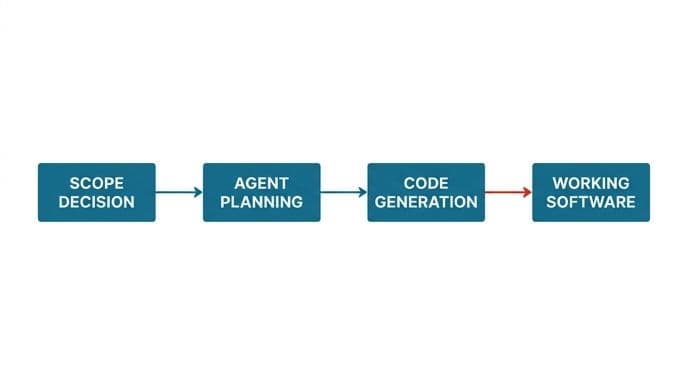
The first conversation is about scope, not technology. We ask what decision the prototype has to settle. Sometimes the answer is a funding round. Sometimes it's an internal argument about whether extraction accuracy is good enough to stop retyping invoices. Either way, we write it down as one sentence, and anything that doesn't serve that sentence stays out of version one.
Then comes a feasibility pass, which is the honest core of the AI proof of concept process. We take real samples of your data, run them through candidate models, and look at where the output falls apart. This takes days, not weeks, and it kills bad ideas cheaply. If a general model handles your documents, you don't need fine-tuning. If it doesn't, you find out before anyone has written application code.
After that, the fixed price gets named. You know the number before work starts, and it doesn't move unless you change the scope. Build runs in short slices with something clickable at the end of each one, so the MVP development timeline stays visible rather than reported. Working software lands in month one. A sensible timeline for a single AI workflow runs in weeks, and the parts that stretch it are usually integrations with systems you don't control, not the model work.
How agentic AI changed MVP workflows, and what it didn't
Agentic tooling has genuinely changed the shape of this work. Agents that read a repository, plan a change, write it, and run the tests have compressed the distance between an idea and something you can click. For rapid AI prototyping, that difference is the whole ballgame, and it's why we can promise working software in month one and keep the price fixed.
Well-structured project instruction files sit in the repo and tell an agent the conventions, the folder layout, and what not to touch. They make a considerable difference to velocity. We keep one in every project because it also doubles as onboarding material for humans.
What agentic AI has not changed is the judgment about what to build. An agent will happily produce a settings page nobody asked for, a second payment flow, or an admin dashboard with eleven filters. Speed applied to the wrong scope just gets you to the wrong product sooner.
The other thing agentic AI hasn't changed is accountability. Anything touching money or a customer still gets approved by a person before it runs. That's less about distrust of the model and more about the fact that nobody wants to explain an automated refund to a regulator.
Tech debt is what makes a cheap MVP expensive
Here is the number that should shape how you think about speed. The tech debt accumulated during a rushed first phase can meaningfully reduce the return a product generates over its life. Not a rounding error. That's the difference between a product that pays for itself and one that quietly doesn't.
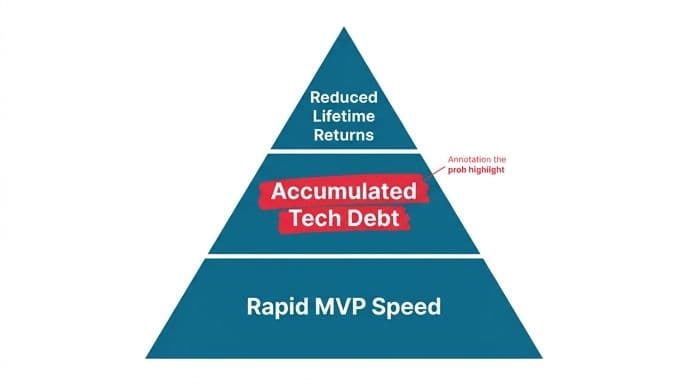
AI-assisted code has a particular debt signature. It duplicates. Ask an agent to add a feature and it will often write a fresh version of a helper that already exists three directories away, because finding and reusing the existing one is harder than writing a new one. Multiply that over a few hundred commits and you have four slightly different date parsers, two of which handle time zones and two of which don't.
You can see this without reading a line of code. Run git log --shortstat -20 on the repository and look at files changed per commit. Small, focused commits touching two or three files suggest the design holds together. Commits sprawling across twenty files for a minor feature mean the structure isn't carrying its weight, and every future change will cost more than the last one. Ask any vendor to show you that output. It takes them ten seconds and it tells you more than a code review they've had notice to prepare for.
We'd rather spend a day consolidating duplicated logic during the build than hand you a codebase that slows down every engineer you hire after us.
The security gap in AI-generated applications
This one deserves its own section because it shows up constantly and almost never gets caught by a demo. A meaningful share of AI-generated applications ship with exposed endpoints caused by missing or weak row-level security. The pattern is consistent. The agent wires the frontend directly to the database using a browser-side key, the database is configured to trust that key, and anyone who opens developer tools can read tables they were never meant to see.
The test for this security gap takes about ten minutes. Log out, open the app, and try to read data. If a logged-out request returns rows, you have the most common vulnerability in AI-built software, and it's sitting in production. We run that test before anything goes near a real user, and we wire it into the build so a logged-out read returning data fails the pipeline rather than shipping.
Fixing it properly means row-level security policies that explicitly name the authenticated user ID and restrict access to rows that user owns. Not a policy that returns true. Not a policy applied to one table and forgotten on the other six. For regulated work, that sits inside a wider security and compliance architecture for AI systems rather than being bolted on at the end. We won't guarantee any system is breach-proof. We will tell you exactly what we tested and what we didn't.
Testing strategies and code quality standards for AI-written code
Developers are right to be cautious about generated code. The top frustration isn't code that fails. It's code that is almost right: a function that handles ninety percent of cases and breaks on the one your biggest customer uses. Those are harder to find than outright errors because everything looks fine until it doesn't.
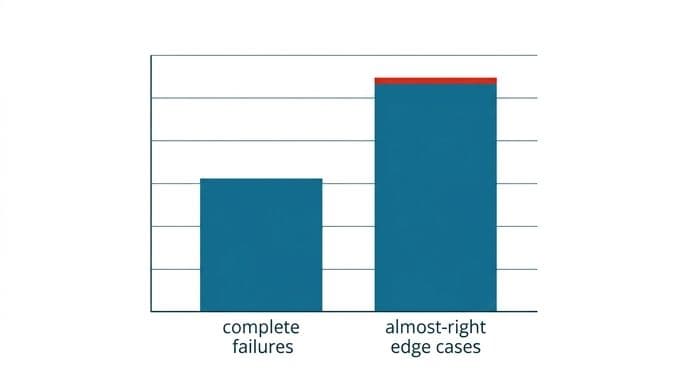
So the testing strategy changes shape. Instead of writing tests that confirm the happy path, which an agent can generate in seconds and which prove very little, we write tests around the edges. Empty inputs, duplicates, the malformed scanned PDF, the transaction that arrives twice. For AI features specifically, that means a fixed set of real inputs with known correct outputs, run on every build, so you notice when a model update shifts behavior underneath you.
There's a comprehension cost too. Engineers who lean heavily on AI assistance can end up understanding their own code less deeply than they would have writing it by hand, and the gap tends to show up most on debugging and explaining why something failed. That matters at three in the morning when something breaks. We counter it by requiring that whoever ships a module can explain what it does without opening it, which sounds old-fashioned and saves weeks later.
Hardware, hosting, and what happens to your model bill as usage grows
Most AI MVPs don't need GPUs. They need an API key, sensible caching, and a hosting setup that doesn't fall over at fifty concurrent users. Starting with hosted model endpoints keeps the first version cheap and the infrastructure boring, which is what you want when the product is still changing weekly.
The question worth asking early is what happens to the model bill at scale. Per-call pricing that looks trivial in testing becomes a line item at volume. The usual levers are caching repeated queries, routing simple requests to smaller models, and batching anything that doesn't need an instant answer. Design for those from the start and the economics hold.
Two situations change the calculus. One is sensitive data that can't leave your infrastructure, where private LLM fine-tuning and secure hosting on your own hardware or private cloud becomes the requirement rather than the upgrade. The other is high, predictable volume on a narrow task, where a smaller tuned model on dedicated infrastructure costs less than general API calls. On enterprise endpoints with retention switched off, your data isn't used to train anyone's model, and we'll show you the configuration rather than asking you to take our word for it.
Onboarding engineers to an AI-built codebase
You will hand this code to someone eventually, either your own hire or another firm. AI-built repositories are harder to join than hand-written ones because the usual archaeology doesn't work. There's no single author to ask. Commit messages are generic, and patterns vary between modules written weeks apart.
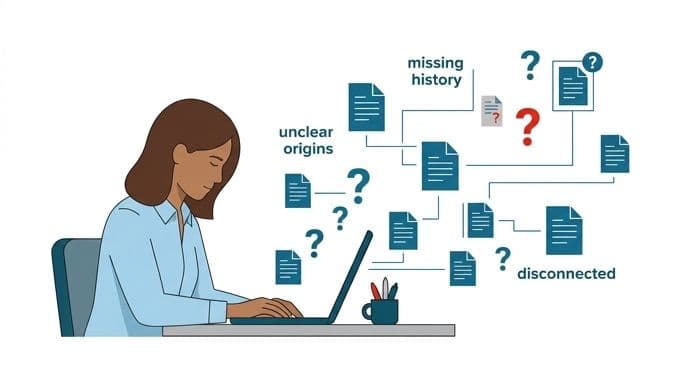
What fixes onboarding to an AI-built codebase is unglamorous. A single document in the repo that states the architecture, the data model, the external services, and the decisions that look odd but were deliberate. A local setup that runs with one command. Tests that describe behavior in plain language, so a new engineer learns the business rules by reading them.
We write all three as we go, because on a fixed price we carry the cost of bad handover, not you. You own the code, the accounts, and the keys from day one, with no escrow arrangement and no license that expires when the engagement does.
Deciding whether to build an AI prototype at all
Before you spend anything, be honest about which of two situations you're in. If an off-the-shelf tool does eighty percent of what you need and the missing twenty percent isn't your differentiator, buy it. If the gap is a connector between systems you already pay for, that's integration work, not custom AI product development. We've told plenty of companies they didn't need us to build anything, and we'd rather say it in the first call than the fourth invoice.
Build when the thing you need doesn't exist, or when it exists but can't touch your data. That's when it's worth learning how to build an AI MVP properly. Narrow scope, real data in the feasibility pass, fixed price, working software in weeks. Our approach to AI MVP development and prototyping assumes you'll walk away with something you can run without us.
If you're weighing this now, the cheapest next step is a conversation about scope. Book a free automation audit and we'll tell you what we'd build, what we'd skip, and what it costs. If you'd rather see the mechanics first, read how we run projects end to end.
Wondering what this would take against your own systems?
The audit costs nothing, and you keep the costed plan and the risks whether you go ahead or not.
Book a free automation auditHitasoft
LinkedInHitasoft has built software since 2008, for companies that mostly do not have an IT department. These pieces are written by the people who do the integrations rather than by anybody in marketing.