A founder we spoke with last year had a beautiful pitch deck. The demo video was convincing. The beta was not. Testers quit in the first session, and almost none of them quit because the AI wasn't smart enough.
That gap is the real subject of this article. If you're planning fitness app development with AI, the hard part is rarely the model. It's the order you build things in. Teams that prioritize the wrong sequence end up spending their runway debugging audio cues while a half-finished digital human sits in a branch nobody has merged.
The part every AI fitness app plan gets wrong
Most plans open with the coach. Persistent memory, adaptive programming, a voice that knows your name. Those are the features that make a deck land, so they get the attention and the budget. The plumbing underneath gets a line item and an assumption that it's already solved.
Beta testers judge reliability before they judge intelligence, and they judge it fast. A user who opens your app at 6 a.m. before work has a narrow tolerance for a loading spinner. If the session won't start, there is no second chance to show off the coach.
Your app has a floor and a ceiling. The ceiling is how impressive the experience gets when everything works. The floor is how bad it gets when something breaks. Users form their opinion at the floor.
So the build order inverts the pitch deck: boring first, brilliant second.
Why building the whole vision at once doesn't work
Pursuing the whole vision at once is really two separate builds in one. There is a fitness app: accounts, onboarding, program storage, timers, logging, media playback, offline behavior. Then there is a real-time generative system: speech in, speech out, animation, memory, pose analysis. They have different failure modes and different test strategies. The people who are good at fixing one often aren't the people who fix the other.
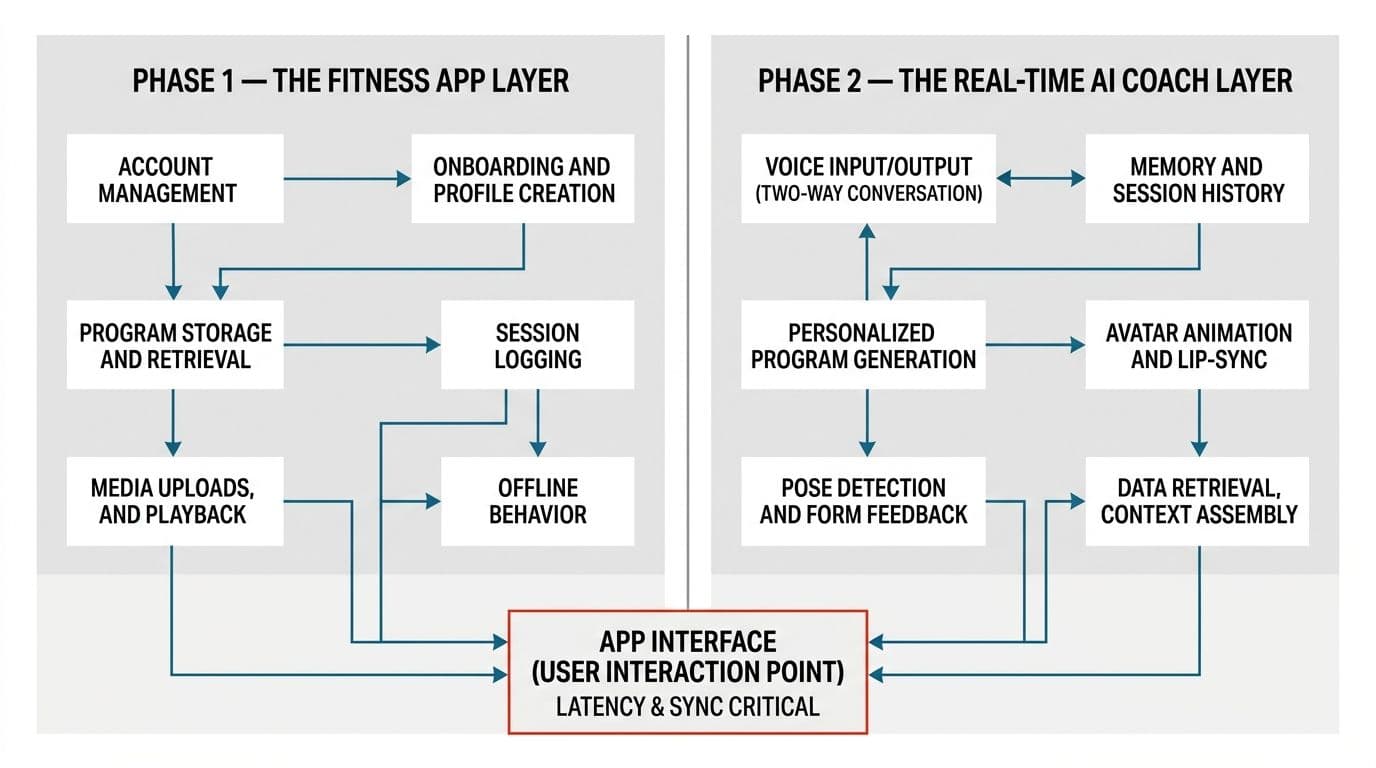
Teams that attempt both in a single sprint cycle end up splitting attention at exactly the wrong moment, and weeks pass with neither half reaching a demonstrable state.
Phasing the work isn't a downgrade of the vision. In fitness app MVP development, the first honest user feedback almost always reshapes the roadmap. You want that feedback before you've spent four months on animation.
Step 1: Get the core app stable enough for beta
Fix the connection between the app and the coach
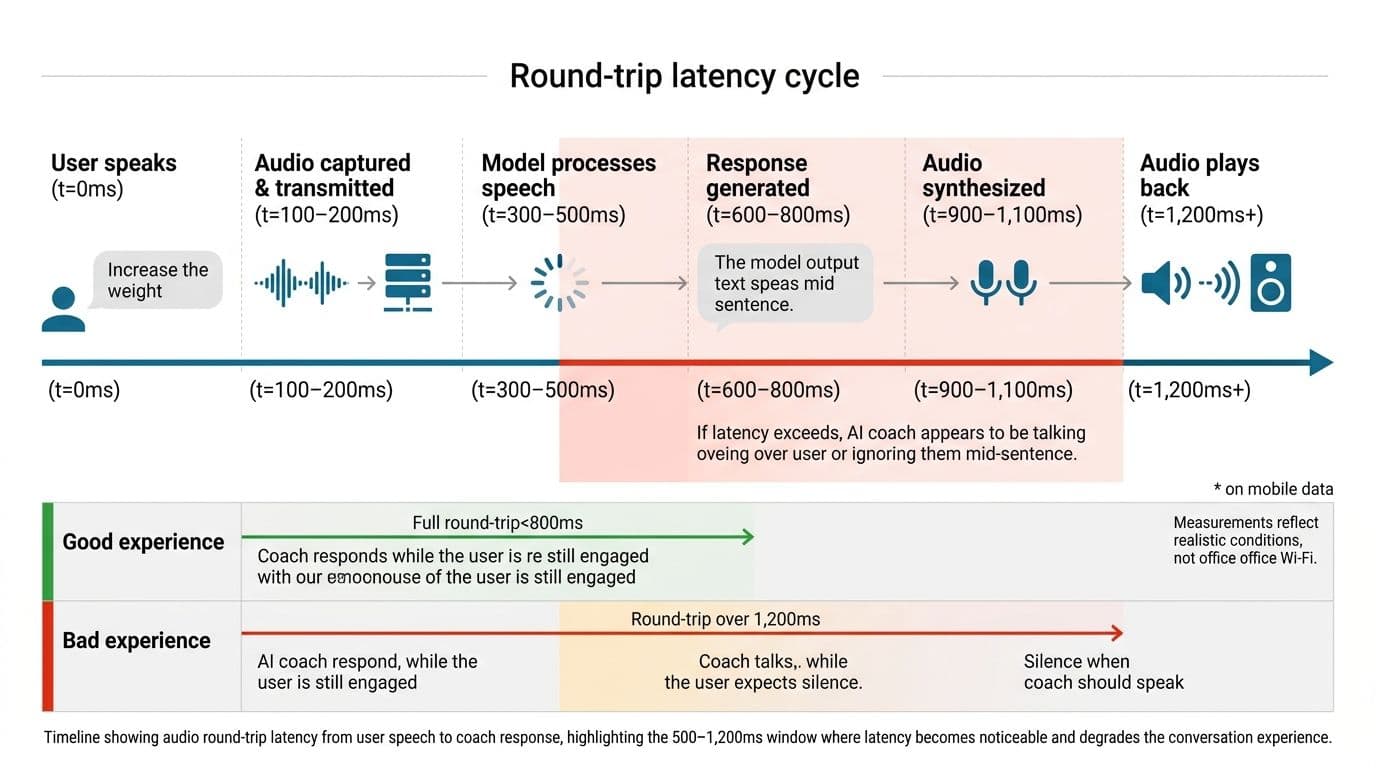
Two-way voice is where most of these builds first show their seams. A conversation that drops half a second of audio, or responds while the user is still speaking, reads as broken in a way text chat never does. People forgive a chatbot that takes a moment. They don't forgive a voice that talks over them mid-set.
Getting this right means treating latency as a product requirement with a number attached, not a vague goal. Decide what round-trip delay is acceptable before the user notices. Measure it on a mid-range Android phone on mobile data rather than office Wi-Fi, and hold the build to it. If a user says "stop" halfway through an instruction, the coach has to stop.
Onboarding deserves the same scrutiny. Photo uploads, profile creation, any avatar or persona setup flow, all of it has to complete every time. It has to work on shaky connections, on old devices, with the app backgrounded halfway through. A flow that works 85 percent of the time looks fine in internal testing and loses a sixth of your signups.
Fix the workout experience itself
Timers, rest periods, and audio cues are unglamorous work. They're also the backbone of trust. A countdown that drifts by three seconds, or a cue that fires after the set has already ended, tells the user the app isn't paying attention to them. Once that impression lands, nothing the AI says later recovers it.
Background behavior is the specific trap here. A timer that pauses when the phone locks will wreck a session, and so will audio that ducks out when a notification arrives mid-rep.
The coach also has to respond to what the user actually does, not a scripted subset of it. If someone skips an exercise, cuts a set short, or says their shoulder hurts, the system needs a sensible path for that. A coach that only handles the happy path is a script with a voice.
The deliverable for fixing the workout experience is one sentence long: a single full workout, from open to finish, with no technical interruption. If you can't do that, you aren't ready to build an AI personal trainer app on top of it.
Step 2: Building the advanced AI personal trainer
A coach with memory, not just a face
Combining conversational AI with generated voice and full-body animation means solving three technical problems that have to stay in sync. Lip movement has to track audio. Audio has to track the model's output. The model's output has to arrive fast enough that the animation isn't waiting on it. Bolt them together loosely and you get an uncanny delay where the figure stands still, then suddenly speaks.
Persistent memory is what separates this from a chatbot wearing a face. The coach should know you missed Thursday, that you said your knee was sore two weeks ago, and that you came back after a month off. That's a data design question long before it's a model question. What gets stored, how it's summarized, what gets retrieved into context for each session, and how old information decays so the coach doesn't keep referencing a goal you abandoned in March.
This is also where a custom AI fitness app earns its cost. Generic programming is available free in a dozen places. A coach that remembers is not.
Real-time form feedback changes the risk profile
Pointing the camera at a user mid-squat moves the product into different territory. Content apps suggest. A real-time form feedback app corrects, and a correction about knee position or spinal alignment carries consequences that a workout video doesn't. Treat it as a safety-adjacent feature from the first design meeting.
Practically, that means three things. Feedback has to be conservative, flagging patterns rather than diagnosing. The language has to stay away from clinical claims, because pose estimation detects joint angles, not injury. A human has to own the rules: someone qualified should review what the system is allowed to say, with the thresholds written down and versioned rather than living inside a prompt nobody has read since launch.
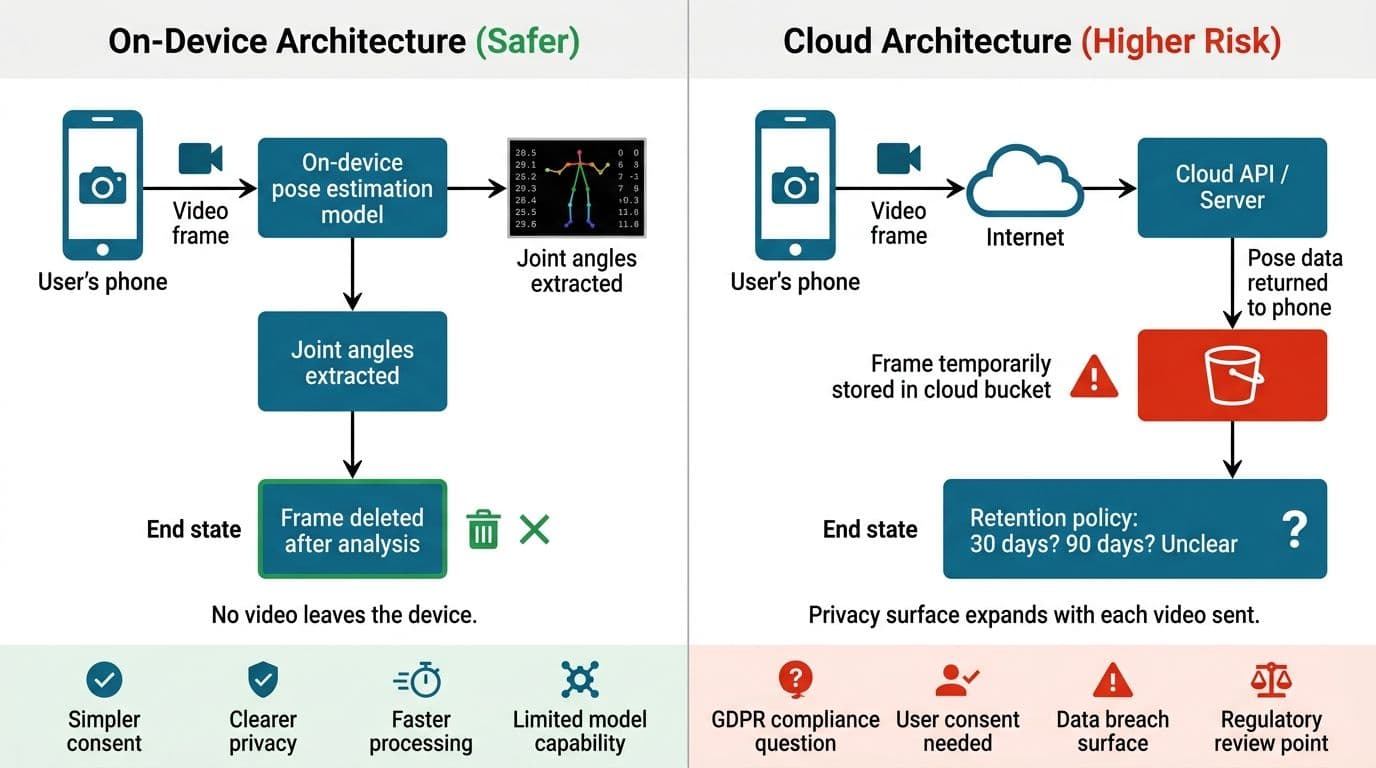
Then there's the data. Video of a person's body in their home is sensitive by any reasonable standard. It should be opt-in, clearly explained, and architected so that frames are processed and discarded rather than quietly accumulating in a bucket. Deciding whether pose extraction runs on-device changes the entire privacy posture, so decide it early.
The cost problem nobody budgets for early enough
Generated humans, synthesized voice, and pose estimation all carry per-use compute cost. A feature that's comfortable at 50 beta testers can become financially unworkable at 5,000 if nobody modeled it. The math that matters is cost per active session, multiplied by sessions per user per week. Run that number before you build, not after your first spike in signups.
The fix is usually architectural rather than a swap to a cheaper model. Which parts run on-device? Which responses can be pre-generated and cached, since the warm-up cue for a given exercise doesn't need a fresh model call every time? Where does a short, inexpensive model suffice, and where do you genuinely need the expensive one? Streaming a full generative avatar for every second of a 45-minute session is a very different bill than generating it for the 90 seconds that actually need it.
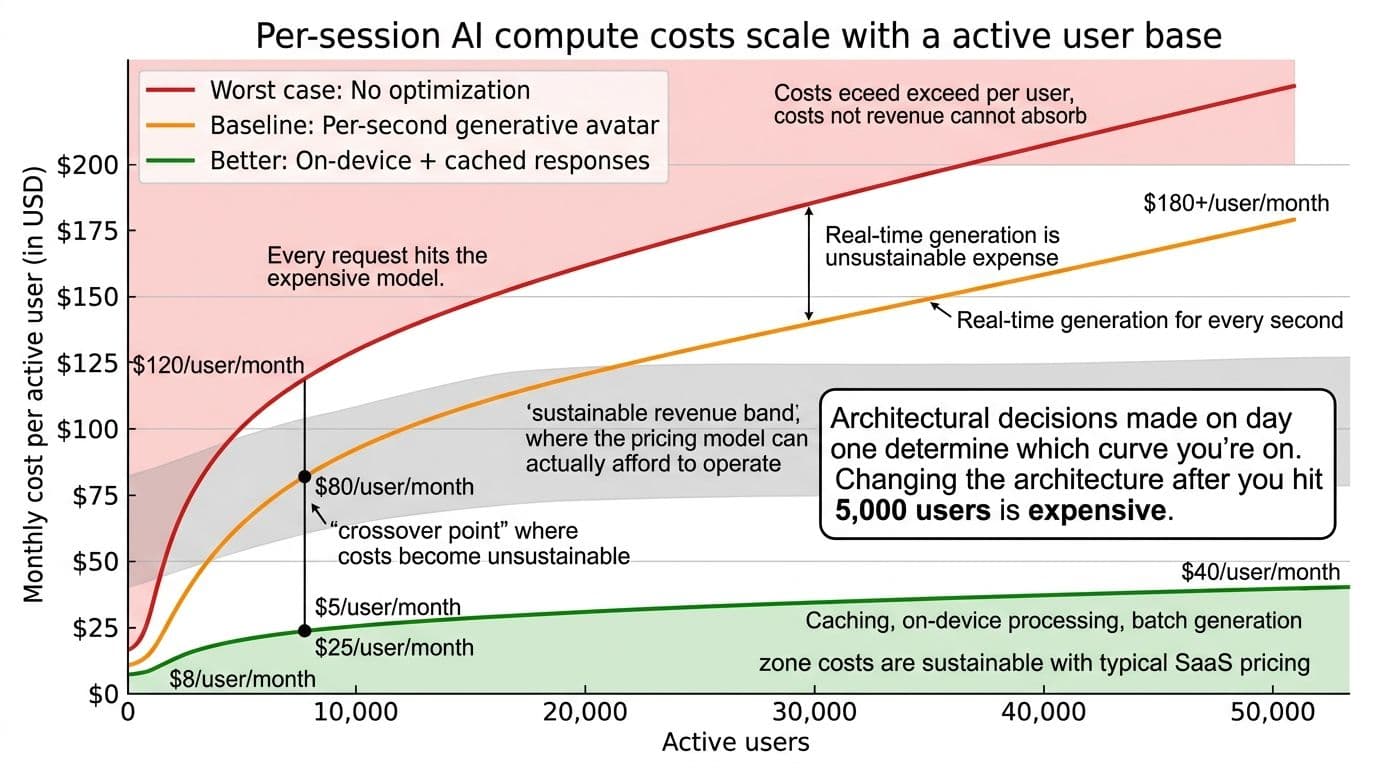
Wiring models together efficiently is a distinct skill from choosing which model to use.
Where wearables fit, and when to add them
Most founders assume wearable integration belongs in version one. It usually doesn't. Apple HealthKit and Google Health Connect are reasonable to add early because they're local, permissioned, and well documented. Direct vendor integrations are another matter, and approval timelines for partner APIs vary enough that building your roadmap around a partnership you haven't signed is how launches slip by a quarter.
The sequencing we'd suggest for a wearable data integration app starts with platform health stores, which already aggregate data from most popular devices. Add direct vendor connections once you know which devices your actual users wear. That second part is worth measuring rather than guessing. Your beta cohort will tell you in a month what a market report won't.
One engineering note saves pain later. Decide upfront whether you're polling in batches or syncing in near real time. Live heart rate during a session is a genuinely different system than a nightly import, and it costs more to run.
Everything about how to build a fitness tracking app that handles biometric history comes back to one principle. Your schema is yours, and providers are interchangeable sources feeding it.
Why this isn't a pre-made platform job
Off-the-shelf fitness app builders are good at a specific thing. Workout libraries, subscription billing, simple progress charts, a branded shell. If that's your product, use one and save yourself six months.
They are not built for real-time two-way voice, custom digital-human animation, or live camera-based pose analysis. Those need direct access to the audio pipeline, the camera buffer, and the render loop. A platform that abstracts the device away from you by design can't hand that access back.
There's a second cost that shows up later. A pre-made platform ties your roadmap to someone else's release schedule at exactly the moment you're trying to build something that doesn't exist yet. When you need a change to how audio sessions are handled, you file a feature request and wait.
Our position on this is consistent, including when it costs us work. If your product is a workout library with a subscription, you don't need a custom build. If it's a coach that listens and watches, you do, and that's a custom AI MVP build rather than a website-builder problem.
What this looks like as a staged technical build
Stage one stabilizes what exists. If you're on React Native or Expo, that means fixing the build, tightening the voice integration, resolving background audio and timer behavior, and proving one clean workout flow end to end on real devices. No new features. The exit criterion is a beta tester finishing a session and not mentioning a bug.
Stage two adds memory and personalization. Session history, user preferences, stated constraints and goals, all retrieved into context so program generation reflects the individual rather than a template. Agent-based orchestration fits here, where one component plans the week, another adapts the session in progress, and a deterministic rule layer sits over both so the system can't prescribe something unsafe. That rule layer is not optional. The model proposes, your code and a qualified reviewer dispose.
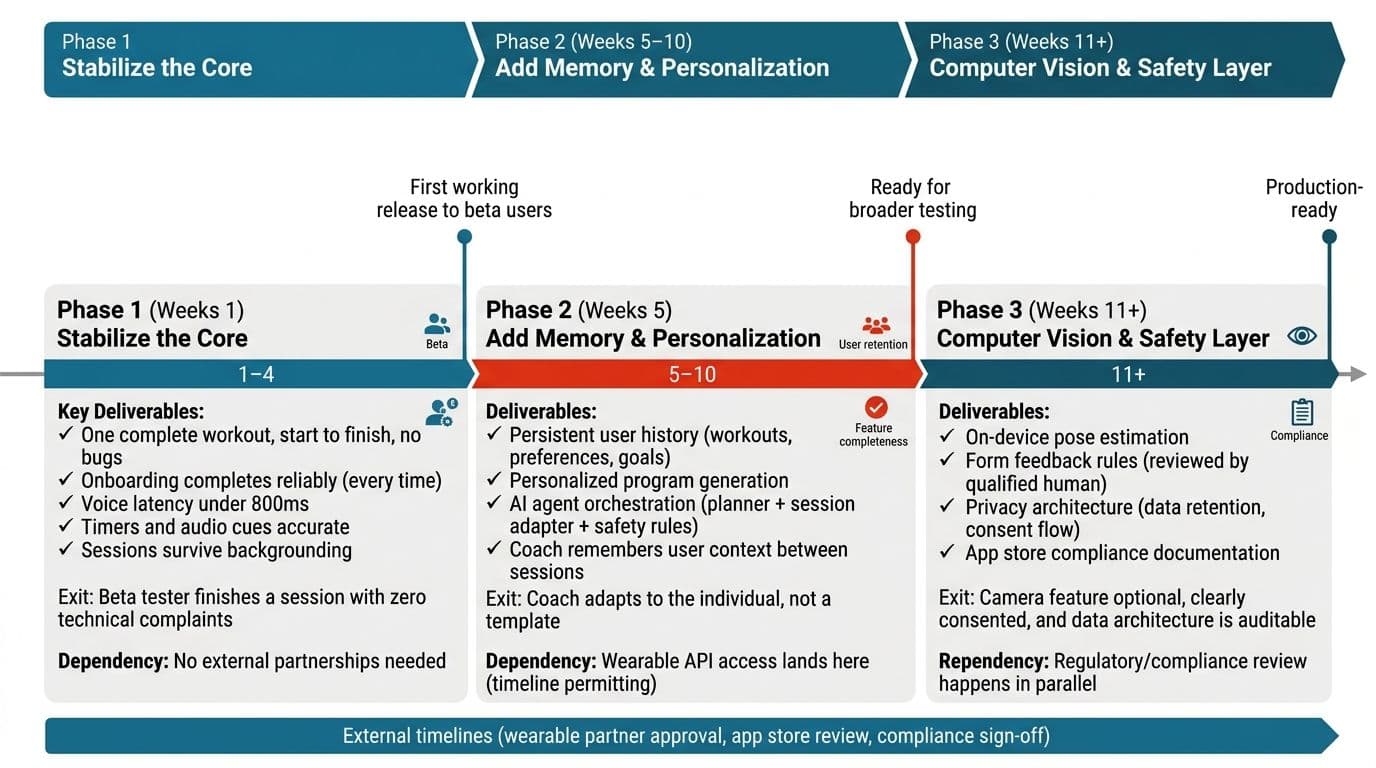
Stage three adds computer vision. Pose estimation for form feedback, gated behind explicit consent, with retention decided in the architecture rather than patched in after a privacy question arrives from the app store reviewer. On the store question, be straightforward with yourself: health and fitness apps draw extra attention to data handling disclosures, camera permissions, and any language that sounds like a medical claim. We can build to the requirements and prepare the documentation.
Each stage ships something usable. That matters for fundraising as much as engineering, because a working beta is a more persuasive artifact than a roadmap.
Questions worth asking before you commit budget
Do you need the full vision on day one, or a working beta that proves people come back in week three? Retention data from 200 real users moves an investor conversation further than a demo of an animated avatar. We've seen the second get funded off the first, rarely the other way around.
Who reviews what the coach tells a user about their form or their health? Name the person. If the answer is "the model handles it," that's a gap, not an architecture. Any output that touches a user's body needs validation in code or by a qualified human, and that review path should be built into the workflow rather than assumed.
What happens to camera data the moment a session ends? If you can't answer that in one sentence before launch, answer it before a single beta tester opens the camera feature.
And the question founders skip: what does a month cost at 1,000 active users, at 10,000, at 50,000? Fitness app development with AI has a usage-linked cost curve that subscription pricing has to absorb. Knowing the shape of that curve early changes which features you build and which you quietly drop.
Where to go from here
Start by being honest about which phase you're actually in. If a full workout doesn't run cleanly on a mid-range phone today, that's your next two sprints, regardless of what the roadmap says. If it does, you're ready to talk about memory, personalization, and eventually vision.
If you want a second opinion on that sequencing before you commit budget, book a free automation audit and we'll go through the build order with you. If the stable core is already there, you can start a prototype of the coach layer. And if you'd rather see the working method first, including the fixed price and the fact that you own the code, accounts and keys at the end, here's how we run projects.
Wondering what this would take against your own systems?
The audit costs nothing, and you keep the costed plan and the risks whether you go ahead or not.
Book a free automation auditCommon questions
Can an off-the-shelf fitness app platform support this kind of AI coach?
No. Real-time voice, digital-human animation, and live camera-based form analysis all need direct access to device audio, camera, and rendering, which pre-made platforms deliberately abstract away.
Will the AI give medical or clinical advice on form corrections?
No. It can flag posture and movement patterns, and it should never substitute for a clinician's judgment. Output of that kind needs human review built into the workflow rather than assumed.
How do we stop AI compute costs from scaling faster than revenue?
Mostly through architecture. Decide what needs a live model call per session, what runs on-device, and what can be cached, rather than hoping a cheaper model solves it after launch.
Should camera-based form analysis be required to use the app?
No. Make it optional and clearly consented to, and design it so users understand what's being observed and what happens to the footage afterward.
Do we need to rebuild the existing app from scratch?
Usually not. Fix and stabilize what exists first. A rebuild is a last resort, not a starting assumption, and most teams that jump straight to one lose three months for no gain.
How long does it take to get a beta in front of users?
It depends on the state of the existing code, but the first stage is weeks rather than quarters. We name a fixed price before work starts so you can scope it against your runway.

Arun Andiselvam
LinkedInI am a startup veteran who has built five brands. I sold the first, an SEO tool, for a six figure exit, and now build AI automation products for businesses. I bootstrapped every one of them from day one.