
A buyer at a dealership has a customer in front of them. There's a trade-in on the forecourt and about three minutes to name a number. Too high and the margin is gone before reconditioning starts. Too low and the customer walks to the dealer down the road. That three-minute window is the entire commercial case for an AI vehicle valuation platform, and it's also why most of these builds stall. The hard part isn't the model. It's getting legal, current, comparable data into it.
If you're scoping a used car valuation app or a dealer purchase-price tool, the sequence that decides your launch date is data licensing, then data quality, then modeling. Teams that start with the algorithm usually spend their second quarter rebuilding around a data agreement they didn't read closely enough the first time.
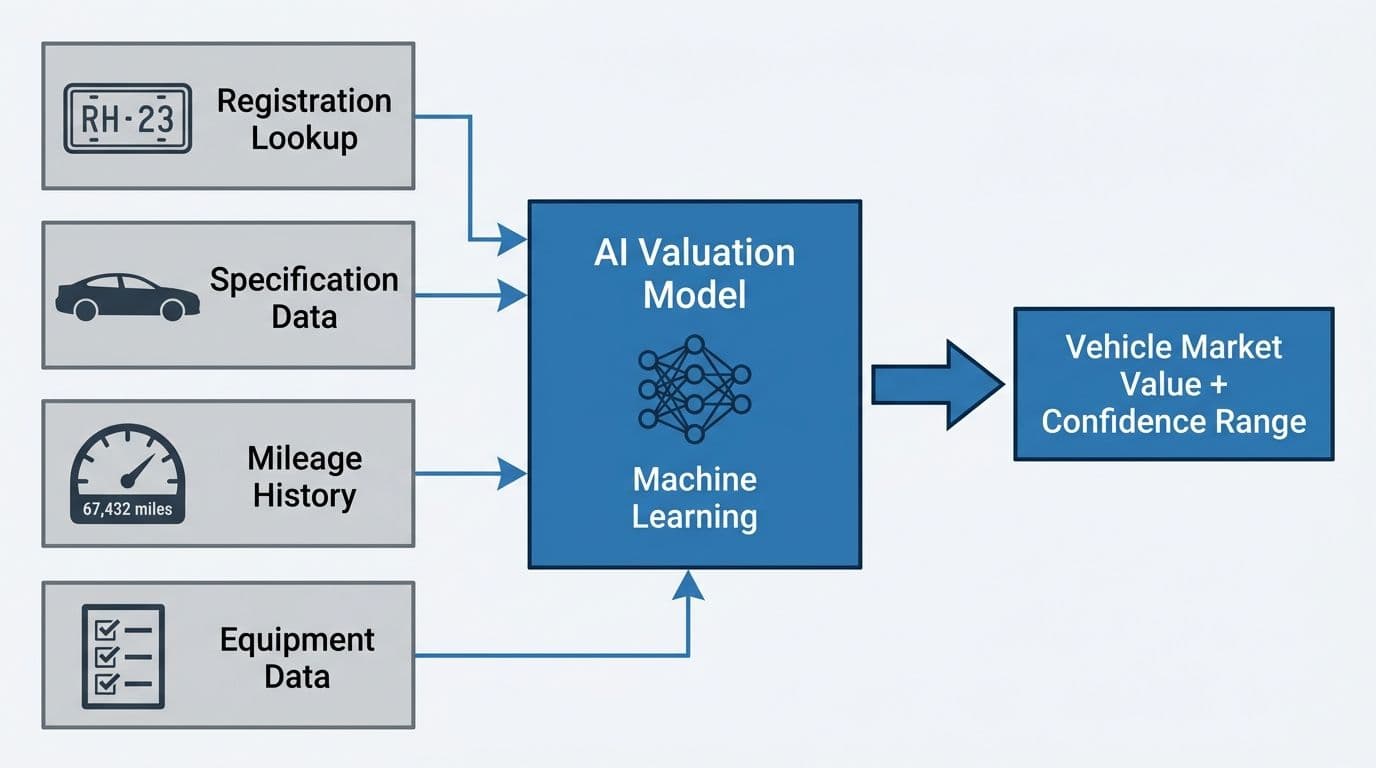
What a Vehicle Valuation Model Actually Needs Before It Can Price Anything
Before a single prediction runs, four things have to exist and be reliable. Registration lookup matters, so a user can type a plate and get back a vehicle rather than filling in twelve fields. Specification data matters too, so the system knows trim, engine, body style and factory options. Mileage history should come from inspection or service records rather than a self-reported number. Equipment data counts as well, because two cars with the same badge can differ by thousands depending on what was ticked at order.
Then there's the part everyone underestimates: comparable vehicle data. A valuation model learns from what similar cars actually sold for or are currently listed at. Without licensed access to transaction or listing data at real volume, any confidence figure your interface shows is decoration. It looks like statistics and behaves like a guess.
A common plan budgets eight weeks for data and twenty for modeling. Data acquisition, cleaning, and reconciling conflicting records across sources is the work that sets your launch timing, not the machine learning.
Licensed Data Is the Real Bottleneck, Not the Algorithm
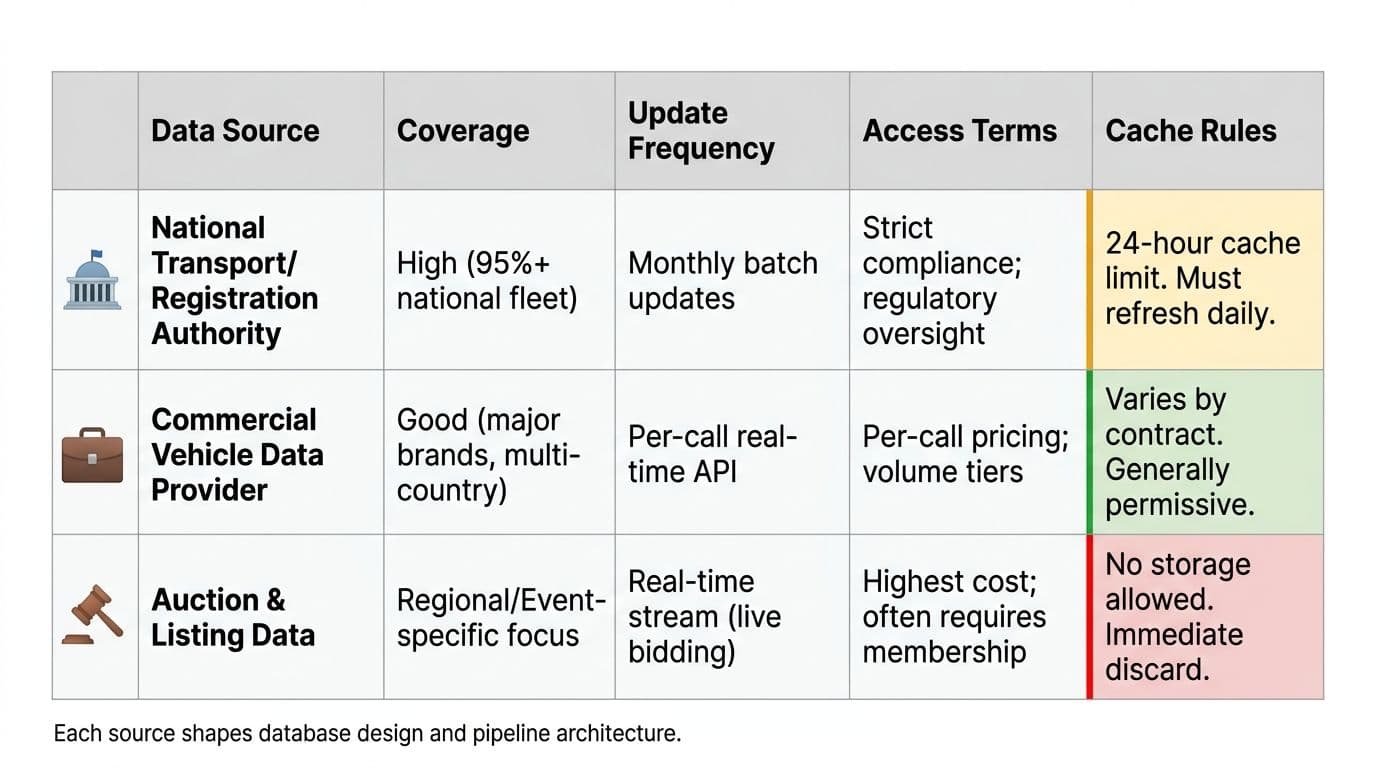
Vehicle data comes from several places and none of them behave the same way. A national transport or registration authority might offer plate lookup with solid coverage but limited technical detail and strict rules on caching. Commercial vehicle data providers fill in specification and options, usually under per-call pricing and retention conditions. Auction and listing data, the raw material for market value, is often the most expensive and the most restricted of the lot.
Each one arrives with its own access terms, geographic coverage, refresh cadence and limits on what you may store. One provider might allow a 24-hour cache, while another might forbid storing anything derived at all. Those clauses shape your database design directly, which is why they belong in the architecture conversation rather than a legal review three weeks before launch.
A platform meant to eventually price every car on the road still has to start somewhere narrower. Scope follows licensing, not ambition. If your agreements cover passenger cars under ten years old in one market, that's your version one, and it's a perfectly respectable one.
Where a data agreement doesn't support automated refresh, you need quality checks and a manual review step in the pipeline from day one. Stale data in a pricing tool is worse than no data, because people act on it.
Choosing Between CatBoost, XGBoost and a Simpler Baseline
Gradient-boosted decision trees build predictions by adding many small decision trees in sequence, each one correcting the errors of the trees before it.. They're a sensible starting point for tabular pricing problems. CatBoost handles categorical fields like make, model, trim and color without heavy preprocessing. XGBoost is faster to tune and has a deeper ecosystem. Either will estimate retail market value from comparable vehicles well enough to put in front of a dealer. You don't need deep learning on day one, and starting there usually costs months for accuracy gains the business can't feel.
What matters more at this stage is what you show alongside the number. A single figure with no range invites argument. A figure with a valuation range and a confidence indicator, plus a visible count of how many comparable vehicles sat behind it, invites a conversation. Dealers are already adjusting mentally for a scraped bumper and a service book with a gap in it. Give them something to adjust from.
Manual adjustment controls are not an admission that the model is weak. They're how a human supplies the things the data never captured: condition, tire wear, a non-standard respray. Build them in deliberately, log every adjustment, and you get a second dataset that improves the next model version.
From Vehicle Value to Dealer Purchase Price
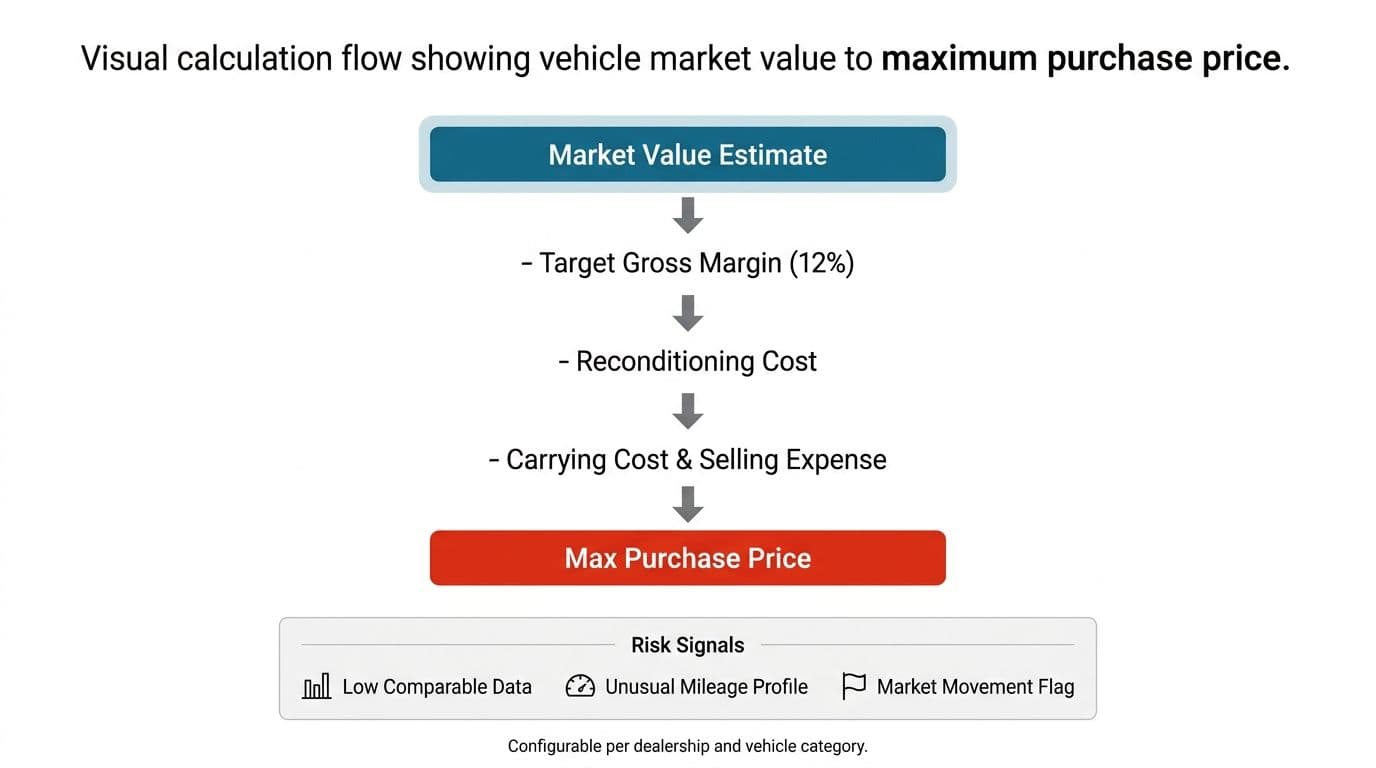
Market value is not what a dealer needs to know. What they need is the maximum they can pay today and still make money. That calculation starts from the estimated retail figure and subtracts target gross margin, expected reconditioning cost, days-in-stock carrying cost and selling expense.
Those assumptions belong to the dealer, not to the model. One group runs a 12 percent gross target, another runs 8 percent and churns faster, and reconditioning averages differ by site. Hard-code these and the tool becomes useless outside the first customer. They need to be configurable per dealership and ideally per vehicle category.
Add risk signals on top. Thin comparable data, an unusual mileage profile for the car's age, or a segment where listing prices have moved sharply in the last 60 days should each raise a flag.. That flag is what turns an estimate into a buying decision someone will defend to their finance director.
This layer sits above the pricing model and carries its own logic and its own tests. It's the difference between a used car valuation app that informs and a dealer tool that gets used every day. The same discipline applies to any system that produces a number people spend against, which is the thinking behind our work on how finance teams automate reconciliation and approvals.
Architecture Choices That Hold Up at Scale
PostgreSQL handles this workload comfortably, provided you design for millions of vehicle records and a growing archive of historical valuations from the beginning.
Store every valuation you issue, with the inputs, the model version and any manual adjustment. You'll need that history for audit, for dispute resolution, and for retraining. Retrofitting it later means losing your most valuable dataset for a year.
Keep the backend and model serving separate from the interface. Python with FastAPI serving CatBoost or XGBoost behind a clean API, and React or Next.js for the dealer dashboard, means you can swap the valuation engine as data access improves without touching the front end. That separation matters more than usual here, because your model will change when your data licenses change.
Secure dealership login, role separation between buyers and managers, saved valuations and side-by-side comparison are table stakes. Nobody chooses your product for them. The differentiation lives entirely in the data behind the number and the purchase-price logic in front of it.
Why Your AI Vehicle Valuation Platform MVP Should Be Smaller Than the Long-Term Vision
A product aimed at valuing an entire national fleet still has to prove itself on a licensed, representative slice first. Pick a segment where your data is strongest and your early customers are concentrated, then get ten dealers using it daily. Measure how often they override the number and by how much. That feedback tells you more in six weeks than another model experiment will.
The decisions you can't defer are structural. These include database schema, pipeline design, how model versions are stored and rolled back, and how provider-specific retention rules are enforced in code. Get those right and nationwide expansion is mostly configuration and new data contracts. Get them wrong and it's a rebuild.
We work to a fixed price named before anything starts and aim for working software in the first month. That only holds if scope is honest. Sometimes the honest answer is that a smaller first version, or a review of what you already have, gets you to a go or no-go decision faster than the full build would.
We'll say that. If speed to a working demonstration is the goal, a short prototyping engagement is often the cheaper route to finding out.
Where Hitasoft Fits In
This is the kind of first version our MVP practice is set up to build: a baseline valuation model, a vehicle database designed to grow, and a dealer-facing dashboard, with the price agreed before work begins. That's the core of our MVP and prototyping practice, run by a team of 150+ engineers with 18+ years of delivery, 1,000+ clients and 50+ countries served.
Valuation and purchase-price tools touch commercial decisions, so review steps matter as much as model accuracy. We build human approval into anything that moves money, and we don't claim model output is correct without validation. Connecting the model into your existing dealer systems and designing around data residency and retention rules are part of the same job, not afterthoughts.
Licensed data arrives with conditions attached. We build around them rather than past them. When the work is finished, you own the code, the accounts and the keys.
FAQ
Does an AI valuation model need millions of records to start?No. A representative, properly licensed dataset is enough to put a working version in front of dealers. Nationwide coverage is a scaling step, not a launch requirement.
Can the valuation model guarantee accurate pricing?No model output should be used unchecked. Valuation ranges and confidence indicators are a starting point, with manual adjustment for mileage, condition and equipment built in by design.
Is CatBoost or XGBoost better for a first version?Both work as a baseline. The choice matters far less than having clean, comparable vehicle data to train on. We size that during a review rather than assume it upfront.
What happens if nationwide data access isn't available yet?Build on the data you can legally obtain now, with an architecture designed so broader access later doesn't force a rebuild.
Do we need to build this from scratch?Not always. If an existing tool or a smaller build gets you a decision faster, we'll tell you. Book a free automation audit before you commit to a full build, or see how we work first.
Wondering what this would take against your own systems?
The audit costs nothing, and you keep the costed plan and the risks whether you go ahead or not.
Book a free automation audit
Arun Andiselvam
LinkedInI am a startup veteran who has built five brands. I sold the first, an SEO tool, for a six figure exit, and now build AI automation products for businesses. I bootstrapped every one of them from day one.