
A founder emailed us last spring with a used-car marketplace and a problem. Sellers were listing cars at prices buyers ignored. Listings sat for weeks, and the support inbox filled with "what's my car actually worth?" He wanted a number on every listing page, generated automatically, accurate enough that sellers would trust it. He had eleven thousand historical sales rows in a Postgres table and a quote from another firm for a nine-month build.
He didn't need nine months. He needed six weeks and an honest answer about whether eleven thousand rows could support a price prediction at all.
That's the gap most ai predictive analytics services fail to address. They sell the full platform before anyone has checked whether the data supports the prediction. This guide covers what a predictive model does inside an MVP, what data you need before training anything, how a vehicle valuation prototype actually gets built, and when the right call is to buy something off the shelf instead. Prediction is a data question first and a software question second, and you can answer the data question in weeks for a fixed price.
What AI Predictive Analytics Services Actually Do Inside an MVP
Predictive analytics means using historical records to estimate something you don't know yet. A price. A churn risk. A delivery date or a claim amount. The model learns patterns from what already happened and applies them to a new case.
Inside an MVP, the job is narrower than that definition suggests. You are not building an analytics platform. You are proving one prediction works well enough to change a user's behavior.
For the car marketplace, the prediction was a single number with a confidence range. Nothing else. No dashboard, no admin reporting suite, no retraining pipeline. The MVP answered one question: when a seller enters make, model, year, mileage and condition, can we return a price that lands close enough to real sale prices that sellers accept it?
That narrowing matters because it changes what gets built. A full platform needs data versioning, monitoring and a model registry. A prototype needs a trained model, an API endpoint, and a way to measure how wrong it is. We've shipped the second in four to six weeks on projects across fintech and logistics, while the first takes quarters.
The discipline is deciding what you're willing to not build. Every prediction feature you add before validating the first one multiplies the data you need and the time to a usable answer. One prediction, measured honestly, tells you more than five predictions guessed at.
The Data Question: What You Need Before Anyone Trains Anything
Before writing code, we look at four things.
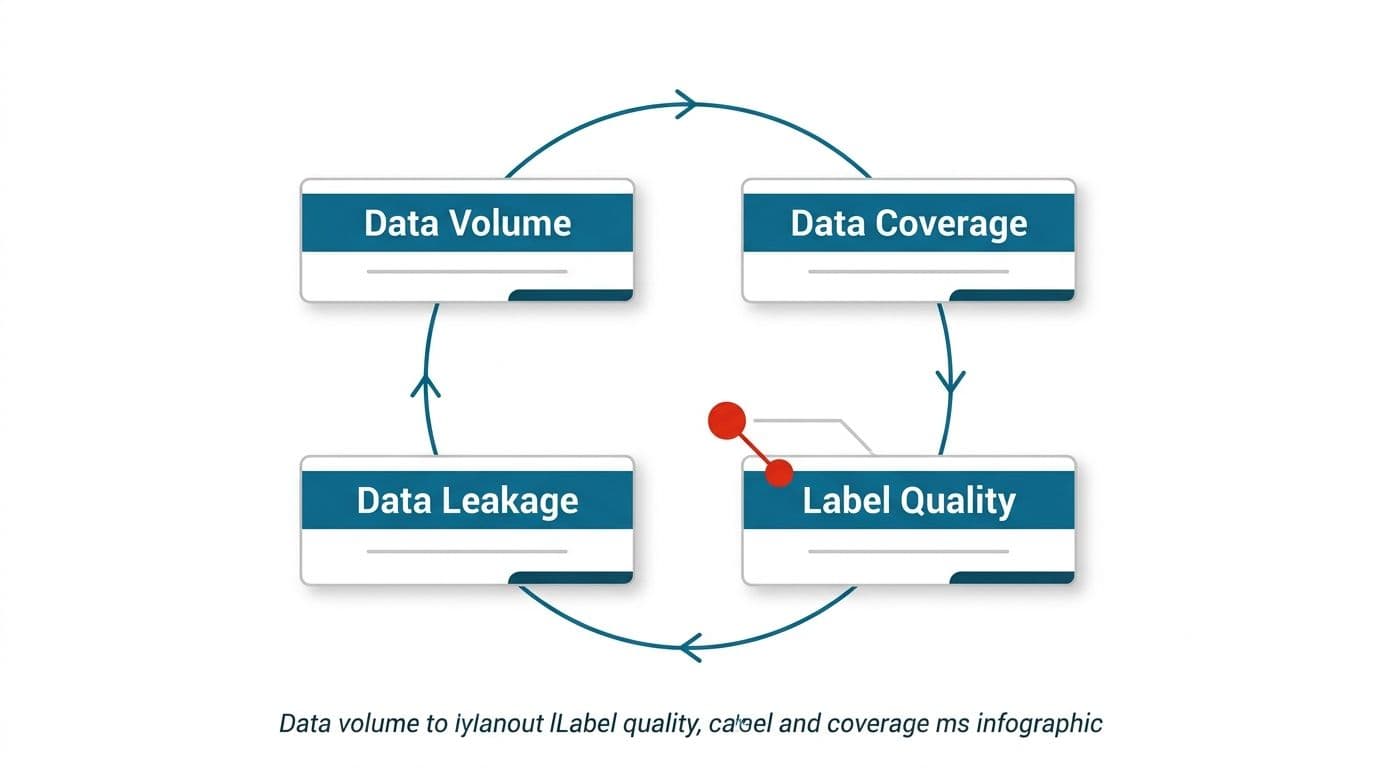
Volume. How many historical examples do you have where you know both the inputs and the outcome? For a price prediction with a handful of features, a few thousand clean records can produce something usable, but for a model with forty features and regional variation, that same few thousand records will overfit and look brilliant in testing before falling apart in production.
Coverage. Eleven thousand car sales sounds fine until you find that nine thousand are hatchbacks under five years old. The model will predict those well and guess wildly on anything else. Coverage gaps are the most frequent reason a demo model embarrasses someone in front of investors.
Label quality. The outcome column has to be the real outcome. Listed price is not sale price. Invoice amount is not amount collected. We've seen teams train on the wrong column for weeks because the field name sounded right.
Leakage. If a column in your training data would not exist at prediction time, the model will use it and score beautifully in testing. A "days to sell" field in a price model is leakage, and so is a "final discount applied" field.
We run this check in the first week, before anyone commits to a model architecture. Sometimes it ends the project early, and that is a cheaper outcome than finding out in month five. If your data doesn't support the prediction yet, the useful work is a collection path so that in six months it does.
Building an AI Vehicle Valuation Platform: How the Prototype Comes Together
Take the car marketplace as a worked example. Here's the shape of the build.
Week one went to data. We pulled the sales history, checked distribution across make, model, year band and region, and found the coverage gap mentioned earlier. The fix was straightforward: restrict version one to the three vehicle categories with enough history, and return "not enough data for this vehicle" for everything else. An honest gap beats a confident wrong number.
Weeks two and three went to the model itself. Gradient boosted trees, not a neural network, because with structured tabular data and under a hundred thousand rows, trees usually win. They're also far easier to explain when a seller asks why their car was valued low. Feature work mattered more than algorithm choice. Mileage per year of age carried more signal than raw mileage, and month of listing captured seasonal demand.
Week four wired it into the product. A prediction endpoint, a valuation widget on the listing form, and a logging table that records every prediction alongside what the car eventually sold for. That logging table is the part most teams skip, and it's what turns an ai vehicle valuation platform from a one-off model into something that improves.
Weeks five and six went to measurement in the live product, with real sellers, against real outcomes. Median error landed in a range the founder could show investors, and more valuable than that: he knew exactly which vehicle types the model handled badly, which told him what data to buy next.
Build or Buy: When Off-the-Shelf Is the Right Call
We will tell you when you don't need to build. It happens more often than you'd expect, and saying so early costs us a project but keeps the relationship.
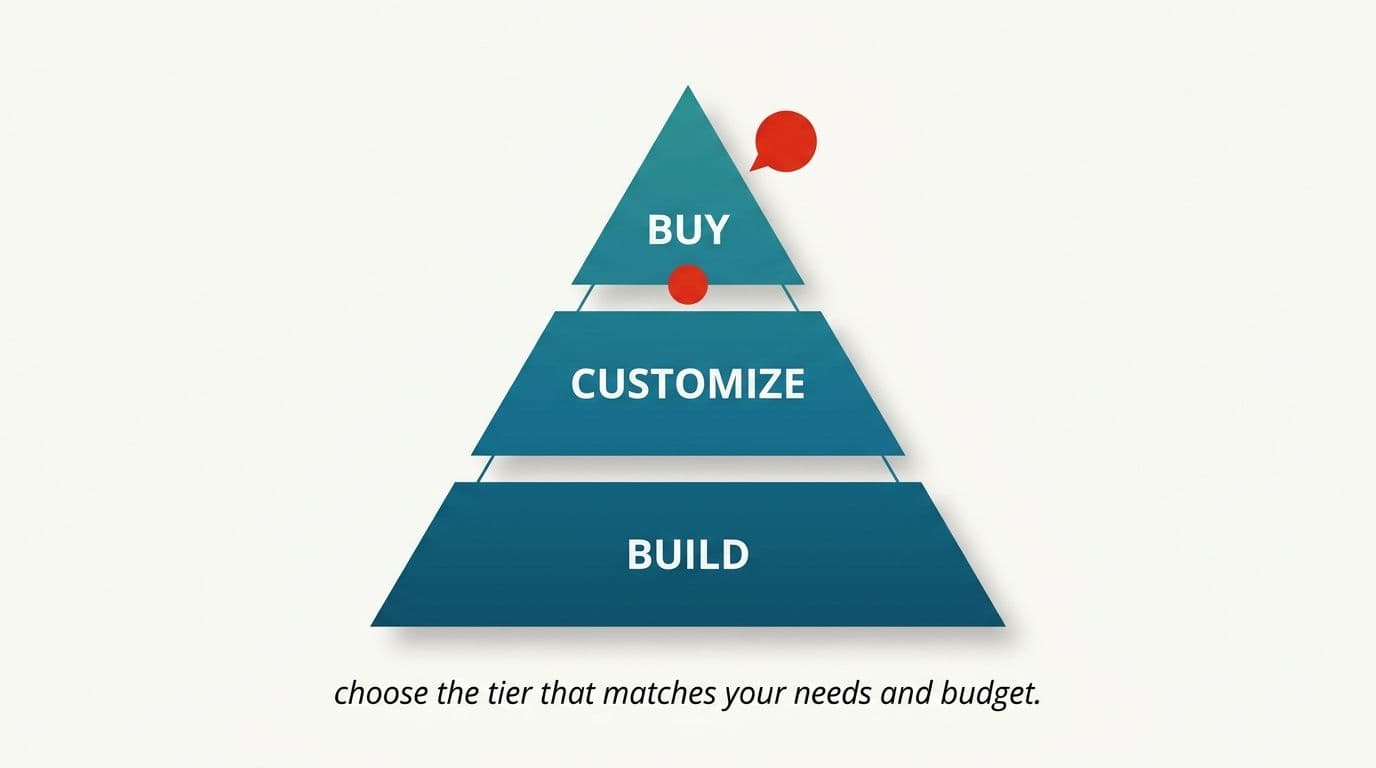
Buy when the prediction is generic and someone else has far more data than you ever will. Standard credit scoring or broad demand forecasting for well-tracked commodities are good examples. Commercial APIs exist, they're trained on volumes a startup can't match, and a wrapper around one of them will outperform anything you train in-house for months. We build those wrappers as a thin, owned layer over third-party model APIs so you keep your keys and can switch providers later.
Build when one of three things is true. Your data captures something the generic provider can't see, like your own platform's behavioral signals. Your market is one those providers cover poorly, which is common in the Middle East and parts of South Asia where vehicle and property histories are thinner. Or the prediction is the product, and renting it means renting your core value.
The middle path works too. Start with a bought API to prove users want the feature, log every request and outcome, and build your own model once you have enough proprietary history to beat it. That sequence has saved founders we've worked with six figures of model development they would have written off.
The real question isn't which option is better. It's whether the prediction you need differs from the prediction a vendor already sells.
How We Scope a Predictive Prototype in Weeks, Not Quarters
Scoping starts with the decision the prediction changes, not the model, and not the stack.
If a seller sees a valuation and lists at that price, the decision is "what price do I set?" That tells us the prediction needs to be a point estimate with a range, needs to return in under a second, and needs a fallback when confidence is low. Three design constraints, derived from one sentence.
We then name a fixed price before work starts. That's possible because the scope is bounded by that single decision. Open-ended discovery phases exist because nobody defined what finished means, and the cost of that ambiguity lands on you.
A typical six-week predictive MVP breaks down roughly as: one week on data assessment, two to three weeks on model and feature work, one week on integration into your existing product, one week on live measurement. You get working software in month one, not a specification document.
Two things we insist on. You own the code, the cloud accounts and the API keys from day one, so nothing we build holds your product hostage. Our builders also talk to you directly, with no account manager translating between your engineers and ours.
Hitasoft has been building these systems with a team based in Madurai, serving clients across multiple countries. The teams who travel to clients are the ones who wrote the code. For a detailed look at the full prototyping approach, see our custom AI MVP development and prototyping work.
What Accuracy Means, and Who Checks the Output
Accuracy is the word that causes the most trouble in predictive projects, because founders and data scientists mean different things by it.
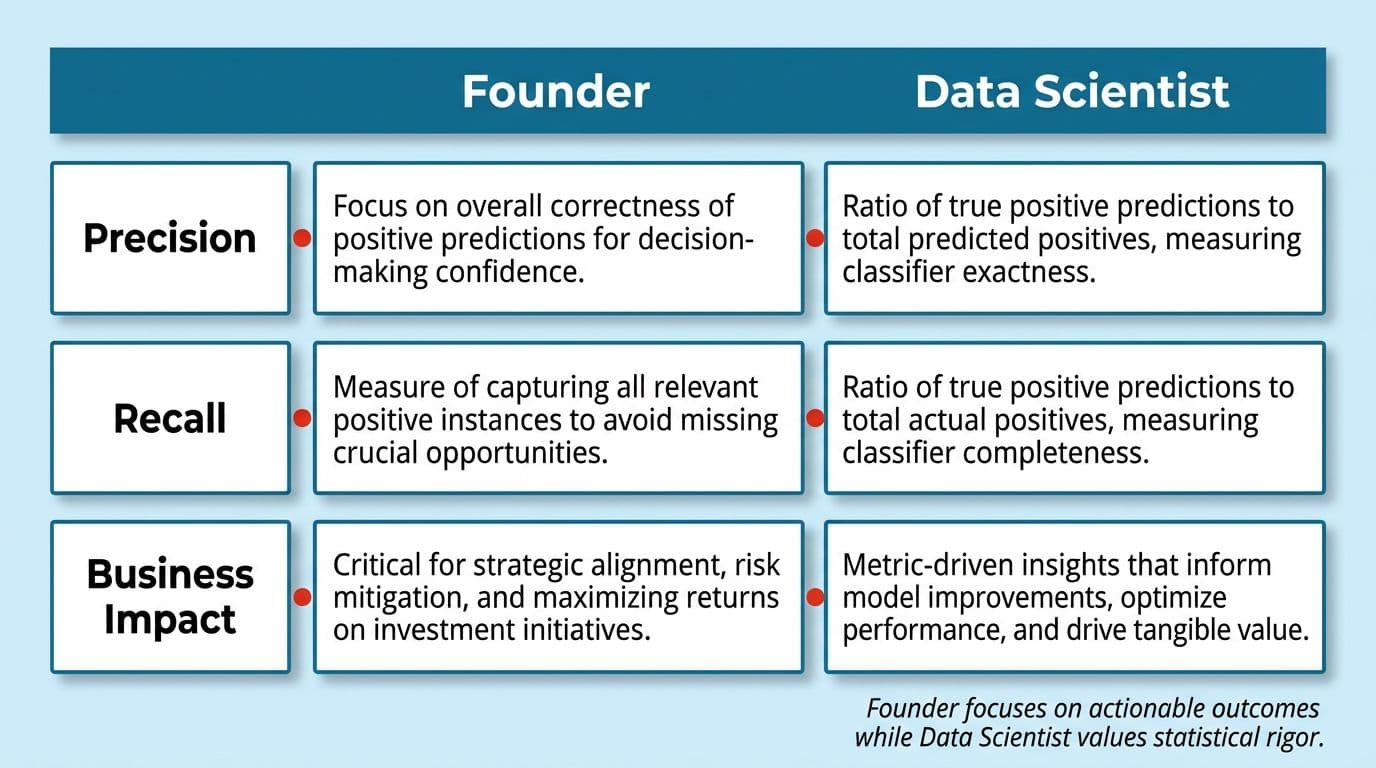
A classification model reporting 94 percent accuracy on a dataset where 94 percent of cases are one class has learned nothing. For a price model, the metric that matters is usually median absolute percentage error, and the distribution of that error matters more than the average. A model that's within 5 percent on most cars and 60 percent off on a few will generate more angry support tickets than a model that's consistently 12 percent off.
We don't promise a specific accuracy figure before seeing your data, and we'd be cautious of anyone who does. What we commit to is measuring honestly against held-out data and telling you where the model fails.
Then there's the human layer. Any prediction that touches money or a customer gets a person or a code rule in the path before it acts. For a vehicle valuation shown as guidance, the seller is that check. For a prediction that triggers a payout, a credit limit or a clinical flag, a named human approves it. That isn't a limitation of current models. It's how you keep a bad prediction from becoming a bad outcome, and it's the design we apply across every system we build, including AI workflow automation where predictions feed into processes that run without supervision.
Confidence scores help. A model that says "I'm unsure about this one" and routes it to a human handles the long tail far better than one that guesses with equal certainty every time.
Keeping Sensitive Data Inside Your Own Infrastructure
Fintech and healthcare founders ask the same question early: does our data leave our control, and will a vendor train on it?
On enterprise endpoints from the major providers, with retention disabled, inputs are not used to train their models. That's a contractual setting, not a courtesy, and we configure it as standard. But a contract isn't the same as data never leaving your boundary, and for some records the difference matters.
When it does, the model runs inside your infrastructure. For structured prediction work like valuation or forecasting, this is easier than people assume. A gradient boosting model is a few megabytes and runs on an ordinary server, so your training data never touches an external API at all. Where a language model is genuinely needed, private LLM fine-tuning and secure hosting keeps weights and prompts on hardware you control.
We don't make absolute security guarantees. No one honestly can. What we can describe is the architecture, including where data sits, which services touch it, what's logged, and who has access. That description is what your compliance reviewer actually needs, and we've built it for teams working under HIPAA expectations and GDPR requirements. We integrated a health platform with India's national ABDM system under exactly that scrutiny.
If your records can't leave the building, say so in the first conversation. It changes the architecture, not the timeline, as long as it's known upfront. Retrofitting a private deployment onto a cloud-first build is the expensive version. Secure AI and compliance architecture is the cheaper version when it comes first.
What a Predictive Analytics MVP Costs
We publish numbers rather than requiring a sales call to get one.
A bounded predictive prototype, meaning one model, one integration point and live measurement, generally runs as a fixed-price engagement in the range most founders budget for a single senior developer quarter. The exact figure depends on the data assessment, and we name it before work starts, not after discovery.
Running costs are the part people underestimate. For a tree-based model serving predictions from your own infrastructure, inference costs are effectively server time, and they barely move as usage grows. A thousand valuations a day and a hundred thousand a day cost close to the same on modest hardware. That's a real advantage of classical models over language models for structured prediction.
Where costs do scale with usage is any feature calling a hosted language model per request. If your ai vehicle valuation platform also generates a written explanation of each valuation, that explanation has a per-call price attached. We model that cost per transaction during scoping so you see it before launch rather than in month three's invoice, and caching repeated patterns and routing simple cases to cheaper models usually cuts that figure substantially.
Retraining is the third line. Budget for it quarterly at first. Markets shift, your data grows, and a model trained on last year's prices drifts. Retraining an established pipeline is a small job. Not having a pipeline makes it a rebuild.
Signs You Shouldn't Build This Yet
Some projects should wait, and the signals are usually visible in the first conversation.
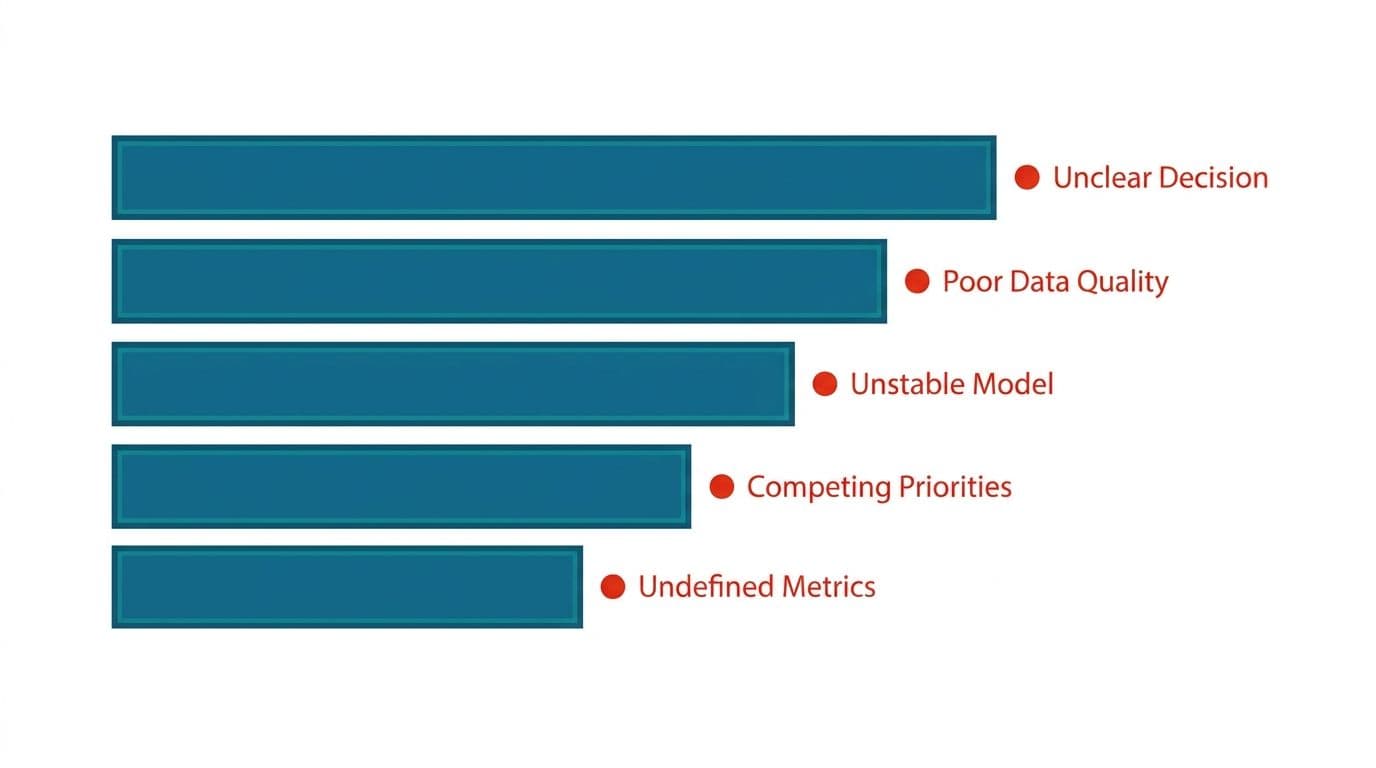
You have fewer than a thousand labeled historical examples and no path to collecting more quickly. Train on that and you'll get a model that memorizes your data rather than learning from it.
Your outcome column is inconsistent. If sale price means three different things depending on which team entered the row, fix the data definition before modeling, since we've seen teams spend more on cleanup than the model cost.
Nobody has defined what decision the prediction changes. If the answer is "it'll be worthwhile for the dashboard," the feature will ship and nobody will use it. Months lost building what nobody asked for is the most expensive failure in this category, and it's avoidable with one scoping conversation.
A vendor already sells the exact prediction, in your market, at a price you can absorb. Start there, prove demand with their API, and build your own when your data gives you an edge theirs doesn't.
Your actual problem is manual work, not prediction. A finance lead reconciling four entities by hand usually needs document processing and OCR rather than a forecasting model. The prediction is interesting. The retyping is what's costing you the week.
Your Next Step
Start with the data assessment, whoever runs it. Pull your historical records, check volume, coverage, label quality and leakage, and write down the single decision a prediction would change. If those four checks pass and the decision is clear, a predictive prototype is a weeks-long piece of work with a known price at the end of it.
If you'd rather have someone else run that check, we do it as part of a free automation audit. We'll look at your data, tell you whether ai predictive analytics services make sense for your case, and say plainly if the answer is no.
Book a free automation audit and we'll come back with a scope and a fixed price, or start a prototype if you already know what you're building. You can also see how we work before committing to anything.
Wondering what this would take against your own systems?
The audit costs nothing, and you keep the costed plan and the risks whether you go ahead or not.
Book a free automation auditHitasoft
LinkedInHitasoft has built software since 2008, for companies that mostly do not have an IT department. These pieces are written by the people who do the integrations rather than by anybody in marketing.