
It's the fourth working day of the month. Your controller has three entities to close. Two bank feeds export in different date formats. A payment processor's settlement file groups refunds differently from the ledger, and a spreadsheet called recon_final_v4 nobody wants to own sits open on three screens. The software to fix this exists, and several hundred vendors say so. Every demo ends the same way though, it handles most of what you do, and the remaining sliver is the part that actually costs you the weekend.
That gap is the whole argument in build vs buy finance automation platforms. Not features on a grid. The small remainder.
Here is our position up front, and we build custom software for a living, so read it with that in mind. Most finance teams should buy the core and build only the thin layer that is genuinely theirs. Building everything is slow and costly to keep alive. Buying everything leaves you with workarounds that calcify into a second, undocumented system. The useful question isn't which side wins. It's where the line sits for your business, and this article is about finding that line.
Build vs Buy Finance Automation Platforms: The Short Verdict
Buy the parts of finance automation that every company does the same way. Build the parts where your business logic is the product.
Bank feed ingestion, OCR on supplier invoices, and approval chains are solved problems already. Paying a vendor is cheaper than paying your engineers to rebuild them, and the vendor will also keep up with format changes you'd otherwise chase yourself.
Build where the rules are yours. Multi-entity intercompany matching with your specific tolerance rules sits in this category. So does settlement reconciliation against a processor that reports in a shape nobody else uses. Risk scoring that reflects how your customers actually behave belongs here too. A compliance trail that proves which field from which file version produced a given posting is yours alone to own. No vendor will model your edge cases as carefully as you need them modeled, because your edge cases are not their roadmap.
What makes this a real decision rather than a shrug is cost of ownership over time. A bought tool costs money. A built tool costs attention. Attention is the scarcer resource in a finance team of nine or an engineering team of six, and that's the frame we'll use for the rest of this finance automation platform comparison.
What You Are Actually Choosing Between
Three options, not two. Naming them properly makes the rest of the comparison easier.
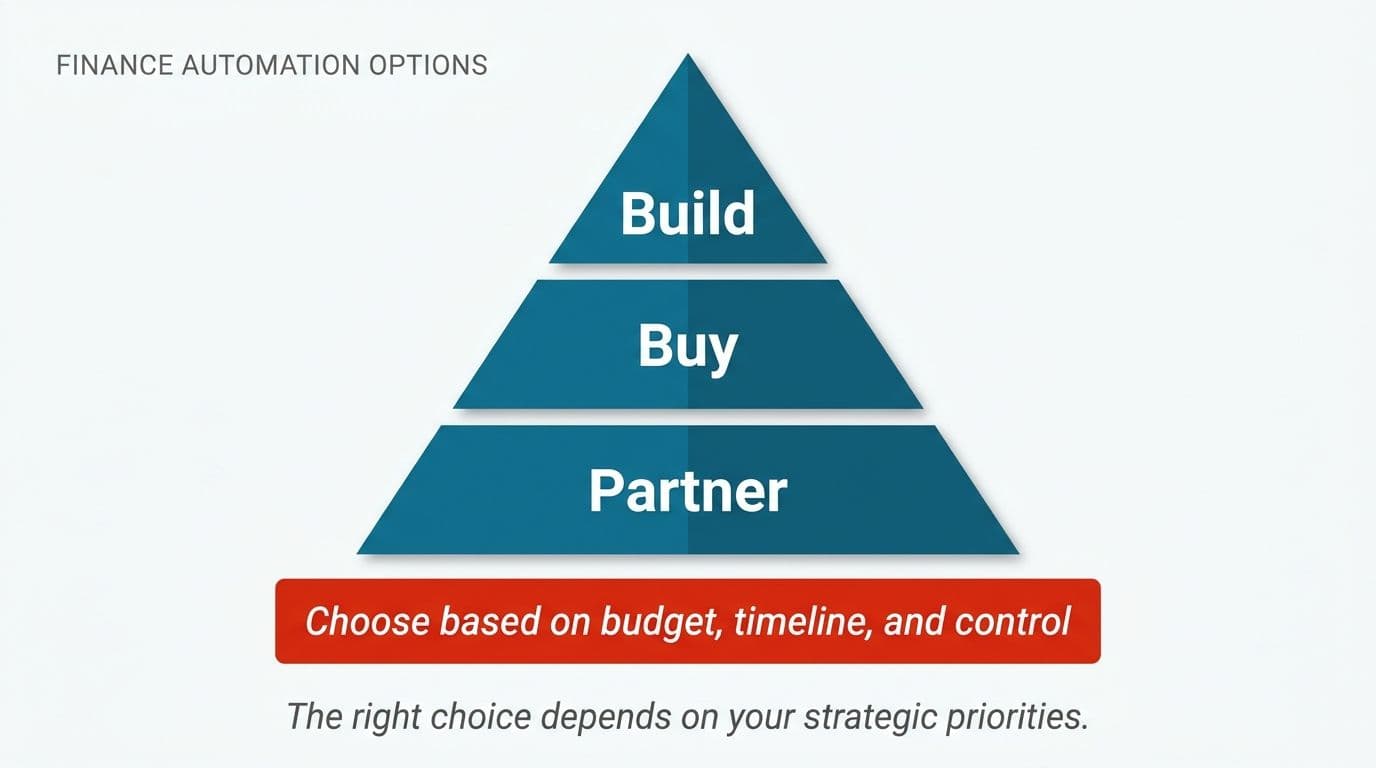
Custom build with an engineering partner. You specify the workflow. Someone builds it against your systems, and you own the repository, the cloud accounts, and the API keys at the end. That's how we work at Hitasoft, with a fixed price named before anything starts and working software in month one rather than a discovery phase that bills for a quarter. Our financial and data automation work usually starts with one painful process, not a platform.
Off-the-shelf SaaS platform. You subscribe, connect your accounts, and configure within the limits of the configuration screens. Deployment is faster and ongoing management is lighter, and that's a real advantage we won't pretend otherwise.
Hybrid. The platform handles the common path. Custom services handle matching logic, audit records, exception routing, or whatever the platform can't reach. The two talk over APIs and a shared data store you control.
The thing worth noticing in the current market is that buyers increasingly want the third option without having to assemble it themselves. Teams are asking vendors for the ability to build their own agents and rules inside the platform rather than accepting only what ships prebuilt. That demand exists because configuration screens run out before business complexity does.
Every path below gets judged on the same points. Price, features, control, and who it suits. In a custom finance automation vs off-the-shelf debate, those four cover almost everything that matters.
Price: How to Put a Real Number on Developer Labor and ROI
Most build estimates are wrong because they count the build and ignore the decade after it.
Do the arithmetic properly. Take the fully loaded cost of an engineer in your market, including payroll taxes, tooling, and management overhead. Multiply by the number of engineer-months the build will take, then add a maintenance tail. Teams routinely discover they spend more hours keeping infrastructure alive than adding anything a customer would notice.
Against that, put the SaaS number. Subscription, implementation fee, and per-user seats stack up fast, and overage charges plus internal configuration time add more on top.
Then the part most spreadsheets miss: the cost of the workaround. If a bought platform covers most cases and two people spend multiple days a month on the remainder, price those days. Over three years, manual handling of the leftover often exceeds the subscription itself.
ROI for finance automation isn't usually headcount removed. It's close cycle shortened, errors caught before they reach a regulator or a customer, and senior finance time returned to work that needs judgment. Those are quantifiable if you measure the before state for one month before you buy anything. We tell clients to do that first, even when it delays the project.
Features Side by Side: Where Off-the-Shelf Finance Software Limitations Show Up
A feature grid flatters bought software, because grids ask whether a capability exists, not whether it fits.
Here's where the off-the-shelf finance software limitations tend to appear in practice, in rough order of how often they bite:
- Matching rules that stop one condition short. The platform matches on amount, date, and reference. Your settlements need amount within a tolerance, date within a window that shifts around weekends and holidays, plus a merchant identifier that only exists in a secondary file.
- Multi-entity structures. Intercompany eliminations, mixed functional currencies, and entities on different closing calendars are where generic tools get thin fast.
- Exception handling. Flagging a break is easy. Routing it to the right person with enough context to resolve it, tracking the resolution, and feeding that decision back into the rules is where products differ enormously.
- Writing back. Plenty of tools read your systems well and write to them poorly or not at all.
- Reporting at the field level. Summary dashboards are standard. Tracing one number back to one row of one source file often isn't.
Custom build inverts this list. You get exactly the matching logic you specify and nothing you didn't ask for, which means your first version will miss things the mature platform handles by default. That's the honest trade in custom finance automation vs off-the-shelf. Precision where you aimed, gaps where you didn't.
Document handling is a good example of where buying usually wins. Extracting line items from supplier invoices is a well-worn problem. Our invoice and document extraction service exists mainly for the cases where format variety or language coverage defeats the standard tools.
Audit Logging and Traceability: The Gap That Decides Regulated Builds
For a regulated finance business, this section matters more than price.
The requirement sounds simple. For any figure in any report, you need to show which source system it came from, which field within that source, and which version of that input applied. You also need the rule that fired, who approved it, and when. If the rule changed last quarter, you need to prove which version of the rule ran against which version of the data.
General-purpose automation tools are weak here, and it's a structural weakness rather than an oversight. They log actions for support and debugging. They weren't designed to produce immutable evidence for an examiner. You'll often find the event log is retained for a fixed window, exportable only as a flat file, and silent about input versions altogether. When an auditor asks a question that spans two years, you're reconstructing history from backups.
This is one of the clearest reasons to build. An owned audit layer can write append-only records at the field level, keep them for as long as your obligations require, and store them inside your boundary. We treat this as architecture work rather than logging, which is why it sits under secure AI and compliance architecture in how we structure projects.
One caution we give every client: we can build the trail and the controls. We can't promise an examiner or a certification body will accept your overall program. That decision stays with them, and anyone telling you otherwise is selling.
API Rate Limits and Scaling Costs Nobody Models at Signup
The pilot runs on last month's data for one entity and everything is fast. Then you connect all entities, three years of history, and a nightly sync, and the picture changes.
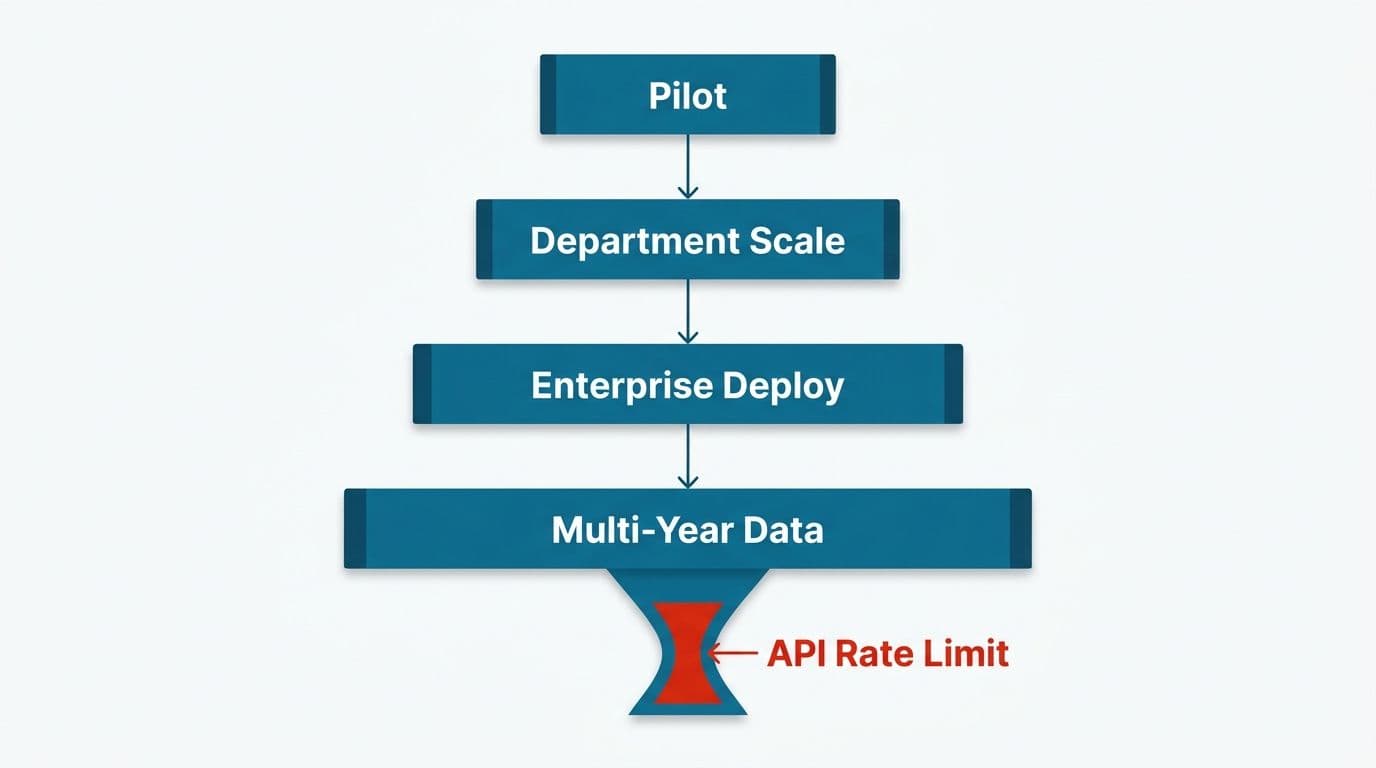
Rate limits are the first surprise. Accounting systems, banking APIs, and payment processors all cap requests, often per minute and per day, sometimes per connected company rather than per account. A backfill that looked like an afternoon becomes a week of throttled batches.
The second surprise is pricing that scales on a dimension you don't control. Per transaction, per document page, or per API call, pick any of these and the bill moves with your business. Finance volume grows with the business, which means the line item grows with the business, usually faster than the team that manages it.
For AI-assisted steps, model spend behaves the same way and clients are right to ask whether it keeps climbing. It does if you send every document to the largest model and never measure. We design pipelines this way by default, and we'd rather tell you the shape of the bill before the build than after.
Build has its own scaling cost. Queues, retries, idempotency, and backpressure all have to be engineered, but you can see the ceiling and raise it yourself.
Break-Even: A Framework for Volume-Based SaaS Pricing
Teams ask for a formula and there isn't a clean one. There is a workable method.
Start with three inputs. Your current monthly volume on the specific workflow, your expected volume in twenty-four months, and the vendor's unit price at both levels including any tier changes. Multiply out the twenty-four month subscription total. Add internal configuration and administration time at your loaded rate.
Then estimate the build. Not the whole platform, just the workflow you're comparing. Add the annual maintenance tail, and add a contingency for the integrations you haven't inspected yet, because integration discovery is where estimates break.
Compare the two totals at the twenty-four month mark and again at forty-eight. If buying wins at both, buy and stop thinking about it. If building wins at twenty-four months, check your estimate again, because it rarely does.
One adjustment makes this honest: discount the build timeline benefit, since the bought tool is live next month and the build isn't.
That last point is the quiet reason volume pricing works so well for vendors. Leverage moves with the data.
The Edge Case Backlog That Never Stops Growing
Every custom finance system accumulates a list. A customer who pays three invoices with one wire and references none of them. A refund that crosses a period boundary. A subsidiary that posts in a currency the parent doesn't trade.
Each one is small. Each one takes a developer a day or two. The list never empties, because the list is a function of how numerous customers, suppliers, and jurisdictions you have, and all three keep growing.
What people usually do is treat the backlog as a transitional phase. They assume it shrinks after year one. New edge cases arrive at roughly the rate the business adds complexity, and old ones return when upstream systems change.
What fails about that assumption is capacity planning. A team sizes the build team for the build, then disbands it.
What works is designing for exceptions as a first-class feature rather than a bug queue. Route unmatched items to a human with the context attached, let the resolver record the reason, and turn repeated reasons into rules on a scheduled cadence. Treat the exception rate as a tracked metric that someone is accountable for. In any reconciliation automation software, bought or built, a residual human review step stays permanent. Anything touching money gets approved by a person in the systems we build, and we won't design around that.
Silent Breaking Changes and Integration Drift
The failure mode that costs the most is the one that doesn't throw an error.
Your numbers quietly stop being right, and someone notices three weeks later during a review, and then you're reconciling the reconciliation.
Bought platforms absorb some of this for you, which is a genuine advantage and worth paying for. They also hide it, so when drift does reach you, you have no visibility into why and no ability to fix it on your schedule. You file a ticket and wait.
We build this scaffolding into every custom API and AI integration project because the alternative is discovering drift through a customer complaint. It adds time to the first release, and it removes a category of failure that is extremely expensive to detect late.
Data Residency, Private Deployment, and Security Inspection
Some finance data cannot leave a specific jurisdiction, a specific cloud region, or in a few cases a specific building. That constraint closes off a large part of the vendor market before features matter at all.

Three questions decide it. Where does the data physically rest, and can the vendor prove the region for every component including backups and logs? Who can inspect the processing, and can your security team review the architecture rather than accept an attestation? What happens to data sent to AI models?
On the last one, the straight answer: on enterprise endpoints with zero-retention configured, prompts and documents are not used to train the provider's models. That's contractual and verifiable. It's also not sufficient on its own for every regulator, which is why private LLM fine-tuning and secure hosting exists as an option. Models run inside your boundary, your data never crosses it, and you can hand an auditor the network diagram.
We won't make absolute security claims. No architecture is breach-proof and nobody honest says otherwise. What we will say is that private deployment changes the question from trusting a vendor's controls to inspecting your own, and for compliance-bound product owners that distinction is usually the whole decision.
For teams working across many regions, residency is also where a finance automation platform comparison narrows quickly. Many strong products simply don't operate in the region you need.
Domain-Driven Design Applied to the Build vs Buy Software Decision
Here's the framing we find most valuable, borrowed from software architecture and applied to purchasing.
Split your finance operation into three kinds of capability. Core domain is what makes your business different and is why customers pick you. Supporting domain matters to you but doesn't differentiate. Generic domain is the same everywhere.
Build the core. Buy the generic. For supporting, buy if something fits well and build only when the fit is bad enough to hurt.
For a payments company, the settlement and fee logic is core, so it gets built. For a lender, the arrears and provisioning rules are core. For most companies, accounts payable approval routing is supporting, and payroll calculation is firmly generic and should never be built by anyone.
That failure is worth naming clearly, because it's the hidden cost in any build vs buy software decision. Heavy customization of a bought product isn't a middle path. It's a build with none of the ownership and all of the maintenance.
Who Each Option Suits
The right answer changes with the situation, so here it is by reader.
Fintech founder, pre-revenue or early. Buy almost everything, because your engineers should be on the product your customers pay for. The exception is anything that is your differentiator, which usually means your core ledger logic or your risk engine. Good finance automation for fintech startups looks like a small amount of owned code surrounded by services you rent.
Finance lead or controller in an established business. Start with a bought reconciliation automation software product and measure your exception rate for three months. If the leftover is small and stable, you're done. If it's large or growing, build the matching layer and keep the platform for ingestion and reporting.
SMB operations manager. Buy. Nearly always.
Compliance-bound product owner. Build or deploy privately, because residency and traceability requirements will eliminate most vendors before you get to feature evaluation.
Multi-entity group with messy intercompany flows. Hybrid, reliably. No vendor models your group structure, and no sensible team builds bank connectors from scratch.
Our work across fintech and finance platforms spans all five of these, and the pattern holds. The smaller the compliance surface, the stronger the case for buying.
The Hybrid Build: Buy the Core, Build the Layer That Is Yours
In practice the hybrid looks like this, and it's more concrete than the word suggests.
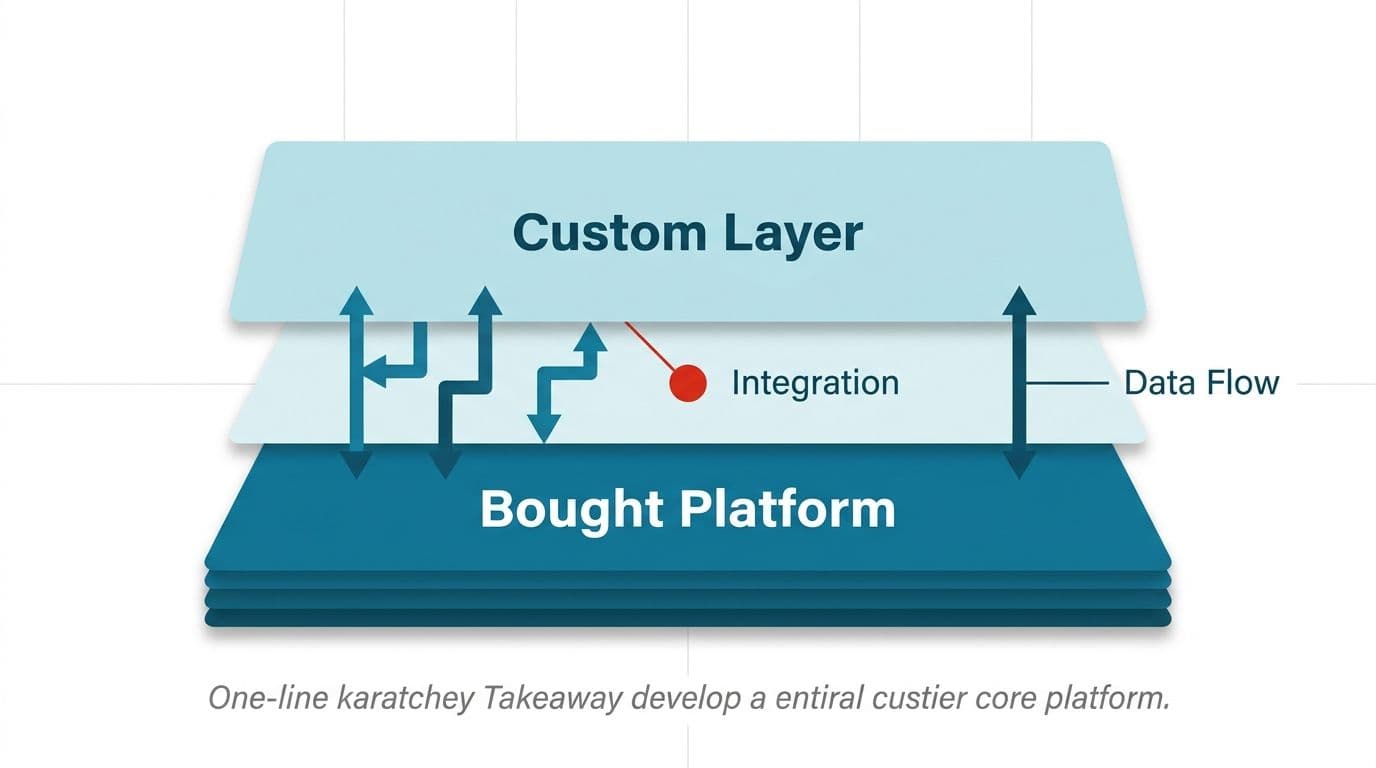
A platform ingests bank statements, card settlements, and ledger exports on a schedule and normalizes them into one shape. That's generic work with a mature market, so buy it.
A custom service sits beside it holding your matching rules, your tolerance bands, your entity hierarchy, and your period logic. It reads normalized data, applies your rules, writes matches back, and emits an append-only audit record for every decision. That's your core. Build it.
An exception queue routes one-of-a-kind items to named people with the source documents attached. It captures resolution reasons, and surfaces the recurring ones monthly so rules can absorb them. Where volume justifies it, autonomous AI agents handle first-pass triage on the queue and a person approves anything that posts.
The discipline that makes this work is a shared data store you own, so the platform is replaceable. Connect through your own integration layer rather than point-to-point, keep normalized data in your database, and treat the vendor as an input rather than the system of record. Our workflow automation practice is organized around exactly this shape.
Scaling AI deployment fails most often when it's treated as a drop-in replacement for a person. The process itself has to be redesigned around what machines do reliably and what people must still decide.
When We'll Tell You Not to Build
We've told prospective clients to buy a product instead of hiring us, and we'd rather do that than take a project that won't pay for itself.
Signs you should not build: your volumes are modest and stable, your entity structure is uncomplicated, and your workflows match how most companies do it. Add standard compliance obligations and no tool that's failed you yet, and the case closes itself. In that situation a subscription and two days of configuration beats anything we could deliver, and the honest finance automation platform comparison ends there.
Signs you should not build yet: you haven't measured the current process, or you can't name the specific workflow that's broken. The request is "automate finance" rather than "match settlements to ledger entries across four entities." Vague scope is the most reliable predictor of a build that nobody asked for.
Signs you should build: a bought tool handles most of it and the remainder consumes multiple days of senior time every month. Your audit requirements exceed what any vendor exposes, or your data can't leave your infrastructure. Or the logic in question is the thing your customers actually buy.
For founders testing a concept before committing, there's a fourth path we'd point at first. A custom AI MVP built in weeks tells you whether the workflow is worth automating at all, for a fraction of a platform commitment. It typically covers one flow end to end, with real data, and either earns the full build or saves you from it.
What To Do Next
Pick one process, the one your team complains about most, and measure it for a month. Hours spent, exceptions handled, errors caught late, and who touched it.
Then price all three paths against that single process using the break-even method above. Not the whole finance function. One process. If buying wins, buy it and move to the next one. If the numbers are close, buy now and build the layer later, with your data model designed so that's possible.
Getting build vs buy finance automation platforms right is mostly a matter of being specific about which process you mean and honest about what the leftover costs you.
If you want a second opinion on where your line sits, book a free automation audit and we'll map the process with you. If we think you should buy something instead, we'll say so. You can also see how we work first, including fixed pricing named before anything starts and code, accounts, and keys that stay yours, or start a prototype if you'd rather test the idea than argue about it.
Wondering what this would take against your own systems?
The audit costs nothing, and you keep the costed plan and the risks whether you go ahead or not.
Book a free automation auditHitasoft
LinkedInHitasoft has built software since 2008, for companies that mostly do not have an IT department. These pieces are written by the people who do the integrations rather than by anybody in marketing.