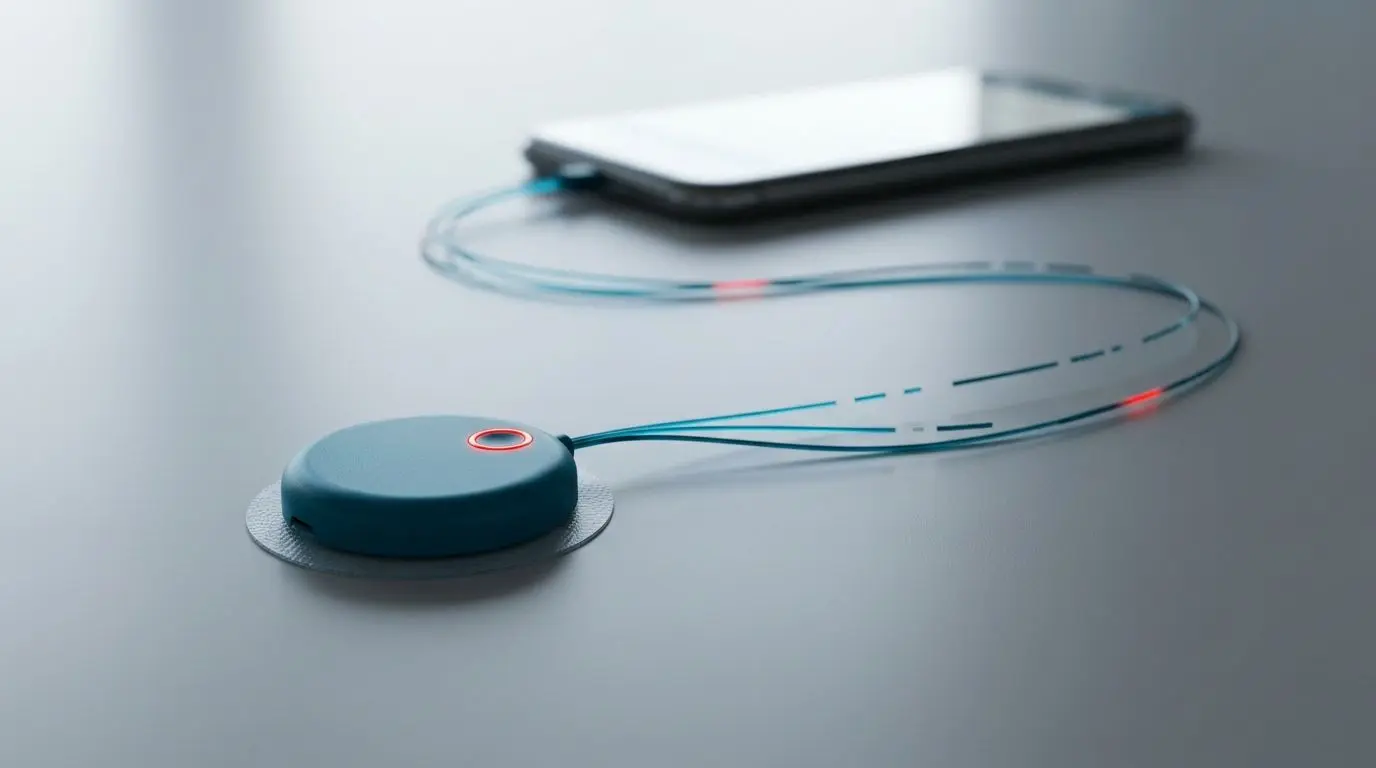
Continuous glucose monitors (CGMs) generate a steady stream of readings. That data doesn't magically appear in your app. It travels through a chain of sensors and APIs before it ever reaches your screen. In this article, we'll walk through how CGM data integration moves from the sensor on your body to the app in your hands. We'll show where CGM API integration fits into the picture.
The moment the assumptions break
The credentials work. Readings are landing in your staging environment. Someone on the team opens the payload and watches values tick in. They quietly assume what almost everyone assumes at this stage. They think a CGM feed is a live sensor stream, the kind of thing you hang a real-time alert on.
It isn't. The sooner your build understands that, the fewer features you'll have to walk back later.
Whether you'll actually be granted access, and on what terms, is its own subject. We cover it in the three decisions behind a diabetes app build. This post assumes access is settled. It looks at what arrives once it is. That means what the hardware produces, how much delay stacks up between the sensor and your server, and which features that delay rules out before you've written a line of code.
A good CGM api integration starts by respecting what the data is. Let's walk the path from filament to database.
What a CGM actually measures, and why the number is already old
A continuous glucose monitor doesn't touch blood. Under the adhesive sits a thin, flexible filament inserted just below the skin, resting in the interstitial fluid that surrounds your cells. Nothing is drawn. Nothing is sampled the way a fingerstick samples. The filament simply sits there and reacts.
In a common design, electrodes at the tip run a glucose oxidase reaction. Glucose and oxygen meet at the enzyme-coated surface. They produce a tiny electrical current proportional to glucose concentration. Measure the current, and you infer the number.
Here's the turn that matters for your product. Glucose reaches interstitial fluid only after it hits the bloodstream, since it has to diffuse out of the capillaries first. So the reading trails actual blood glucose before anything is transmitted, before any radio switches on, before your backend is even involved. This physiological lag is device-dependent, but it sets the baseline for your overall CGM integration latency before data ever leaves the body. And the gap widens when glucose is moving fast, so post-meal spikes and overnight lows, exactly the moments a user cares most, are when the trailing is largest.
Treat this as a product constraint, not a chemistry footnote. A CGM is a trend instrument. It tells you which way things are heading and roughly how far. It does not tell you where blood glucose is at this instant. Scope every feature to inherit that framing from the first sprint.
Inside the patch, and why you never see raw data
Peel back the adhesive conceptually and there's a small but complete electronics stack on it. The sensor interface, an analog front end, a converter, a microcontroller, a radio and a battery run it for the sensor's wear life.
The analog front end (AFE) exists because the current coming off those electrodes is minuscule. It's small enough to need a sensitive front end just to read it without drowning it in noise. The ADC turns that conditioned analog signal into a number. Then the microcontroller does the work that matters to you. It applies calibration and filtering.
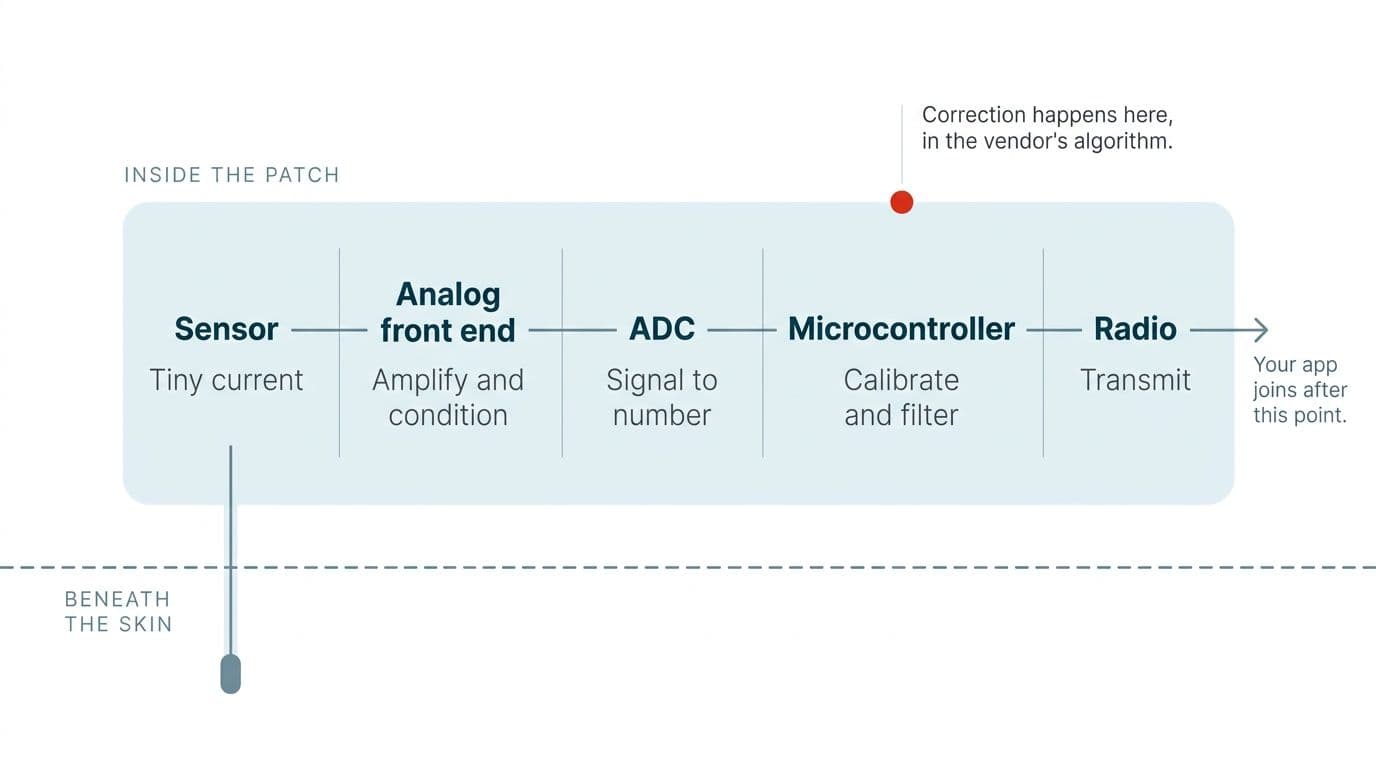
That processing step is doing a lot of correcting. The raw signal is pulled around by temperature, by the sensor ageing over its wear period, by enzyme degradation and by the specific tissue it happens to be sitting in. Manufacturing variance and chemical interference add to it. None of that is optional to correct for.
Here's the part that kills a whole category of engineering ambition. All of that correction happens on the device, inside the vendor's proprietary algorithm, before a single value leaves the patch. Your app receives a finished number.
That means you cannot improve the accuracy. You cannot recalibrate it. You cannot explain a disputed reading to a user beyond what the vendor's own documentation supports. Any accuracy claim in your product is inherited from the vendor, never earned by your code. Scope your marketing to match that limit.
The three paths glucose data can take
Before the delay discussion makes sense, you need to know which pipe the data comes through. Each pipe has its own latency and its own access rules. There are broadly three, and only two of them are realistically yours.
| Path | What it is | What you get |
|---|---|---|
| Direct BLE to the sensor | The vendor's own app pairing directly with the patch | Not realistically available to third parties. Proprietary, encrypted, bonded |
| Vendor cloud API | Readings uploaded by the vendor app, retrieved server-side | Delayed, batched, access-tiered |
| Platform health store | Apple Health / Health Connect, populated by the vendor app | Whatever the user has permitted, held on-device, with its own sync lag |
For most CGM data integration work, the vendor cloud API is the path you'll build on. Which of these you'll actually be granted, and on what commercial and eligibility terms, is the subject of our companion piece on scoping a glucose app, not this one. Start there before you lock a path into your roadmap.
⚠️ Vendor access models, data scopes and eligibility criteria change without much notice. Check each vendor's current developer documentation before you commit anything to a roadmap. What was a partner-only tier last year may be self-serve today, or gone.
Adding up the delay
This is the number nobody hands you, because it isn't a number. The delay between glucose entering the bloodstream and a value being usable is a stack of four additive components. You have to reason about all four.
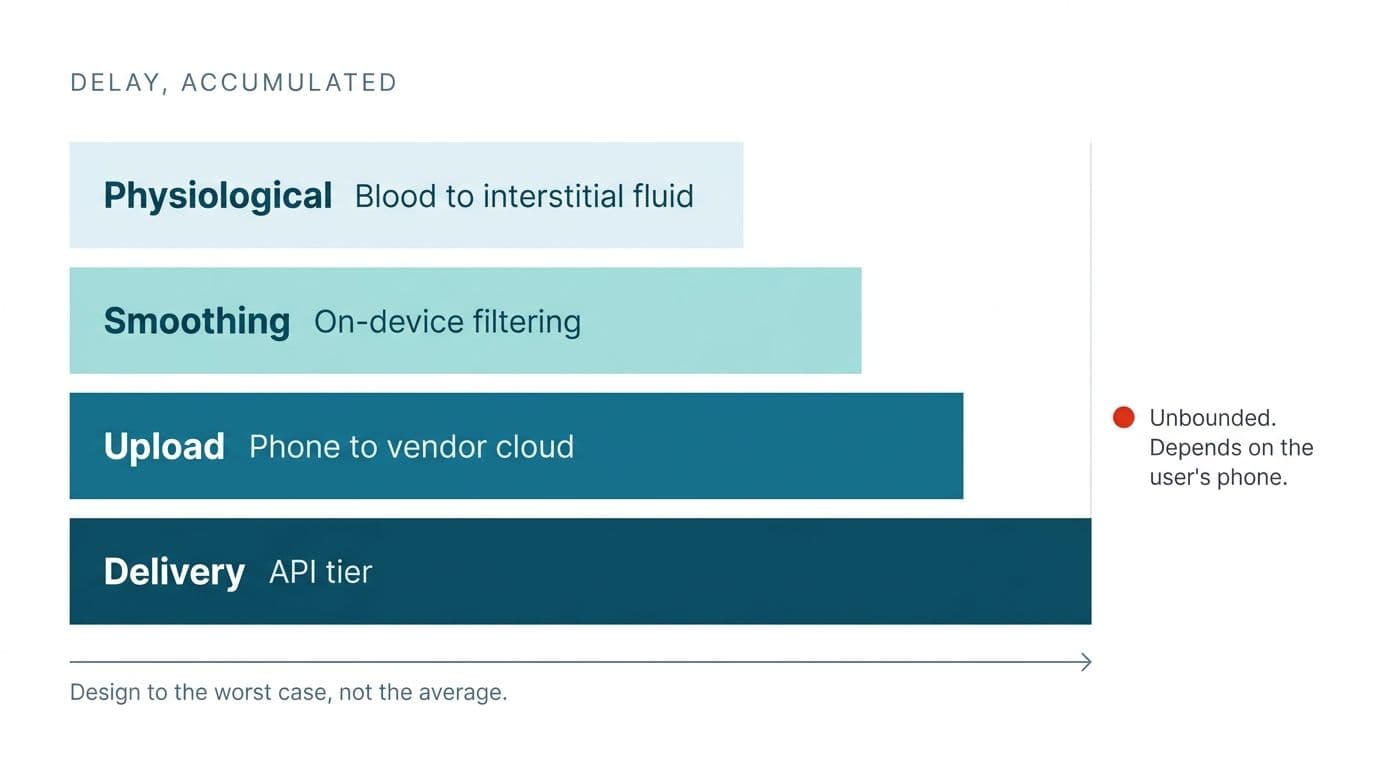
- Physiological. Blood to interstitial fluid, as covered above. Baked in, unavoidable, larger when glucose is moving fast.
- On-device. The smoothing and filtering the microcontroller applies before it will emit a value at all. Stability costs time.
- Upload. The vendor app batching readings up to the vendor cloud. This depends on the user's phone being powered, sufficiently active, and connected to a network.
- Delivery. The API tier you're on, which may impose a deliberate delay on top of everything above. A public tier commonly lags a partner tier.
Component three is the one that should keep you honest. It is under nobody's control, not yours, not the vendor's, not even the user's on purpose. If the phone is in a bag with no signal, nothing uploads. The moment it reconnects, everything arrives at once, in a burst, timestamped for when it was measured rather than when it landed. Your CGM integration latency is therefore not a fixed budget. It's a distribution with a very long tail.
So the question is not "how delayed is it." The right question is this. What is my worst case, and does my feature survive it? A feature that behaves correctly at five minutes and produces a dangerous result at three hours is not a feature that mostly works. It's a feature that fails, on a schedule you don't control.
Pick the worst case. Design to it. Treat anything faster as a bonus, never as the baseline.
⚠️ API delivery delays and reading upload cadence are tier-dependent and change over time. These are the most volatile figures in any CGM build. Confirm them against current vendor documentation rather than trusting a number from a blog post, including this one.
What the payload looks like when it lands
"A number arrives" undersells the integration surface badly. What lands is a small structured record. Most of its fields will bite you if you treat them casually.
Value and unit. Glucose comes in mg/dL or mmol/L depending on region. Store one canonical unit and convert only at display time. Getting this wrong is not a formatting bug. It's patient-safety-adjacent, because a number shown in the wrong unit is a number a user might act on.
Cadence. Readings arrive at a fixed interval that varies by device generation. Every charting and averaging assumption you make quietly depends on knowing that interval. Read it from the data, don't hardcode a guess.
Trend. The direction of travel arrives as an enumerated value, a defined set of arrows or states. It's not free text and not a slope you compute. Map the vendor's enum explicitly. Do not derive your own trend from consecutive values, because the vendor's version accounts for the smoothing that yours never will, and the two will disagree at exactly the wrong moments.
Timestamp. Device time, server time and the user's timezone are three different things. Travel and daylight saving break naive implementations that assume they're the same. Store UTC, plus the offset that was actually in effect when the reading was taken, so you can reconstruct local context later.
Sensor status. Warm-up, calibration-needed, expired and error states arrive alongside the readings. Surface them. A status you swallow becomes a chart that lies about why it's empty.
Five fields, and four of them cause bugs the moment you take them at face value. Map each one deliberately before you write your ingestion layer.
⚑ Confirm the exact trend enum values and reading intervals against the specific vendor and device generation you're targeting. They differ, and they change between hardware releases.
The gaps you have to design around
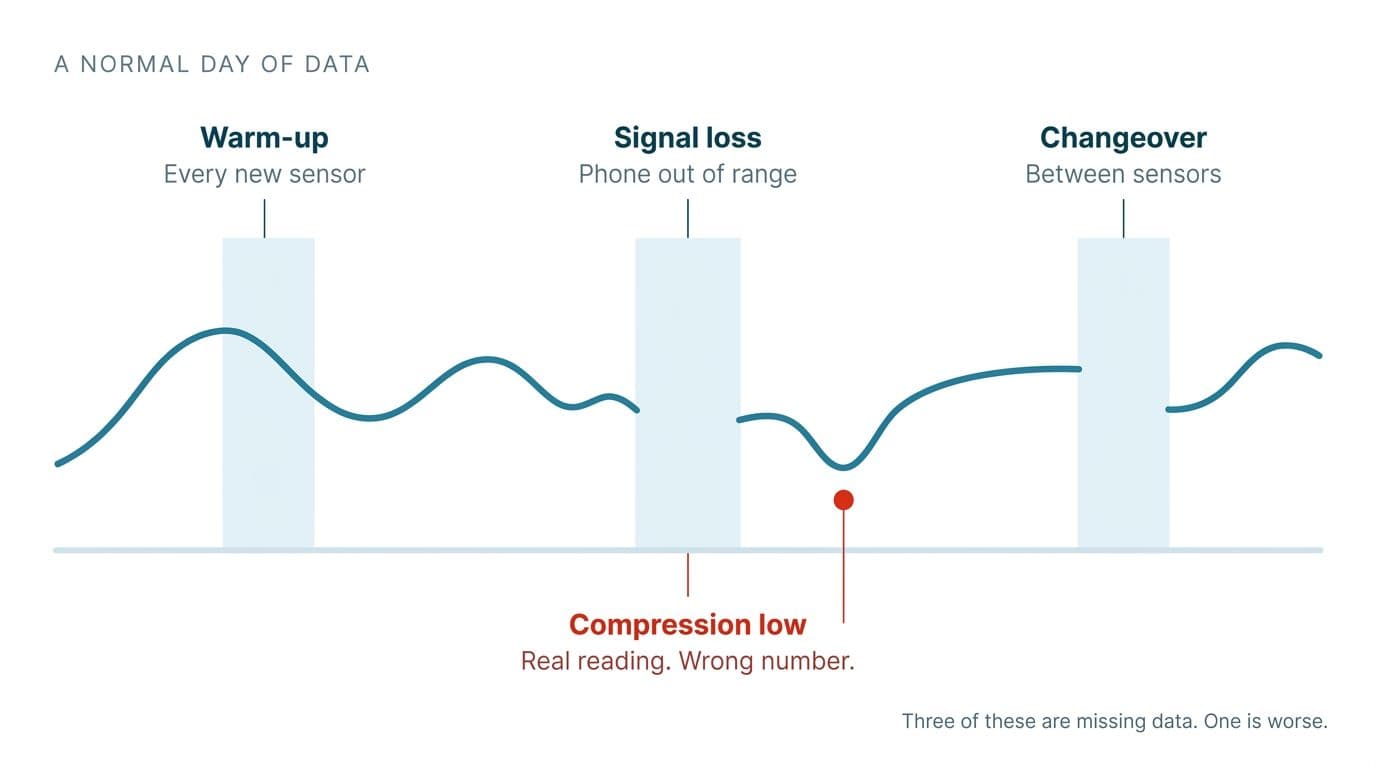
Missing data is not the exception in a CGM series. It is the normal, recurring, permanent state, and four distinct mechanisms produce it.
Warm-up. Every new sensor reports nothing for a period after insertion while it stabilises. This isn't a one-time onboarding event. It recurs on every single sensor change, on a fixed cycle, for as long as the user wears the product.
Signal loss. Phone out of range, Bluetooth off, app killed by the OS to reclaim memory, dead battery. Readings simply stop, then resume later and backfill in a burst.
Changeover. The window between one sensor expiring and the next finishing its warm-up. A predictable, regular hole in the timeline.
Compression lows. Lie on the sensor while sleeping and mechanical pressure produces a falsely low reading. The sensor is reporting honestly, but the number does not reflect blood glucose, and typically nothing flags it as suspect. Anything that alerts or scores on lows will fire on these, in the middle of the night, wrongly.
The consequences are where the design work lives:
- Averages must state their denominator. Don't silently divide by whatever happened to arrive. An average over 40% of the day is a different claim from an average over 95%, and the user deserves to know which one they're looking at.
- Time-in-range needs a data-sufficiency threshold. Below some coverage level, show nothing rather than a confidently wrong percentage.
- Streaks and engagement mechanics that punish gaps punish users for the sensor's behaviour, not their own. A user who did everything right during a warm-up window should not lose a streak for it.
- Charts need an explicit no-data rendering. Interpolating a smooth line across a gap invents readings that never existed, and users will read the invention as fact.
Build these four gap types into your schema before you touch the UI.
What the delay and the gaps rule out
Put the delay and the gaps together. A list of features you cannot build responsibly falls out. This is the part worth being blunt about.
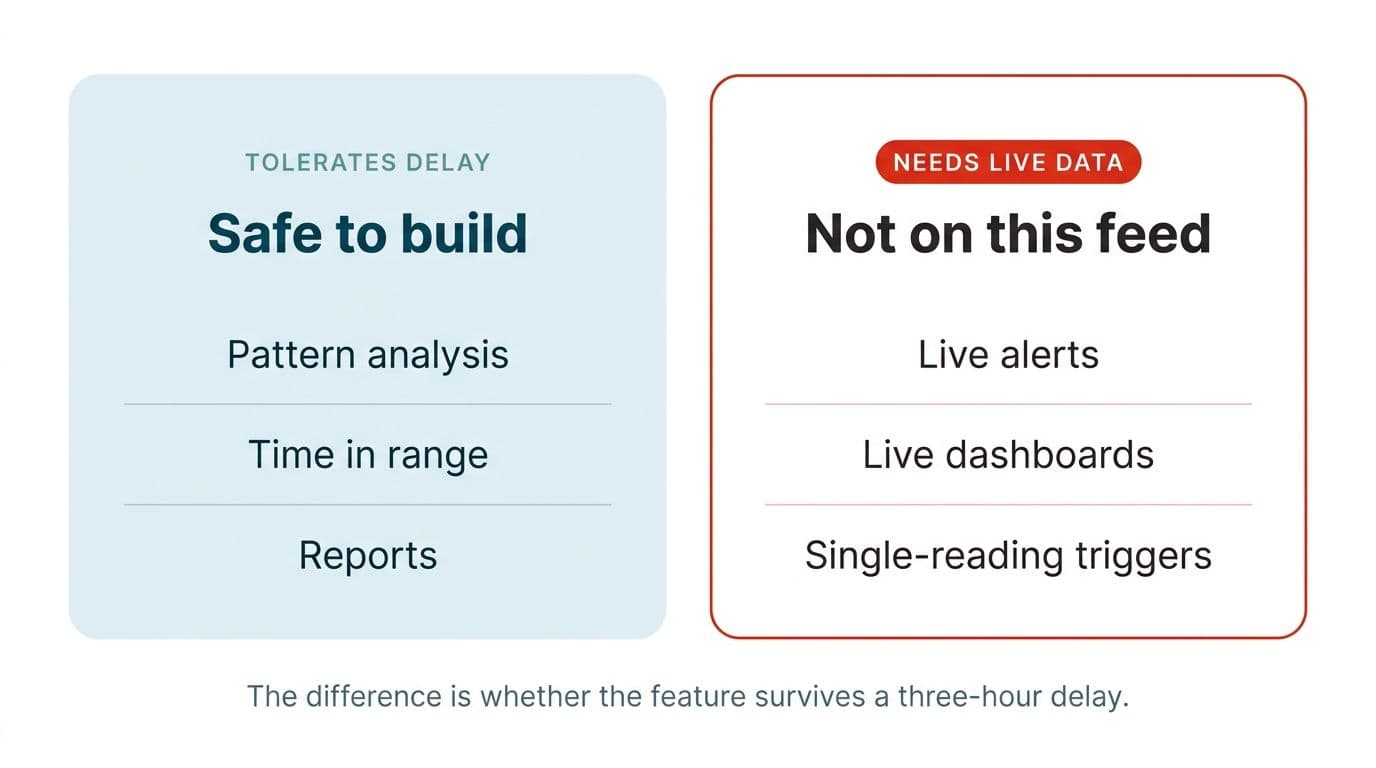
Real-time hypo alerting. If your feed is delayed, an alert you raise describes a state that may have already passed. The vendor's own app has direct BLE access to the sensor. You do not. Don't try to compete with it on immediacy. You will lose, and losing here is a safety problem, not a UX one.
Live dashboards. A clinician-facing view that implies current status while showing delayed data is a misleading interface, however good it looks in a demo.
Anything that triggers an action on a single reading. Compression lows alone make this unsafe. One bad number should never fire an irreversible action.
What you can build is substantial. It's where our healthcare and consulting practice spends most of its time. Think retrospective pattern analysis, time-in-range summaries and contextual correlation of glucose against food and sleep. Every one of these tolerates delay and gaps, because they operate on a window rather than a single moment. Start your roadmap from that list, not the forbidden one.
Dose calculation sits in its own regulated category and we make that case in full in the parent post. It's not something to bolt onto a first release.
What this means for your backend and your scope
CGM API integration means polling, not streaming, with idempotent backfill, out-of-order handling, revisable readings, and compliant health-data storage baked in from the start. Basic ingestion is sprint work; the hard parts are quarter work. Scope them early. Book an integration audit before surprises slip your timeline.
Wondering what this would take against your own systems?
The audit costs nothing, and you keep the costed plan and the risks whether you go ahead or not.
Book a free automation audit
Arun Andiselvam
LinkedInI am a startup veteran who has built five brands. I sold the first, an SEO tool, for a six figure exit, and now build AI automation products for businesses. I bootstrapped every one of them from day one.