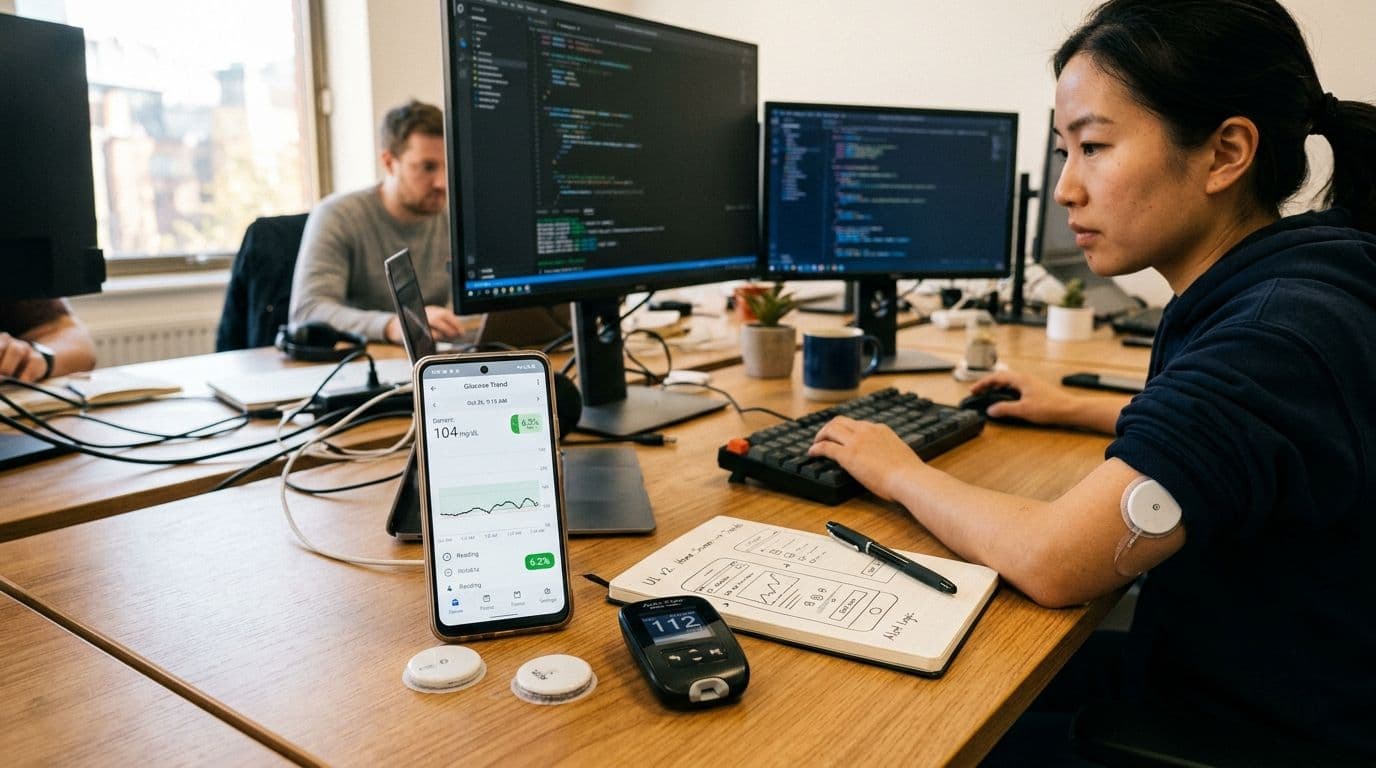
Most diabetes management app development briefs arrive looking like this. User onboarding, glucose tracking, insulin reminders, weekly reports, AI-powered insights, a secure backend, and CGM integration "through an official API/SDK if available." It is a sensible list. It describes a product a real person would use, and every item on it exists in shipping apps today.
It is also missing the three things that will actually determine whether your product ever ships.
Nothing on that list is wrong. But a feature list treats every item as equal engineering work, and in this category three of them are not engineering work at all. CGM access is a commercial partnership. A dose calculator is a regulatory programme. And "patient app versus platform" is an architecture decision you make before the first sprint, not a v2 upgrade. Get those three right and the feature list builds cleanly on top of them. Get them wrong and you spend a year rebuilding foundations. This article walks the ten features every mature app has, then the three decisions that sit underneath them.
Table stakes, the MVP that earns the right to exist
A multi-parameter logbook is the core. Not just glucose, but carbs, insulin, activity, and mood in one timeline. Users won't maintain two apps. So the logbook has to be the single place their day is recorded.
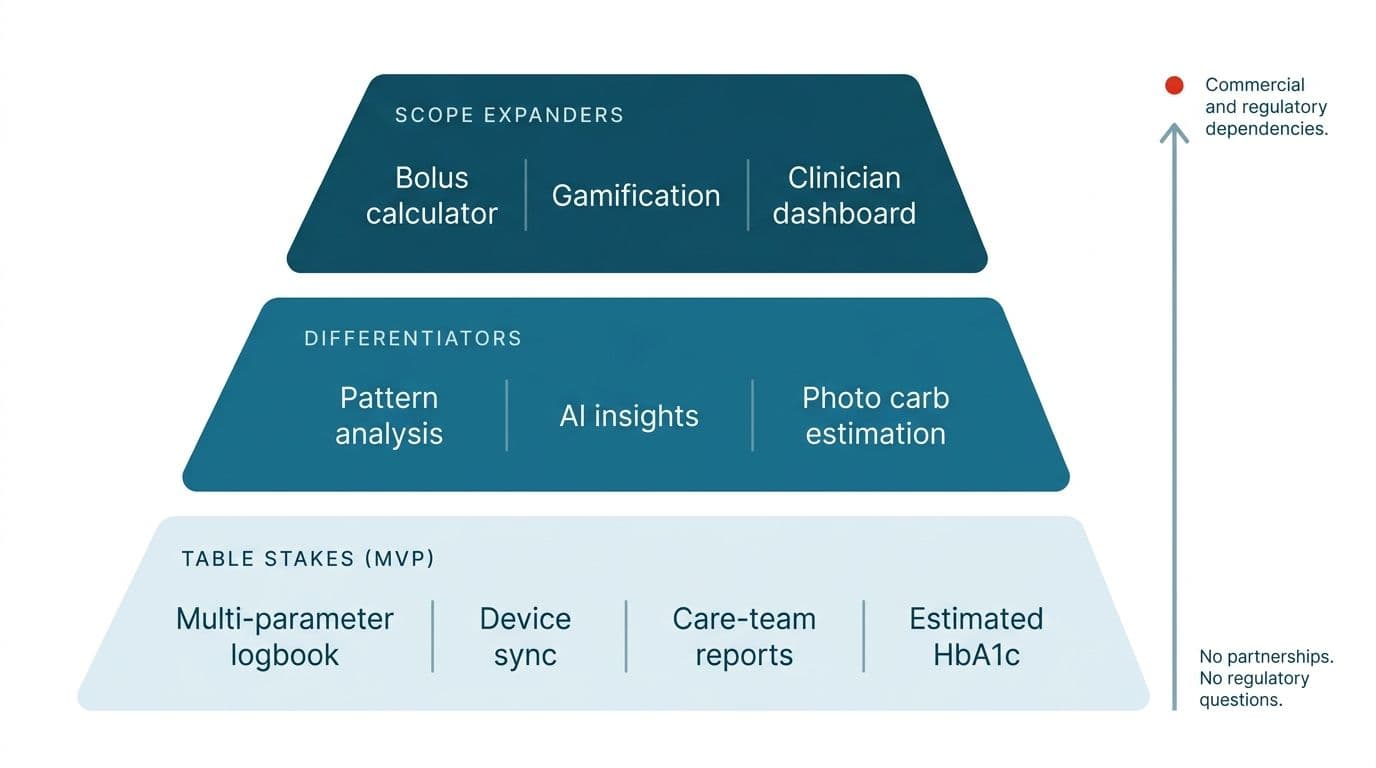
Device sync is the difference between an app people abandon in a week and one they keep. Manual entry fatigue is real. Glooko is the reference point here. Its value is the breadth of meters and CGMs it ingests, which is precisely why the integration story matters more than the UI (see Section 2). Start by mapping which devices your first users actually own.
Reports for the care team turn the logbook into something clinically useful. A shareable PDF or dashboard summarising glucose trends and events is what a user brings to an endocrinologist appointment.
Estimated HbA1c (or GMI) gives users a single number they understand. It's computed from average glucose, cheap to build once you have the data, and it anchors the whole experience emotionally. That's a coherent MVP for a glucose tracking app development project. It's valuable to one user, on their own, with no partnerships and no regulatory questions. Ship this slice first, then decide what earns the next sprint.
Differentiators, where retention actually comes from
Pattern analysis is the first real step beyond logging. Detecting recurring lows after exercise, or dawn-phenomenon spikes, is what makes users feel the app works for them rather than just storing data. Start with the pattern your first cohort will notice fastest.
AI insights and conversational assistants extend that. Diabetes Cockpit, for example, lets users ask questions of their own data in natural language. "Why was I high on Tuesday?" And it returns a reasoned answer grounded in their logs rather than a generic tip.
Photo-based meal logging with carb estimation removes the single most tedious task in diabetes self-management. Undermyfork built its identity around photo meal logging correlated with glucose outcomes, and newer entrants like ChatCGM are pushing image-based carb estimation further. This is an insulin logging app's best friend. Better carb data makes every downstream calculation more honest. Prototype one of these differentiators against real user logs before you commit to all three.
Scope expanders, powerful and not free
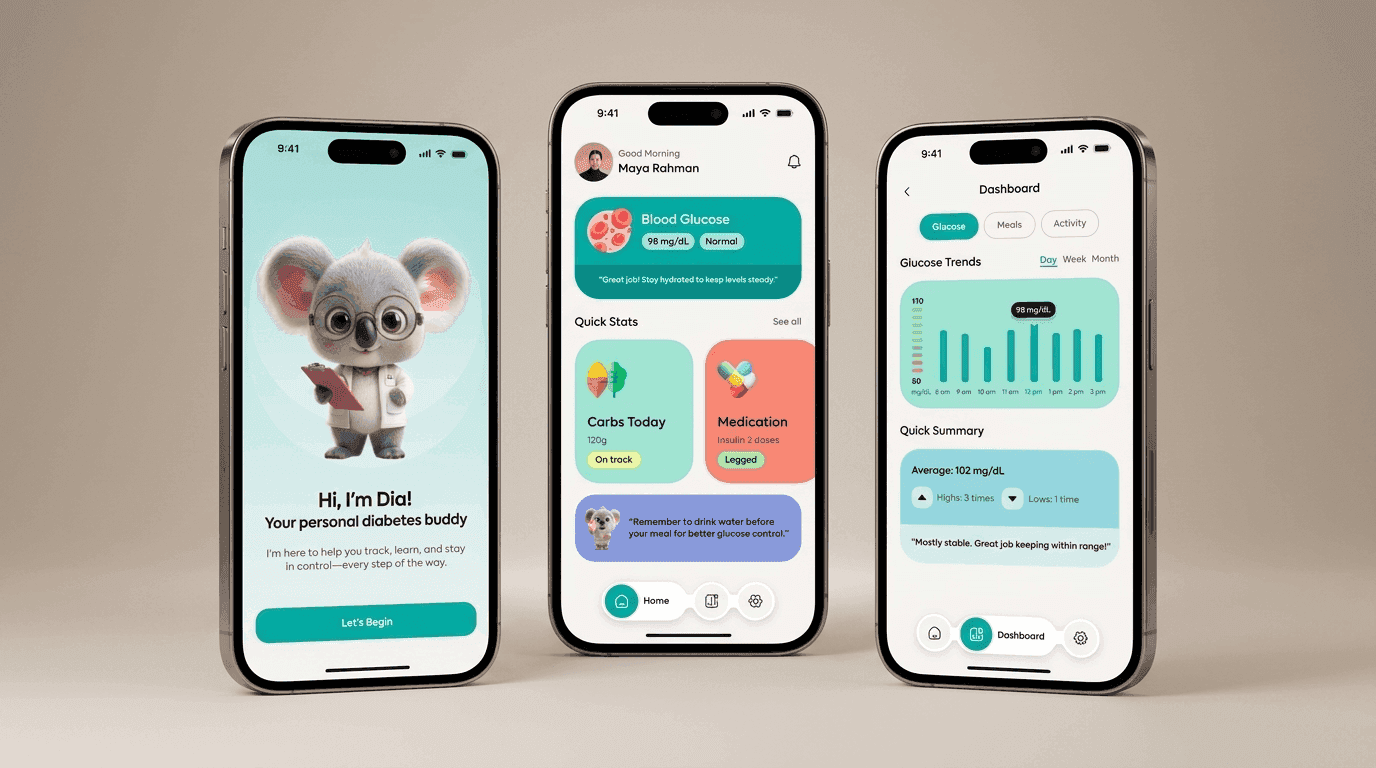
A bolus calculator recommends insulin doses. It is the highest-value feature on this list and also the one that changes what you are legally building. It gets its own section below.
Gamification covers streaks and badges, and in several studies it improves engagement and wellbeing. Honesty matters here. The evidence that gamification improves time in range specifically is still thin. Treat it as an engagement layer, not a clinical intervention, and you won't oversell it.
A clinician-side monitoring dashboard turns your product into a two-sided platform. Diabetes:M Monitor is a clear example of the provider-facing companion to a patient app. This, too, is an architecture decision more than a feature (Section 4).
That's ten features, sequenced. Now weigh the three decisions underneath them before you scope a single one.
Decision one: CGM integration is a partnership problem, not an API problem
Go back to that original brief. "CGM integration through an official API/SDK if available." That two-word conditional, if available, is carrying the entire risk of the feature, and most founders don't notice it until they're mid-build.
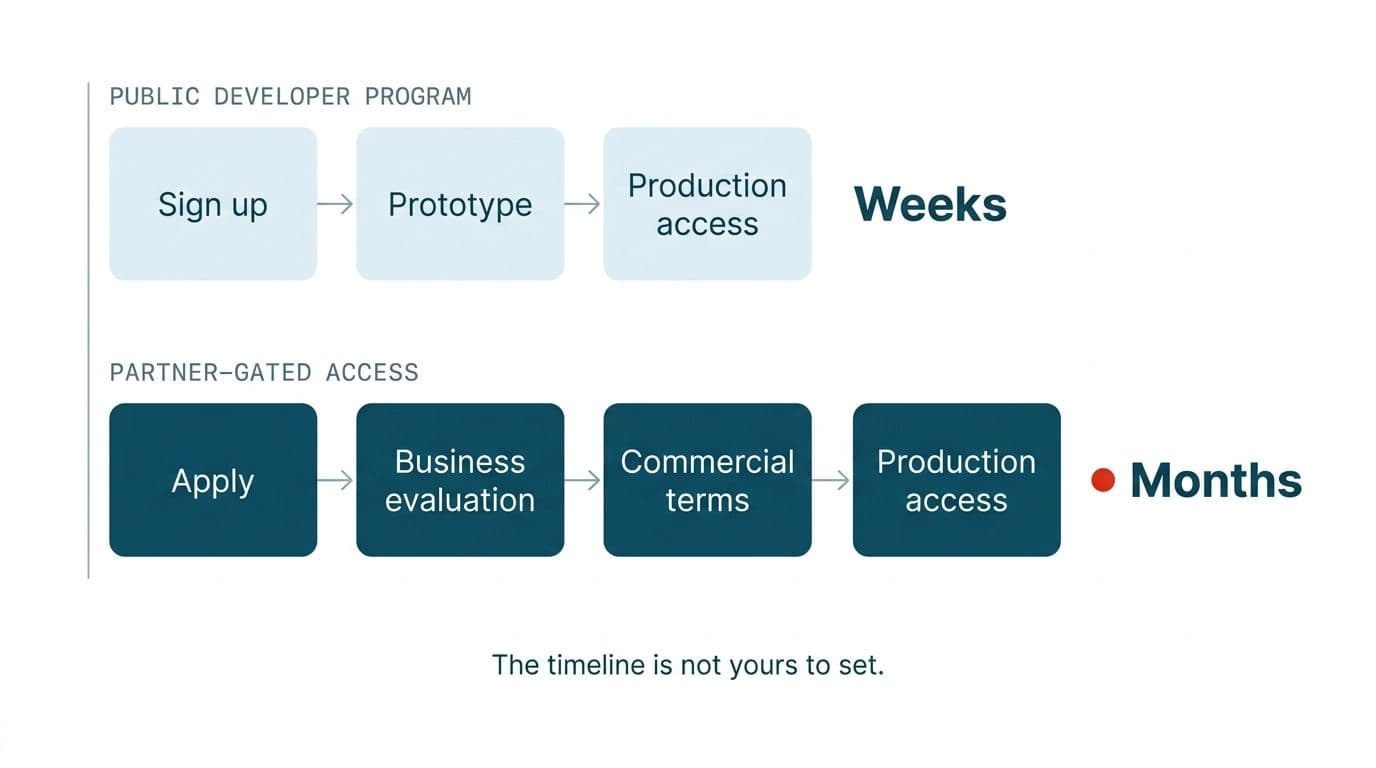
Here is the distinction that matters. Some device data is reachable through publicly available developer programs you sign up for and start prototyping against. Other data sits behind partner-gated access. You apply, you're evaluated as a business, and access is granted or not on commercial terms. The gap between those two models is the gap between a two-week integration and a nine-month negotiation.
⚠️ Verify current vendor terms before relying on any specific arrangement. Major CGM manufacturers such as Dexcom and Abbott operate developer and partner programs, but the exact access tiers, data scopes, and eligibility requirements change and must be checked against each vendor's current documentation before you commit a roadmap to them.
The practical consequence is blunt. CGM access timelines are commercial negotiations, not integration sprints. You cannot promise investors a live CGM feed on a fixed date, because the date isn't yours to set. A vendor evaluates your company, your use case, and your volume before granting production access. That process runs in parallel with, and often much longer than, your engineering.
So build the app to be genuinely worthwhile before CGM access lands. Three data paths get you there:
- Manual entry, done well, with fast input and smart defaults.
- Meter sync via Bluetooth glucometers, which typically have far lower access barriers than CGMs.
- Platform health-data import, pulling glucose data that a user has already routed into Apple Health or Google's health platforms.
Each of these makes the logbook, reports, and pattern analysis fully functional. When direct CGM access arrives, it becomes an upgrade to an already-working product rather than the thing the product was waiting on.
One caution on open-source. Community projects that reverse-engineer CGM data are excellent prototyping tools. They let you validate your UX and analytics before you have sanctioned access. They are not a production path. Building a commercial product on unofficial access is a compliance and reliability risk you don't want to carry into a vendor negotiation. Use them to learn, then switch to sanctioned access to ship. Sanctioned access is also the point at which the data's real constraints show up, and what actually arrives from a CGM feed determines more of your feature set than the access route does.
Decision two: the bolus calculator changes what you're building
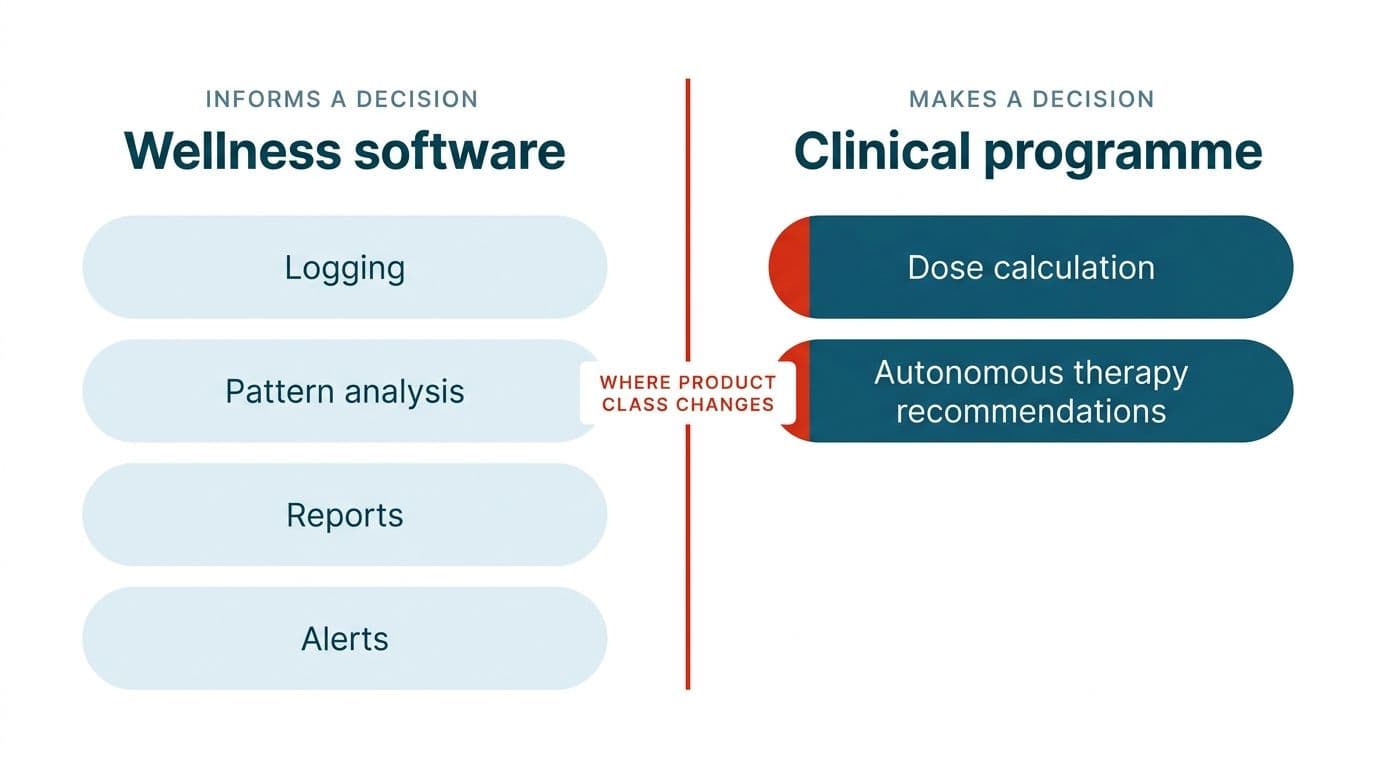
Everything else on the feature list is, broadly, wellness software. A feature that recommends an insulin dose is not. This is the single decision most likely to blindside a first-time health founder.
Look at how a serious product treats it. Diabetes:M ships a bolus advisor, restricts that feature in markets including the USA and Australia, and in July 2025 launched a clinical study specifically evaluating the calculator. Read that carefully. An established, shipping product treats one feature as an ongoing clinical programme with geographic restrictions. That tells you more than any regulation citation could. A dose calculator is not a sprint ticket. It is a workstream with its own evidence and market-by-market gating.
⚠️ Regulatory classification of any dose-related feature depends on jurisdiction and intended use. Get qualified regulatory review before you make claims about your product's status or name specific device classes.
The practical framing for your build is straightforward:
- Build the logging and analytics layer first. Carb data, insulin history, and glucose patterns are beneficial on their own and are the same data a calculator would eventually need.
- Architect so dose calculation can be added behind a feature flag, ideally region-gated, so you enable it only where and when you're cleared to.
- Treat classification as a pre-sprint decision. Whether you build a dose calculator determines your regulatory pathway, your documentation burden, and your timeline. Deciding it late means rebuilding around it.
The good news is that the whole rest of the product is buildable without ever touching this. Multiple successful diabetes apps deliberately stop at logging, insights, and reporting, and let the clinician make the dosing call. That is a legitimate product, not a compromised one. Decide your product class before you write the first ticket.
Decision three: patient-only or two-sided?
The original brief describes a patient app. But every mature product in this category has a provider side, and the International Diabetes Federation now frames the whole category as Diabetes Management Platforms. Dashboards, increasingly AI-assisted, that consolidate multi-device data for clinicians to act on.
The point for your roadmap is direct. This is an architecture decision, not a v2 feature. If there's any chance you'll add a clinician-facing dashboard, the foundations have to be laid now. Three things in particular are cheap to design in and painful to retrofit:
- Multi-tenancy, the ability for one clinic to manage many patients, with strict data isolation between organisations.
- Consent and data-sharing models, explicit, revocable, auditable permission for a patient to share data with a specific provider.
- Role-based access control, with patient, clinician, admin, and support roles scoped clearly.
Retrofitting these into a system designed for a single patient means re-architecting the data model, the auth layer, and the entire permission surface. Doing it up front costs a few extra design conversations and some deliberate schema choices.
It also changes the business model, which is the part founders care about most. Consumer diabetes apps monetise slowly. The provider side, clinics and health systems paying for population dashboards and remote monitoring, is usually where the revenue is. Deciding "patient-only for now" is fine. Deciding it by accident, because nobody asked the question, is how you end up rebuilding in year two. If you're weighing this trade-off, our healthcare and consulting practice exists to work through exactly these calls. Ask the two-sided question out loud before design starts.
What AI actually does here
"AI-powered insights" is the vaguest line on any diabetes app brief. Strip the marketing and it resolves into four concrete jobs, each a real, scoped piece of engineering:
- Carb estimation from meal photos, computer vision that turns a picture of a plate into a carbohydrate estimate. Genuinely hard, genuinely valuable, and the differentiator behind products like Undermyfork and ChatCGM.
- Pattern detection across glucose and context data, surfacing correlations between glucose and food, sleep, or time of day that a user wouldn't spot manually.
- Natural-language querying of the user's own history, letting someone ask "how do I usually react to pasta?" and getting an answer grounded in their own logs, as Diabetes Cockpit does.
- Report generation, producing clean, clinically legible summaries for appointments automatically.
Notice what's not on that list. Autonomous therapy recommendations. The category has settled on AI that produces reports and alerts, not AI that tells you how much insulin to take. That line, between informing a decision and making one, is exactly where the regulatory boundary sits. It's the same argument as the bolus calculator, viewed from the AI side. Building the four jobs above is a well-understood custom AI MVP development effort. Crossing into autonomous dosing is a clinical programme. Keep them separate in your planning and scope only the reporting side first.
Sequencing a build
Put all of this together and the build order writes itself. Three phases, each shippable, each useful before the next begins:
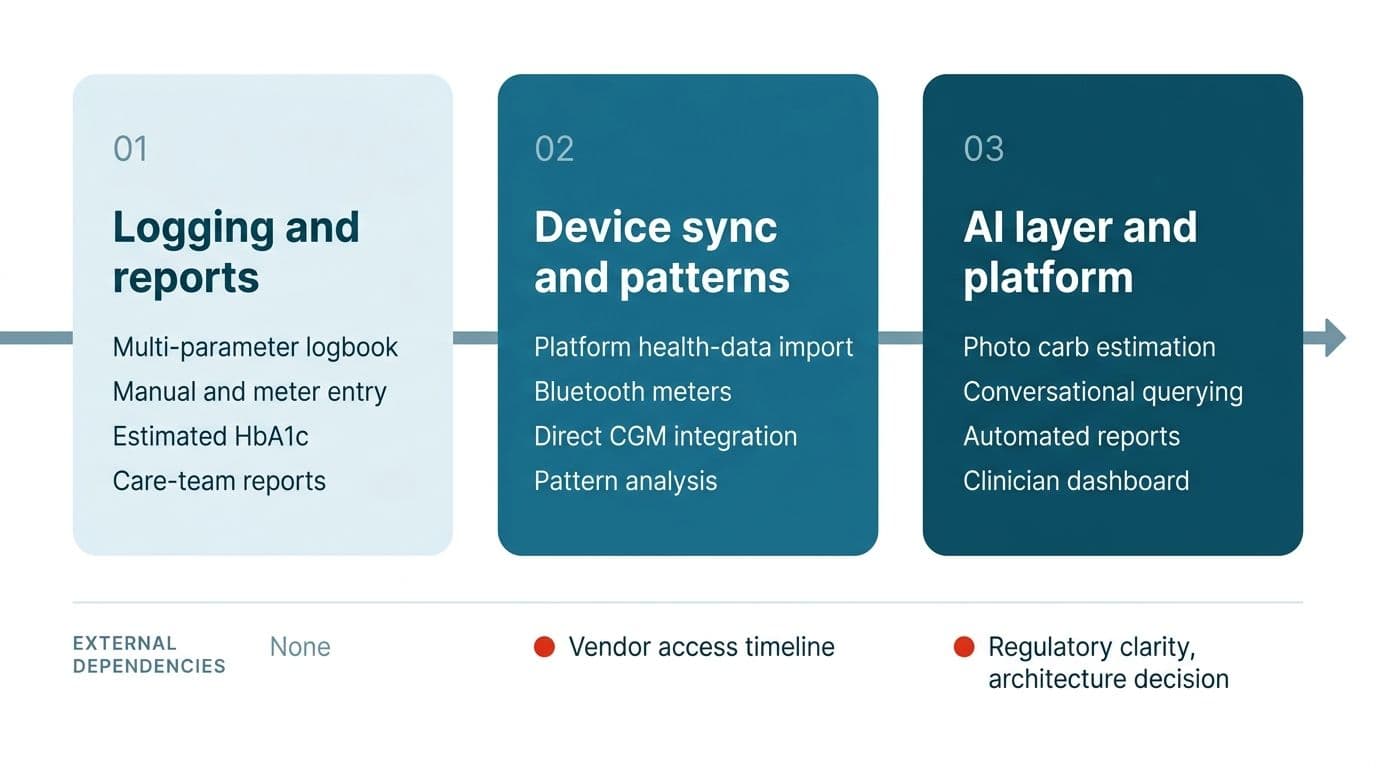
Phase 1, logging and reports. The multi-parameter logbook, manual and meter-based data entry, estimated HbA1c, and shareable care-team reports. This is useful to a single user on day one, with no partnerships and no regulatory questions. It's also the data foundation everything else needs.
Phase 2, device sync and pattern analysis. Platform health-data import, Bluetooth meters, and, as access negotiations land, direct CGM integration, layered under pattern-detection features. Because CGM access arrives on the vendor's timeline, Phase 1 must stand on its own without it.
Phase 3, AI layer and clinician dashboard. Photo carb estimation, conversational querying, automated reports, and, if your architecture decision pointed that way, the provider-facing platform.
The organising principle is simple. Never let your product's usefulness depend on something you don't control. CGM access and regulatory clarity both arrive on external timelines. Build so that a real user gets real value while you wait for them. Draft your own three phases before you write a line of code.
The three decisions, one conversation
The ten features are the uncomplicated part. What actually decides whether your diabetes management app ships are three questions the feature list hides. Is your CGM access a public program or a partner negotiation? Are you building a dose calculator, and therefore a clinical programme? And are you building a patient app or a two-sided platform? Each is cheap to answer now and expensive to answer late.
That's the conversation worth having before the first sprint. As a healthcare app development company, we'd rather scope it honestly than quote it blindly. So bring us your feature list, and we'll tell you which parts are integration work, which are architecture, and which are programme-level commitments. Start a scoping conversation with your current list and any prior work, and we'll map it against what a build actually costs.
Wondering what this would take against your own systems?
The audit costs nothing, and you keep the costed plan and the risks whether you go ahead or not.
Book a free automation audit
Arun Andiselvam
LinkedInI am a startup veteran who has built five brands. I sold the first, an SEO tool, for a six figure exit, and now build AI automation products for businesses. I bootstrapped every one of them from day one.