
Fintech back office automation means using software and workflows to handle the behind-the-scenes tasks that keep a financial services business running. Think reconciliation, compliance checks, customer onboarding and reporting. Instead of manual effort and disconnected spreadsheets, automation lets these repetitive, high-volume processes run with more speed and accuracy.

For fintech companies scaling fast, the back office turns into a bottleneck and it's the part of fintech automation that gets planned last, if at all. Knowing what to automate first frees up your team. It cuts errors and lowers operational costs, without you overhauling everything at once.
1. The back office is not the product
Most conversations about fintech automation are conversations about the product. A fintech can have a genuinely automated product and a manual company. The two facts sit side by side more often than anyone admits. On the customer side there's real-time order execution, instant onboarding, a UX team obsessing over the gap between a two-step and a three-step flow. On the other side, someone opens a spreadsheet on Monday morning. They reconcile last week's statements by hand, line by line, against three provider exports that don't share a format.
That gap is where fintech back office automation actually lives. It helps to define the term concretely. The work covers onboarding, application submission and reconciliation. It handles exception routing, status tracking and compliance reporting too. It's the work that keeps the regulated machine running and never appears in a product roadmap.
It gets underinvested for a structural reason, not a negligent one. The back office doesn't demo. Engineering capacity flows toward the revenue story, because that's what raises rounds and closes customers. Operations absorbs the difference the only way it can, with headcount. That works until it doesn't. The signal that you've crossed the line is specific and easy to check. Ops headcount grows in step with transaction volume rather than lagging behind it. When each new tranche of volume needs a proportional new tranche of people, you no longer have an operations team. You have a variable cost dressed as one. That's the operational load that financial services businesses carry quietly until it becomes the thing limiting growth. Map your headcount against volume this quarter and see where the line points.
2. Why "automate the biggest pain" is the wrong starting question
The instinct, when you finally get budget to fix this, is to automate whatever people complain about most. It feels responsive and humane. It's also the wrong question. Complaints surface the most annoying work, not the most automatable work. Those are different sets, and they overlap less than you'd expect.
This default produces two predictable failure modes. The first: you automate a judgment-heavy workflow because it's stressful, the thing ops dreads, the escalation-prone corner of the month. You spend the next few months discovering edge cases you couldn't have listed at the start. You ship something ops quietly doesn't trust and routes around. The second: you automate something visible but low-volume, because it's simple to point at in a stakeholder update. The dashboard looks good. The actual hours, which live in a dull high-frequency task nobody flagged, stay exactly where they were.
The reframe is to stop hunting for the worst job. You want the workflow where the ratio of mechanical steps to judgment calls sits highest. Lots of repetitive motion, very little deciding. That's where automation is both feasible and safe. It's rarely the thing that generates the loudest complaints, so ignore the noise and score the mechanics instead.
3. Three questions that rank the candidates
Sequencing fintech back office automation comes down to three questions, asked of every candidate workflow. They produce a defensible order. They matter more than any generic ranking. They respond to your volumes and your risk profile rather than someone else's.
3.1 How many times is the same data entered?
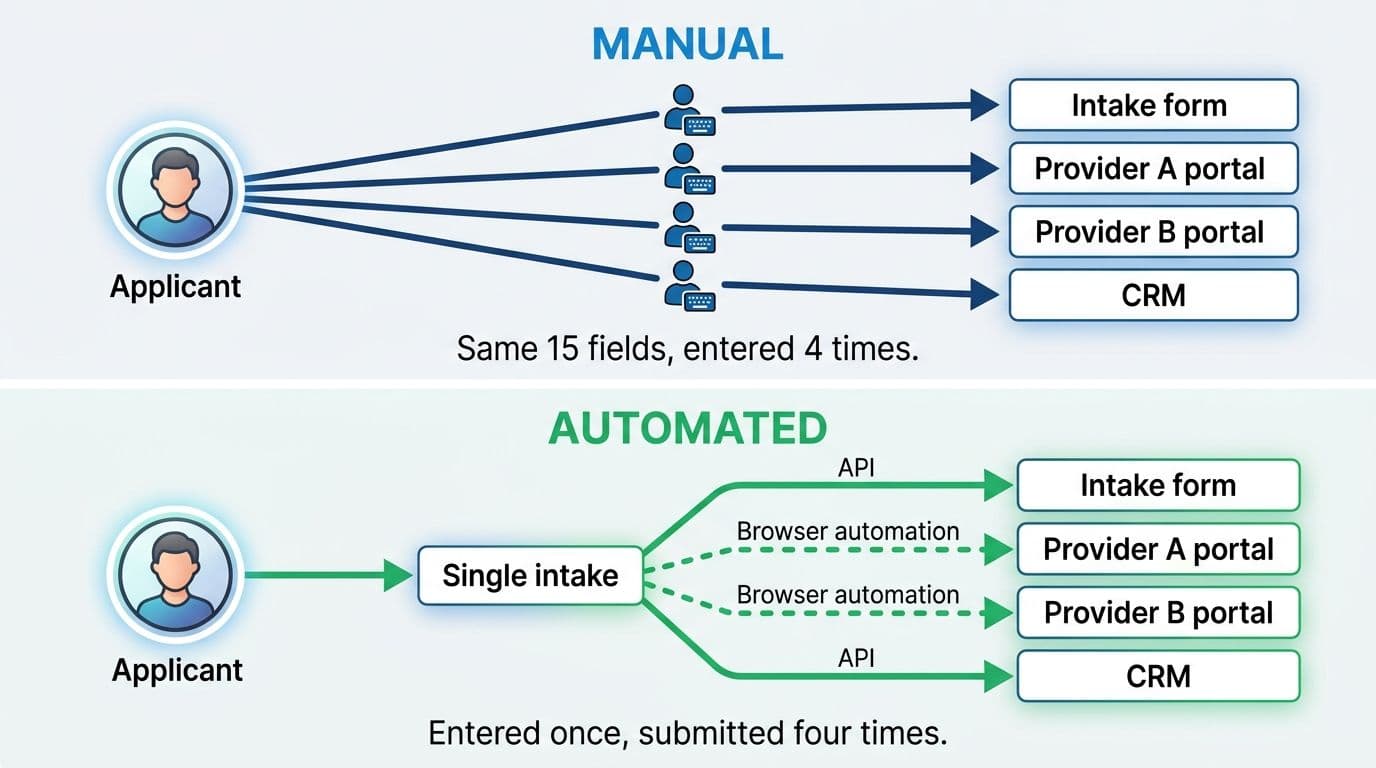
The clearest automation signal in any back office is duplicate entry. Applicant details typed into an intake form, then keyed into a provider portal, then a second portal, then copied into the CRM so support can see it. The same fifteen fields, four times, by four different people or the same person four times over.
This is worth automating first even when it isn't the most painful task on anyone's list. The win is unambiguous and measurable, and it needs the system to make no decisions at all. You're moving known data from one place to many. There's no judgment to get wrong, so this is where you should start scoping.
The pattern is capture once, submit to many. The practical reality complicates it: some providers expose clean APIs and some don't, and the ones without an API are frequently the ones consuming the most human time. For those, credential-based browser automation is a legitimate tool — it drives the portal the way a person would. It's less durable than an API, it breaks when the portal's markup changes, and it demands that credentials live in a secrets manager rather than hardcoded in a script. Those are real constraints, not disqualifiers. Just budget for the maintenance.
3.2 What happens if it's wrong?
Correctness tolerance is the axis most fintech AI automation advice skips entirely. It's the one that separates fintech from everything else. A misfiled document is recoverable. You find it, you refile it, an afternoon is lost. A misclassified transaction that flows into a regulatory filing is a different category of problem, and it might not be recoverable at all.
So the rule is uncomplicated. Low-consequence, high-volume work goes first. High-consequence work either goes later, once you trust the surrounding machinery, or goes in immediately with a human confirmation step permanently attached. Not as a temporary training-wheels measure, but as the design. This is where fintech diverges from general back office advice. A mistake doesn't just cost time. It costs a licence conversation, and the ordering shifts to respect that. Score each workflow on what breaks when it fails, and let that reshuffle your list before you build.
3.3 Can a human still see what happened?
Automation that removes a person from a workflow also removes the person who used to notice when something looked wrong. That noticing was doing quiet, unbudgeted work. It doesn't survive the transition unless you design it back in.
This is a hard design requirement, not a nice-to-have. Failed steps must be flagged, never silently dropped. A submission that errors and disappears is worse than one that never left the queue. At least the un-sent one is visibly waiting. The silently-failed one looks done and isn't, and nobody watches for it until a provider asks where the application went.
Auditability is the fintech-specific version of this constraint. Months after the fact, someone needs to reconstruct why a decision was made. An auditor, a regulator, your own compliance lead. An automation that can't explain its own reasoning is a deferred liability, not an asset. Build the visibility layer into your first spec, not a later patch.
4. A working sequence of fintech automation
The three questions produce an order. For most fintech automation projects, here's the default they yield.
First: intake and submission. Single capture, automated onward submission wherever a destination exists. This has the highest duplicate-entry elimination and the lowest judgment requirement, which makes for the clearest before-and-after you'll get. It's the foundation the rest sits on.
Second: status and visibility. A consolidated view of where every item stands, so nobody logs into four portals to answer one question. This is cheap relative to its impact, and it does something subtler. Once you can see what the intake automation submitted and what came back, you'll actually rely on it. Visibility is what converts a working system into a trusted one.
Third: classification and matching. Transaction categorisation, reconciliation matching and document type recognition, often helped by document processing and OCR where the input arrives as scans and PDFs. This is higher volume than the first two layers, but it carries higher correctness stakes. That's exactly why it comes third and not first. You want the visibility layer in place before you let software make categorisations you'll later have to defend.
This is where fintech AI automation tends to get oversold, so it's worth being precise about the architecture. It isn't one technology. It's deterministic rules where the answer is knowable and must be right, an account number either matches or it doesn't. It's a language model where the input is messy and some judgment is genuinely needed, a free-text payment reference mapped to an invoice. And it's a confidence score sitting between them, routing anything uncertain to human review rather than guessing. Not rules or AI. Both, with a routing layer deciding which handles each item.
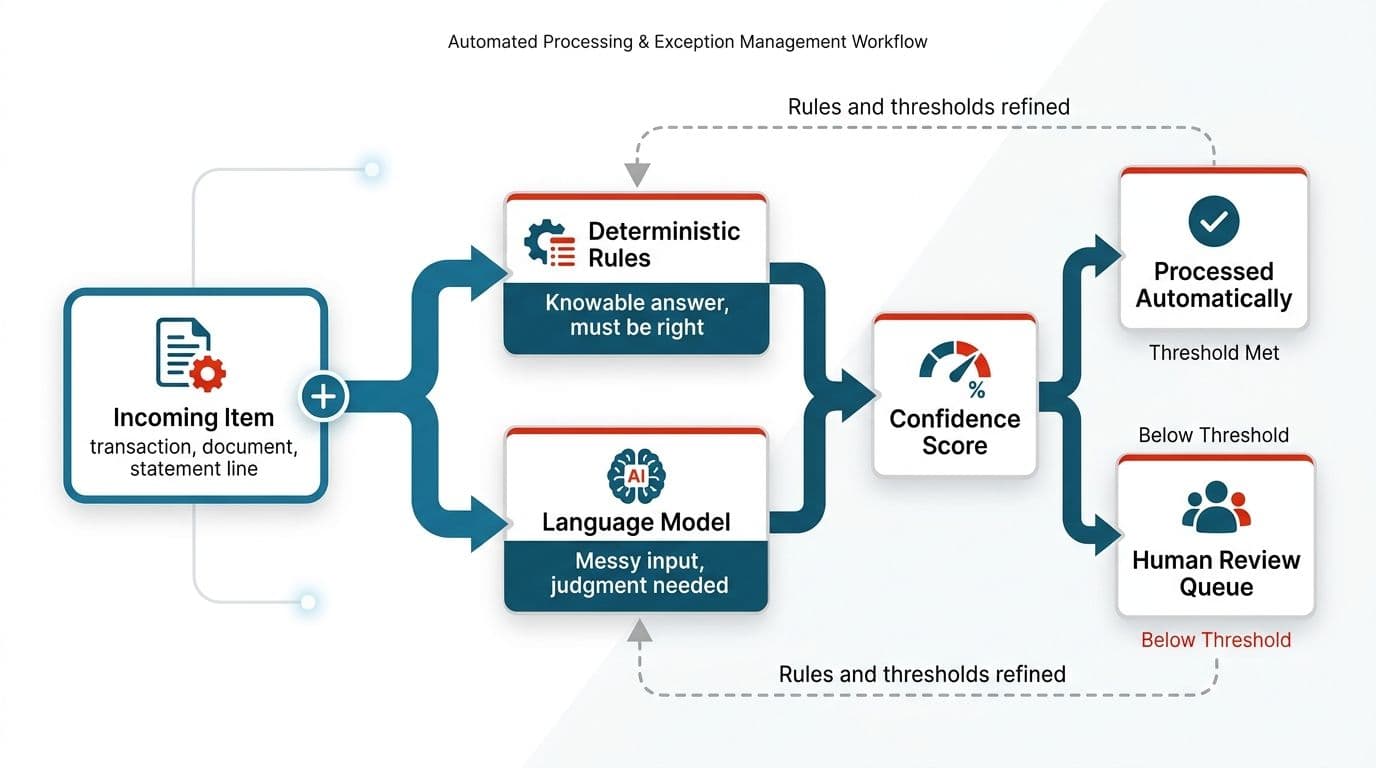
The mental model worth stating plainly: software handles the volume, a person handles the exceptions. The goal is to shrink the exception queue over time as the rules and models improve. Not to empty it, which is neither realistic nor safe. Aim to trim that queue a little each quarter.
Fourth, and only then: the harder things. Approval routing with real monetary thresholds, exception resolution and anything that touches a regulatory filing. These come last because they combine high consequence with genuine judgment. They benefit from every layer of trust and visibility you built underneath them.
| Workflow | Volume | Correctness risk | Suggested phase |
|---|---|---|---|
| Intake & multi-provider submission | High | Low | First |
| Status & visibility consolidation | Medium | Low | Second |
| Classification, reconciliation, matching | High | Medium | Third |
| Approval routing, exceptions, filings | Medium | High | Fourth |
5. What to leave alone
Deliberate non-automation is a design decision. Saying so up front stops the project being judged as incomplete later. A system that hands the right things to a human isn't unfinished. It's correctly scoped.
Some categories should route to a person immediately, every time:
- An exception the rules can't resolve, a reconciliation break above threshold, or a document that doesn't match the applicant on file.
- Anything where the answer is a decision rather than a lookup: a fee waiver, an approval outside policy, a manual override.
- Repeated failures on the same item, which usually signal a broken assumption rather than a bad input.
- Anything outside the system's defined authority.
- Anything that will end up in a regulatory filing.
- Anyone explicitly asking to speak to a person.
The handoff quality matters more than the handoff trigger. When a person picks up an escalated case, they need the full history in front of them. What the customer already provided, what the automation already tried. Without it, the customer repeats themselves from the start. The automation has produced an experience worse than having no automation at all.
A smaller point in the same spirit: never ask someone for something they've already given you. A system that re-requests a document it already holds tells the customer, in the clearest terms, that nobody is paying attention. In a regulated relationship built on trust, that's an expensive message to send by accident. Audit your intake flow for anything you're asking twice, then cut it.
6. The constraint that reorders everything: compliance
In most industries, compliance is a review gate at the end. You build the thing, then someone checks it before it ships. In fintech it's an input to the design. It changes what you automate, not just how you ship it. That's why it belongs in the first scoping conversation rather than a later one.
a handful of concrete constraints shape scope from the outset:
- PII encrypted in transit and at rest, and never written to logs in plaintext, which is the most commonly overlooked copy of your data.
- Retention limited to the period the task actually requires, rather than kept indefinitely because storage is cheap.
- Credentials held in a secrets manager, never in code or configuration files.
- An audit trail that survives staff turnover, the record can't live only in one person's memory of how things were done.
The practical consequence is that a workflow which looks like the obvious first candidate on volume alone drops several places once its data handling is scoped properly. The high-volume onboarding flow that seemed like the easy win might involve the most sensitive PII you hold, which changes the engineering and the sequencing. Far better to discover that in week one than in week six, when you've already built the wrong thing. Getting the secure and compliant architecture settled early keeps the sequence from unravelling later, so put compliance in the room from day one.
7. Start narrower than feels right
The most common scoping error is proposing a platform when what's actually needed is one workflow. A platform takes a quarter before it proves anything. A single workflow proves or disproves the whole approach in weeks. The narrower start isn't a lack of ambition. It's how you buy evidence cheaply before spending on scale.
So pick one workflow. Instrument it well enough that you genuinely see the before and the after. Hours spent, error rates, re-entry eliminated. Ship it. Then decide the second workflow with evidence in hand, rather than committing now to the list you wrote at the start, before you knew anything.
The sequence in this post is a default, not a prescription. The three questions in section three are what should actually produce your order. They respond to your specific volumes and your specific risk profile, which no generic ranking knows in advance.
It would help to work through those three questions against your own operations. Which workflows carry the most duplicate entry, where the correctness stakes actually sit, and what compliance reorders. Get in touch and we'll map your back office against the criteria. It's a scoping conversation, not a demo.
Wondering what this would take against your own systems?
The audit costs nothing, and you keep the costed plan and the risks whether you go ahead or not.
Book a free automation audit
Arun Andiselvam
LinkedInI am a startup veteran who has built five brands. I sold the first, an SEO tool, for a six figure exit, and now build AI automation products for businesses. I bootstrapped every one of them from day one.