
A support lead at a payments company counted what her team answered in one week. Out of 412 tickets, 280 were variations on nine questions, covering chargeback windows, settlement timing, and what counts as a verified merchant. Every answer already existed somewhere, spread across a 90-page operations manual, a shared drive of product sheets, and a wiki nobody had pruned since 2023. Her plan made sense: build a custom AI chatbot with private documents behind it, point it at the drive, and stop retyping the same paragraph.
The first pilot took about a week to stand up. It answered fluently. It was also wrong often enough that the team quietly stopped using it, and a confident wrong answer about settlement timing costs more than a slow human one.
That gap between "working demo" and "something people trust" is what this article is about. The technical pipeline is well understood and not especially hard. What decides whether the project survives contact with your business is the state of your documents, and whether you build in the discipline of showing where every answer came from. Get those two right and the rest is plumbing. Get them wrong and you have an expensive way to generate plausible-sounding mistakes.
The part most guides skip: your documents decide whether this works
Most tutorials start with embeddings and end with a chat window. That part is a weekend of work for an experienced engineer. We have watched far more projects stall on the material going in than on the model coming out.
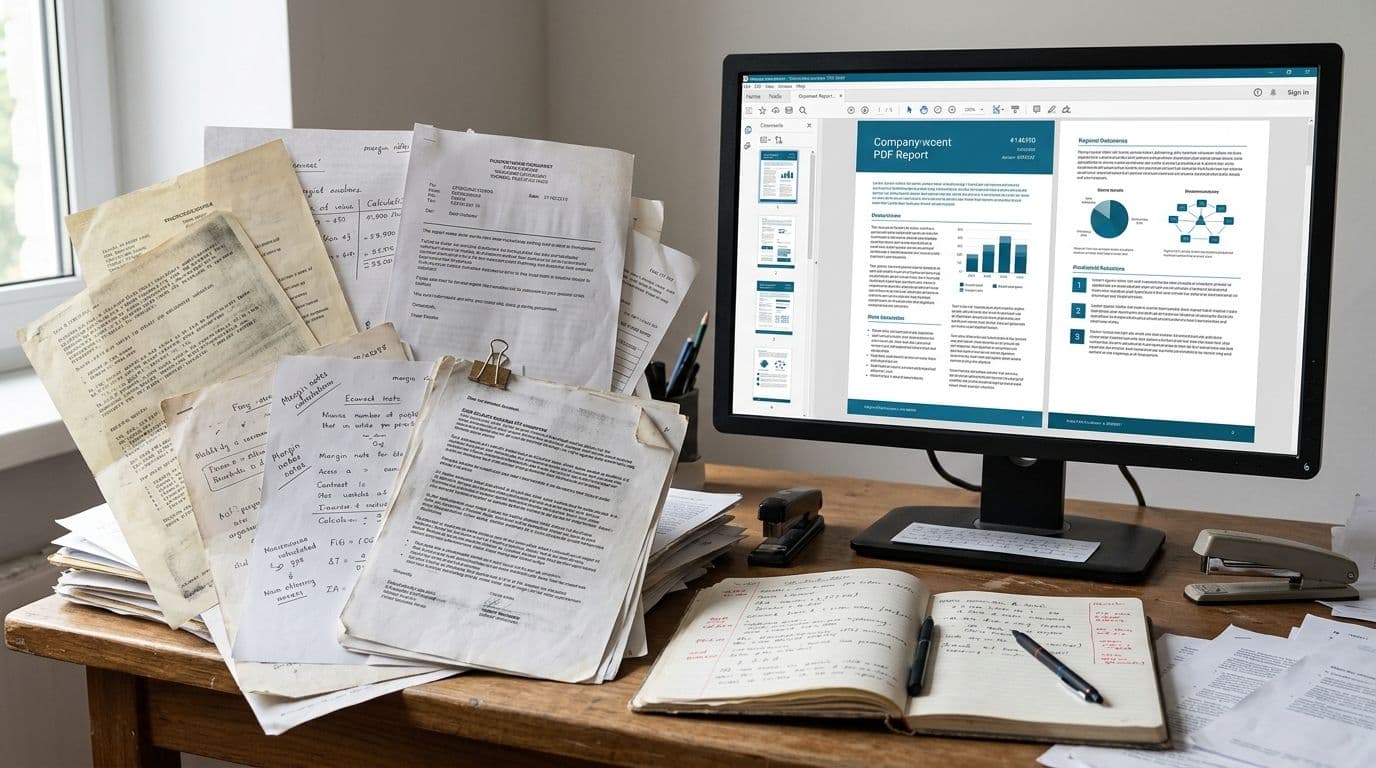
Here is what that usually looks like in practice. A finance team hands over "the policy folder." Inside it are 40 clean PDFs, 120 scanned pages from a printer that was running low on toner, and a 2019 version of a document that was superseded twice but never deleted. Nobody can tell you which version is current. The retrieval step cannot either, so it returns the 2019 text with the same confidence it returns the 2025 text.
The second thing teams underestimate is edge cases that were never written down. Your senior analyst knows that the approval threshold is different for one subsidiary. It is not in any document. The chatbot will never know it, and it will answer the general rule as if it applied everywhere.
So set the bar correctly from the start. A useful RAG chatbot is not one that always has an answer. It is one that says "I can't find that in the documents I have" when the documents don't cover it, and points at a page when they do. That single behavior is unglamorous and it is the whole product. Teams that chase coverage instead of honesty end up with a system their own staff route around.
Budget for document work before you budget for model work. On most of the builds we take on, preparing and structuring source material takes longer than wiring up retrieval augmented generation itself.
What "private documents" actually means for your architecture
"Private" is doing a lot of work in that phrase, and it means different things depending on who is asking.
For an SMB operations manager, private usually means "not public on our website." A hosted model behind an enterprise endpoint with data retention switched off is fine. For a compliance-bound product owner handling patient records or customer financial data, private means the files cannot leave infrastructure you control, and no amount of contractual assurance changes that. Those two readers need different builds, and the decision has to be made before anyone writes code, because retrofitting it later means rebuilding the retrieval layer.
The honest version of the vendor question: on enterprise API endpoints from the major providers, your inputs are not used to train their models, and zero-retention can be configured so they are not stored either. Both are terms you can verify in your account settings and in the contract, not a matter of faith. But it still means your text transits a third party's servers, and for some regulators, auditors, and customers that is the line.
When that line applies, an on-premise AI chatbot built on open-weight models is the route. Private LLM deployment means the model runs on hardware you control, inside your network boundary, and the documents never move. The trade-off is real. You give up some answer quality compared with the largest frontier models, you take on GPU costs and operations work, and someone has to maintain it. We will say so plainly when that trade is not worth it for your use case.
Two places to go deeper on the deployment side: our work on running open-weight models on infrastructure you control, and how we design systems around audit, access control, and data residency requirements when the rules are not optional.
The core pipeline: retrieval augmented generation, plainly explained
Retrieval augmented generation is a plain idea wrapped in an unhelpful name. Instead of asking a language model what it remembers from training, you look up relevant passages from your own documents first, hand those passages to the model, and ask it to answer using only what you gave it.
Three parts do the work.
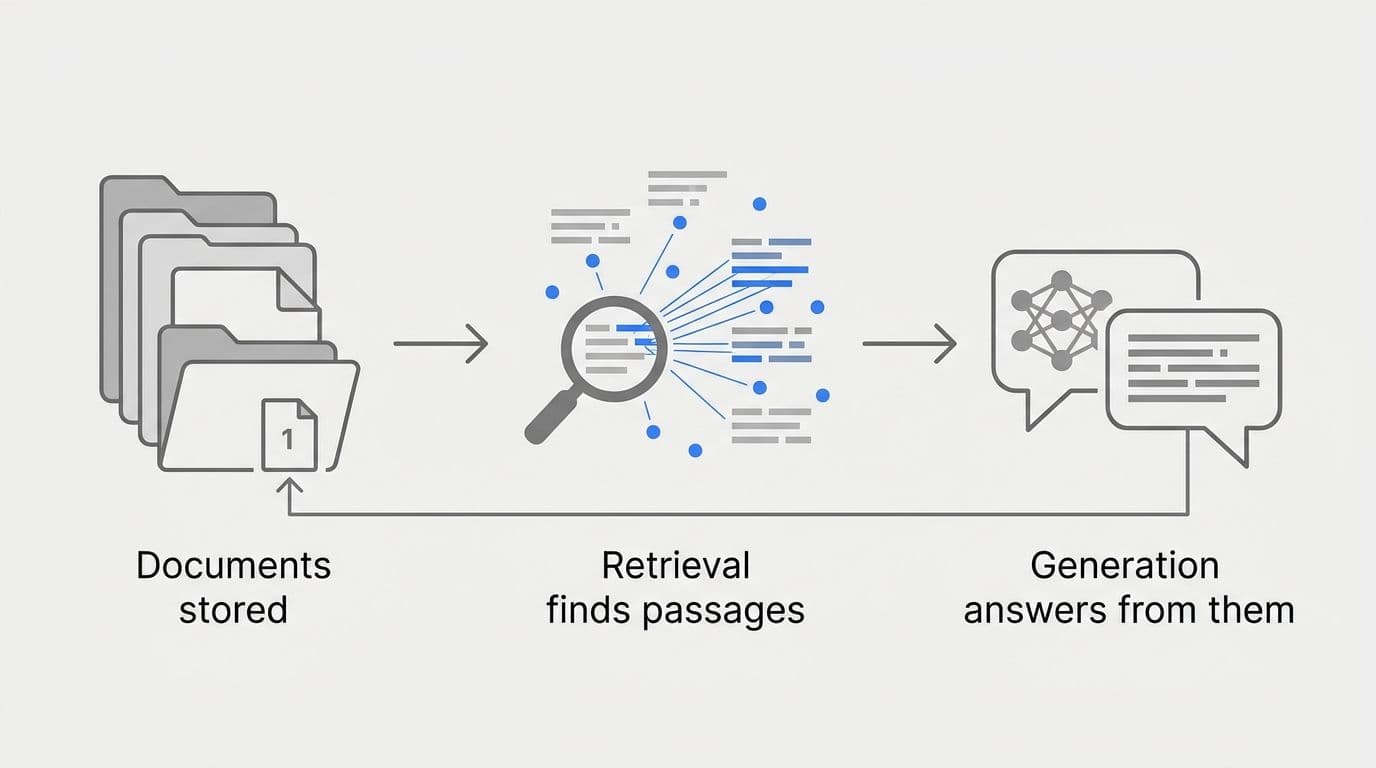
Storage. Your documents get split into chunks and converted into vectors, which are numeric representations that let a computer find passages by meaning rather than by exact keyword match. Those vectors live in a vector database. Common choices include Pinecone and Qdrant, or pgvector, an extension to PostgreSQL. If you already run PostgreSQL, pgvector is often the sensible answer, since one fewer system to operate is worth more than a marginal speed difference.
Retrieval. When a question comes in, the system searches that store and pulls back the handful of passages most likely to contain the answer. This step is where most quality problems actually live. Chunk size, overlap, and whether you combine vector search with keyword search all change results more than swapping models does.
Generation. The model writes an answer from the retrieved passages, with instructions to stay inside them.
The output of a RAG chatbot is only as good as the passage it was handed. A fluent answer built on the wrong paragraph is still wrong, just harder to spot. That is why we treat retrieval tuning as the main engineering task in a RAG chatbot build, not an afterthought once the demo works. Grounding is the point of retrieval augmented generation. Fluency came free with the model.
Answers need receipts: citations, not confidence
Every answer should name the document and the page it came from, as a link the reader can open. This is the difference between a toy and a tool.
Think about who uses this thing. A support agent is about to tell a merchant their settlement window. A controller is about to apply a treatment to an intercompany transaction. Neither of them can act on a paragraph of confident prose with no provenance. They need to click through, read the source line, and confirm it matches. Citations turn a system people have to trust into a system they can check, and checkable beats trustworthy every time in a regulated environment.
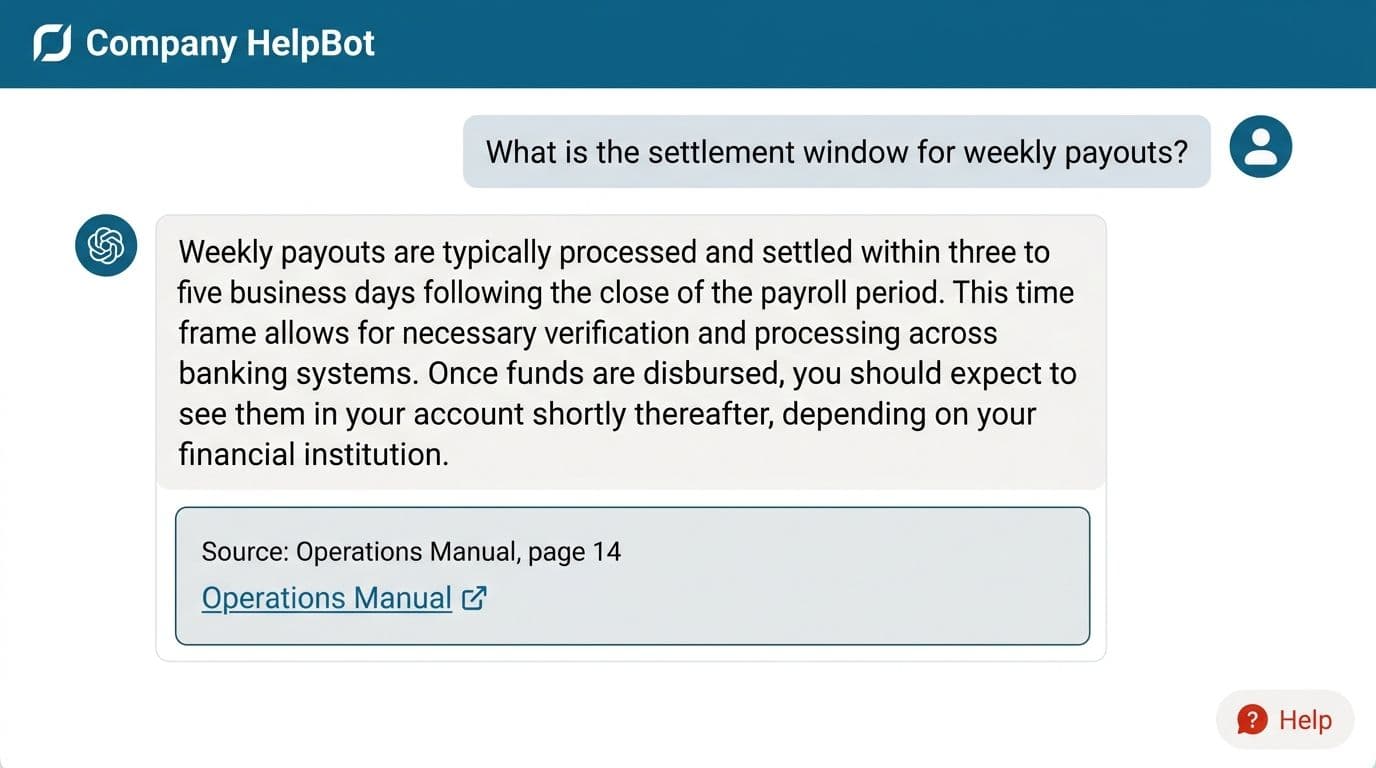
Citations also change behavior inside the build. Once the interface has to display a source for every claim, you can no longer paper over weak retrieval with a well-written prompt. If the system cannot find a supporting passage, it has nothing to cite. The correct output becomes an admission: "I don't have that in the documents I've been given. Here is the closest related section." That refusal path has to be designed deliberately, tested, and protected from anyone who later asks to make the bot "more helpful."
Most off-the-shelf chatbot products handle citations poorly. Some show a document name with no page anchor. Some cite a source that does not actually contain the claim, which is worse than no citation because it manufactures false assurance. In our experience, the citation requirement is the most common legitimate reason a custom build is justified over a subscription.
If you take one design rule from this article, take that one. Receipts on every answer, and silence instead of a guess.
Building the system: the pieces that have to work together
The parts list for a production RAG chatbot is shorter than people expect.
A backend endpoint. Usually FastAPI in Python, because the document and embedding libraries live there. It receives the question, runs retrieval, assembles the prompt with the retrieved passages, calls the model, and returns the answer with its citation metadata attached. Keep the retrieval logic in this layer rather than in the front end, so you can change it without touching the interface.
A chat interface. It needs a message list, a source panel, and a way to flag a bad answer. That is close to the whole requirement. We have seen teams spend six weeks on an interface and two days on retrieval, then wonder why nobody uses the result. A plain interface that is finished beats a designed one that is still three sprints out.
Access control. If your documents have permissions, the chatbot inherits them. A retrieval step that ignores who is asking will cheerfully surface an HR file to a contractor. Filter at the retrieval layer by user permissions, not by asking the model nicely.
Logging and a review dashboard. This is the piece teams skip and then regret. You want every question, every retrieved passage, every answer, and every thumbs-down stored and searchable, because a month after launch that log is your entire roadmap. It tells you which questions fail and which documents are missing.
We build this shape of system as support assistants that answer from a company's own knowledge base, and the dashboard is almost always what the operations team ends up living in.
Before you build the pipeline: what state are your documents actually in?
Clean, text-layer PDFs are the easy case, and almost nobody has only those.
Real document sets look like this: contracts signed and rescanned at an angle, faxed loan approvals, forms with handwritten annotations that carry the actual decision, and tables that lose their structure the moment you extract them to plain text. Add fifteen years of inconsistent file naming on top. Standard text extraction handles none of it well. A table that becomes a run-on line of numbers will produce a chunk that retrieves well and means nothing.
That is where OCR becomes its own stage of the project rather than a library call. Optical character recognition converts images of text into machine-readable text, and modern document pipelines go further. They classify what kind of document each file is, extract specific fields, and preserve table structure while attaching metadata like effective date and version. Done properly, this intake layer is what lets retrieval filter to "current policy, UK entity" instead of searching everything and hoping.
Version control deserves its own mention. If superseded documents sit in the same index as current ones, your RAG chatbot will contradict itself depending on phrasing. Tag effective dates during intake and filter on them at retrieval time.
When a chatbot gives a confident wrong answer, the cause is usually upstream of the model: a garbled table, a scan that read "1,000" as "l,OOO," two versions of the same policy with no way to tell them apart. That is a preparation problem that no prompt fixes.
Our intake pipelines for scanned, mixed-quality document sets exist because this stage decides the ceiling on everything built above it.
Proving it works before anyone trusts it
Build a question set before you build anything else. Sit with the people who will use the system and write down 15 to 20 real questions, with the correct answer and the source page for each. This takes an afternoon and it is the most valuable artifact in the project.
Then run the system against that set every time anything changes. Not the answer alone. Check that the citation points to the page that actually contains the answer. A right answer with a wrong citation means retrieval got lucky, and luck does not survive the next 200 questions.
Three failure types are worth scoring separately, because they have different fixes. Retrieval misses, where the right passage exists but was not found, point at chunking or metadata. Grounding failures, where the passage was found but the answer drifted beyond it, point at prompting and model choice. Coverage gaps, where the answer is genuinely not in any document, point at your content, and the correct response there is for the bot to say it does not know.
Evaluation frameworks like RAGAS can score faithfulness and relevance for you, worth adopting once the question set grows past a hundred. For the first version, a spreadsheet and an hour of a subject expert's time will tell you more.
Human review stays in the loop for anything the business depends on. We do not claim accuracy without it, and we would be careful with anyone who does. For answers that touch money, customer commitments, or regulated advice, a person approves before the response goes out. The honest framing for a RAG chatbot in those contexts is that it drafts fast and a human signs.
Where this fits into bigger systems
A document chatbot rarely stays standalone. Within a few months of launch, the requests arrive. Put it in the support queue so agents get a suggested reply. Connect it to the CRM so it knows which plan the customer is on. Let it open a ticket when it cannot answer.
That progression is usually worth following, because the chatbot's value goes up sharply once it knows context beyond the documents. A question about settlement timing has a different answer for a merchant on a weekly cycle than a daily one, and the RAG chatbot can only know that if something tells it.
The line to hold is between answering and acting. A system that retrieves and explains has a bounded failure mode: a wrong answer a person can catch. A system that issues a refund, updates a ledger, or emails a customer has a failure mode with consequences. Agents that call tools need an approval step before anything touches money or a customer. That approval has to be a real human decision, not a confirmation dialog nobody reads.
We build that boundary in by default. Agents that take actions across your systems run with explicit permission gates, and the sequencing logic around them sits in automated workflows that move work between tools without retyping.
One practical note on scope. Connecting the chatbot to four systems at once is how six-month projects happen. Ship the document answering first, let people use it for a month, then connect the one integration the logs tell you matters.
Build it yourself, buy it, or get it built: an honest look
The decision to build or buy gets made emotionally more often than it gets made on evidence. Let us put some structure on it.
Buy, when: your documents are clean and already in a system that offers a chatbot add-on, your questions are general, citations are nice-to-have rather than required, and nothing you handle is regulated. A subscription tool will be live in days and cost less than a build. Take it.
Build or commission, when: answers need citations down to the page because someone will be audited on them, your documents cannot leave your infrastructure, you need the chatbot to respect existing user permissions, or it has to read from systems a vendor's connector list does not include.
The weakest reason to build is that custom sounds more serious. The strongest is that an off-the-shelf tool encodes assumptions about your documents and your workflow that do not match yours, and you will spend more working around those assumptions than building the thing.
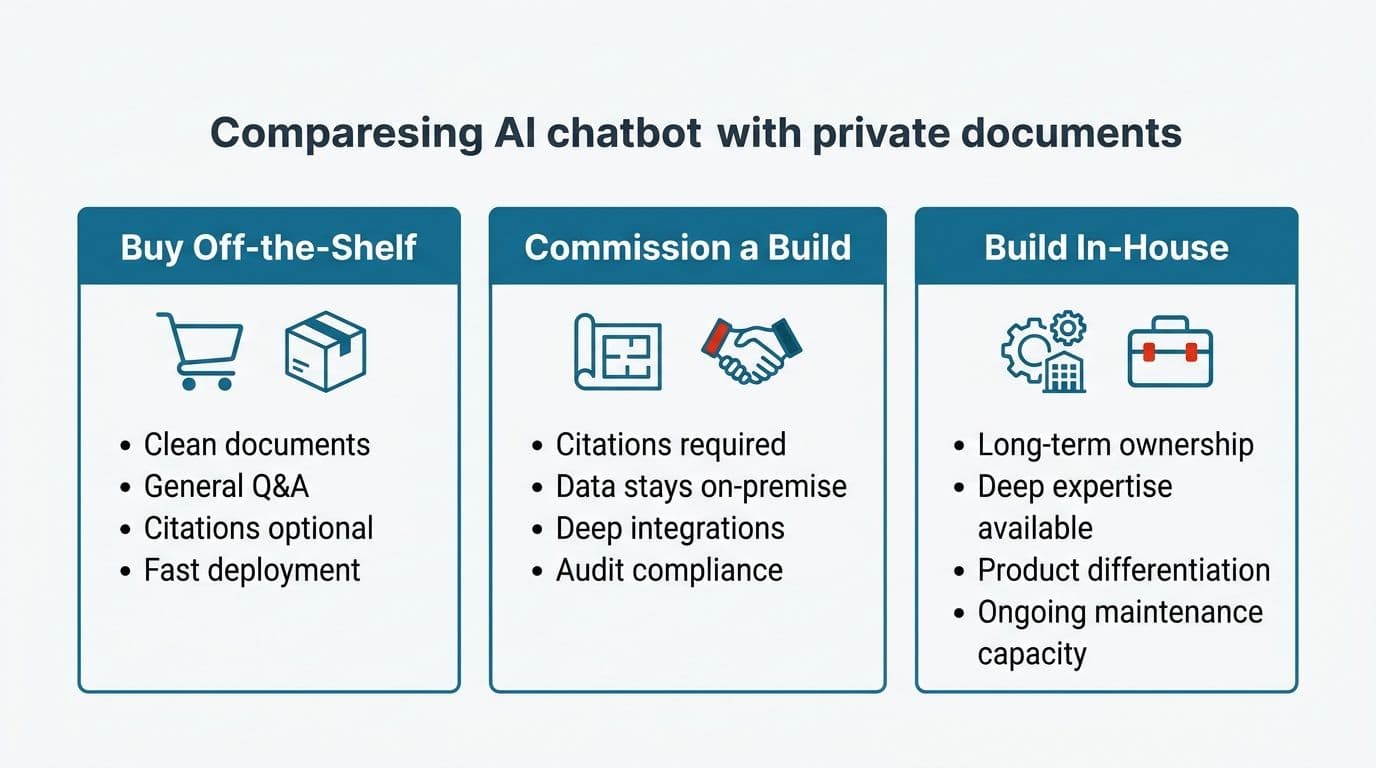
The second half of the question is who builds it. An in-house team can absolutely do this. What usually goes wrong is not capability but attention: the RAG chatbot competes with the product roadmap, the document cleanup stays unglamorous, and six months later there is a half-finished prototype nobody owns.
We have been building software for 18 years with a team of 150 in Madurai, for more than 1000 clients across 50-plus countries. A fair share of the conversations we have end with us saying the problem is smaller than a build: a better-structured help center, a search filter, a scripted macro. If that is the answer, we will tell you, because a project that should not have been built is worse for both of us than one we turned down.
What a custom AI chatbot with private documents costs, and what you actually own
We name a fixed price before work starts, not a range that firms up after discovery, and not an hourly rate that drifts as scope moves. You see the number, the scope it covers, and what sits outside it, and then you decide.
Running costs break into two lines. Infrastructure is the vector store and hosting, usually modest and predictable. Model spend is usage-based and it is the one that worries finance leads, reasonably. Here is what keeps it stable. A RAG chatbot sends the model a handful of retrieved passages, not your whole document set. Cost per question stays roughly flat as your library grows from 500 pages to 50,000, because retrieval is doing the narrowing. What moves spend is question volume and how many passages you retrieve per question, and both of those are knobs you control. With private LLM deployment the math changes shape entirely: fixed hardware cost, no per-token charge, higher operations burden.
On ownership, the terms are simple. You own the code. You own the cloud accounts and the API keys, in your name, billed to you, and you can take the repository to another team tomorrow and it will run. We have no interest in being a dependency.
On timing, working software lands in month one, not a discovery document, not a phase plan. Something your team can open and ask questions of, with the gaps visible, so the next decisions come from use rather than speculation. Our builders travel to clients when a project needs it, and you talk to the people writing the code rather than an account manager relaying messages.
Frequently asked questions
Will the AI vendor use our documents to train their models?
Not on enterprise API endpoints. Training on your inputs is off by default there, and data retention can be switched off as well. That is a setting you configure and a contractual term you can read, rather than a promise to accept on faith. Check it yourself before go-live and have whoever owns compliance sign off on the configuration. If your requirement is that the text never reaches a third party's servers at all, the answer is an on-premise AI chatbot instead, a different build decided upfront.
Do we need a fully custom build, or will an off-the-shelf tool do?
It depends on three things: whether you need citations at page level, whether your data can leave your infrastructure, and how deep the integration with existing systems has to go. If the answer to all three is "not really," buy something. Sometimes the honest conclusion is that no new software is needed, just better-organized content and a search box, and we would rather say that in the first conversation than three months into a project.
Will model costs keep rising as usage grows?
Usage-based spend is real, and anyone telling you otherwise is selling something. The thing that keeps it predictable is well-scoped retrieval. A RAG chatbot that sends 5 relevant passages per question costs roughly the same whether your library holds 1,000 pages or 100,000. Set a per-question passage limit, cache repeated queries, and monitor spend weekly for the first month. If volume gets high enough, private LLM deployment on fixed hardware can become cheaper than per-token pricing, and that is a calculation worth redoing annually.
Can this run without our documents ever leaving our infrastructure?
Yes. An on-premise AI chatbot using open-weight models, with the vector database hosted inside your network, keeps every document and every query behind your boundary. This is an architecture decision made at the start, not a feature added later, because it determines model choice, hardware, and how the retrieval layer is built. We will not claim any deployment is breach-proof. What we can do is keep the data inside the perimeter you already control and audit.
How do we know the answers are accurate before we roll this out?
Run it against the sample question set with known answers and verified source pages, and check every citation against the actual page rather than trusting the answer text. Track retrieval misses and grounding failures separately, because they have different fixes. Then keep human review in place for anything consequential. We do not make accuracy guarantees without a person or a validation rule in the loop, and that applies to every system we ship.
Where to start
If you are at the beginning of this, do one thing before anything technical: open the folder your documents actually live in and look at what is there. Count the scans. Find out whether anyone knows which version of the main policy is current. Write down 15 questions your team gets every week and check whether the answers exist in writing at all. Half the projects that fail would have been redirected by that hour of work.
If the documents hold up and the questions are real, a working prototype answering from your own content is a short piece of work, not a quarter-long program.
We run a free automation audit where we look at where your team's repeat work actually goes and tell you whether a custom AI chatbot with private documents is the right fix or whether something smaller gets you there. Book an automation audit and we will come back with a scope and a fixed price, or with a reason not to build. If you would rather see something working first, we can put a prototype in front of your team within the first month, and you can read how we price, scope, and hand over projects before you talk to anyone.
Wondering what this would take against your own systems?
The audit costs nothing, and you keep the costed plan and the risks whether you go ahead or not.
Book a free automation audit
Arun Andiselvam
LinkedInI am a startup veteran who has built five brands. I sold the first, an SEO tool, for a six figure exit, and now build AI automation products for businesses. I bootstrapped every one of them from day one.