
Language learning apps have quietly become one of the most competitive categories in EdTech. Learners want instant feedback. Parents want measurable progress. Investors want retention curves that actually hold.
Generic chatbots bolted onto an existing curriculum rarely deliver any of those outcomes. If you are weighing how to integrate LLM into edTech platform architecture without safety risks, runaway API costs, or scoring errors, the answer lies in bounded coaching agents connected to real diagnostic data.
This guide walks through a four-phase implementation model. It ships AI coaching and automated multilingual parent reporting into production EdTech and language learning platforms. Each phase builds on the last. The work moves from speech-recognition stabilization to enterprise-grade guardrails and child privacy compliance.
The temptation for most engineering teams is to start with the model. That is the wrong entry point. Before any AI coach speaks a single sentence to a child, the underlying assessment data must be accurate and stable. A confident AI explaining a wrong score is worse than no AI at all. It erodes parent trust and damages the credibility of the whole product. Start with the data, not the model.
Phase 1: Diagnostic Stabilization & Speech AI Accuracy
The foundation of any AI language coach is the speech assessment pipeline. If the scores underneath are noisy or unfair, every downstream feature inherits that noise. Coaching, parent reports, and retention messaging all suffer. Diagnostic stabilization has to come first. Fix the pipeline before you build anything on top of it.
Handling Speech Recognition (ASR) Uncertainty
Automatic speech recognition is probabilistic, not deterministic. Every transcript arrives with a confidence value attached. Treating low-confidence output as ground truth is one of the most damaging mistakes in speech-based EdTech.
Picture a six-year-old practicing English in a noisy living room. A sibling shouts in the background. A door slams. The ASR engine then produces a garbled transcript. If your pipeline logs that garbled output as a pronunciation error, you have penalized the child for their surroundings, not their ability. Over time, these false negatives wreck the credibility of your scores.
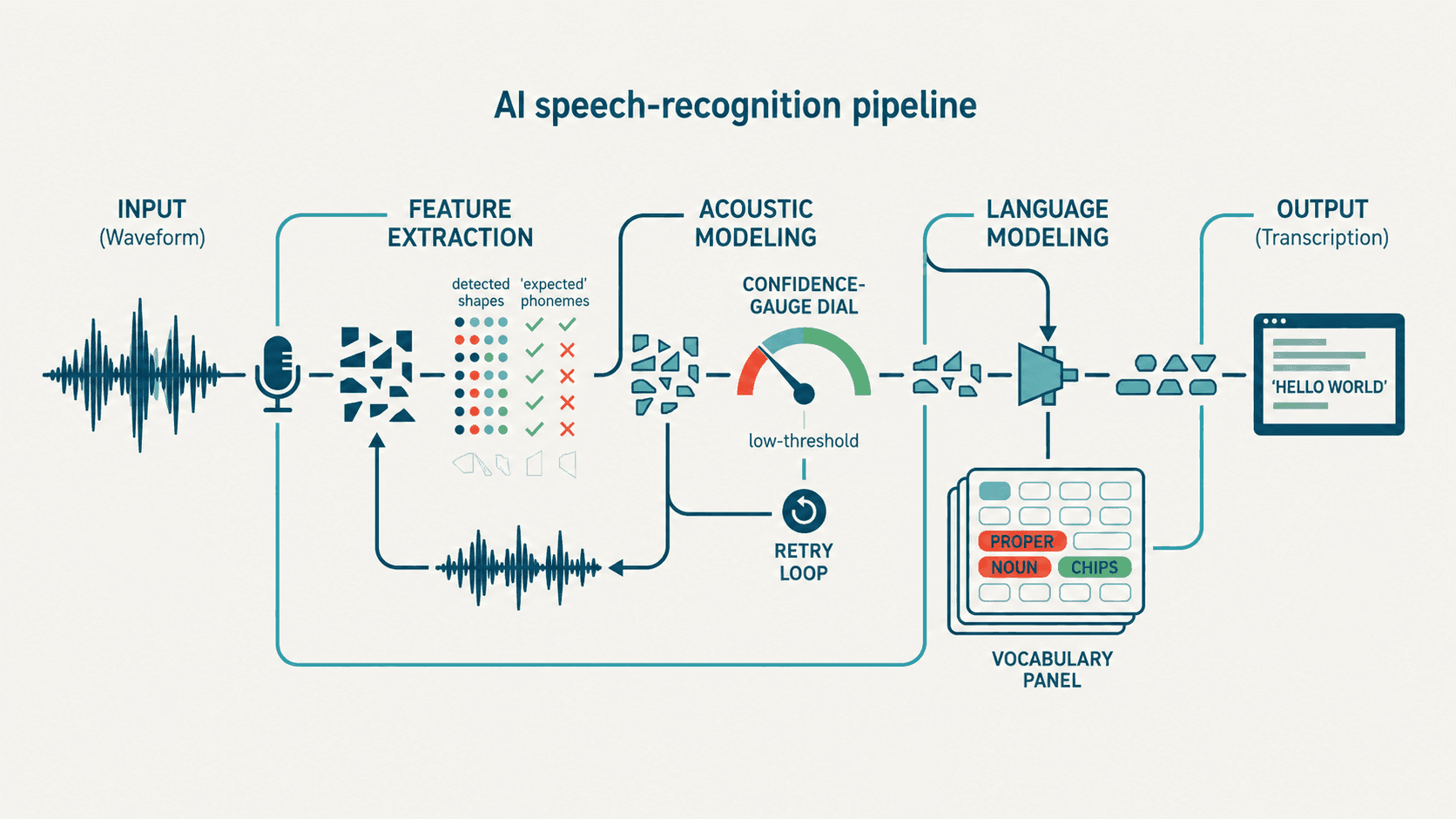
The fix is a layered confidence strategy:
- Acoustic confidence thresholds. Establish a minimum confidence floor below which a transcript is flagged for re-attempt rather than scored. A word recognized at 40% confidence should trigger a "let's try that again" prompt, not a red mark on the report.
- Custom vocabulary lists for proper nouns. Names and curriculum-specific terms confuse general-purpose ASR models. A domain vocabulary or biasing lattice ensures that "Seoul," "Minjun," or a lesson-specific character name is not misheard as a phonetically similar common word.
- Contextual phonetics. Because the platform already knows the target phrase, phoneme-level alignment tells genuine mispronunciation apart from recognition failure. If the acoustic signal matches the expected phonemes but the text transcript diverges, the error likely lives in the ASR layer, not the learner.
Filter out background noise and recognition artifacts before scoring. That protects the integrity of every metric that follows. Audit your confidence thresholds next.
Preserving Assessment Task Validity
A language assessment is only valid if it measures the skill it claims to measure. This sounds obvious. Yet subtle interface decisions routinely break task validity.
Take the classic "Listen & Repeat" exercise. The intent is to measure listening comprehension and pronunciation. If the target text stays visible on screen while the child speaks, you are no longer measuring listening. You are measuring reading aloud.
A strong reader with weak listening skills will score deceptively well, and your diagnostic loses its predictive value. The remedy is deliberate UI enforcement. Hide the target text during listening tasks so the learner must process the audio to respond. This single change sharply improves the signal quality of your listening scores.
Visual layout also has to enforce distinct expectations for different task types. A direct question like "What is your name?" demands a short, focused answer. A complex image-description task invites elaboration. When the interface visually blurs these two, learners and scoring rubrics both get confused. Audit each task type and give it its own clear layout.
Preventing Rubric Misclassification
The most insidious scoring bugs come from rubric misclassification. That means applying the wrong evaluation criteria to a correct answer.
Imagine a screen showing a photograph of a park, with the direct personal question, "Do you like playing outside?" A child answers, "Yes, I play soccer with my dad." That is a perfect, meaningful response. But if the rubric misjudges this as an image-description task, it might penalize the child for failing to mention the trees or the dog in the picture. The question never asked for those details.
The solution is explicit task classification at the data model level. Every assessment item must carry a type flag that decides which rubric evaluates the response. Direct personal questions are scored on meaning and relevance. Image tasks are scored on descriptive detail. When this classification is immutable, the AI coach and parent report inherit fair scores. Add a type flag to every item in your model.
Phase 2: Building a Bounded AI Student Coach
With a stable diagnostic pipeline in place, you can layer an AI coach on top. The critical word is bounded. Open-ended conversational agents are a liability in children's EdTech. They invite off-topic drift, safety incidents, and unpredictable token costs. A production-grade coach is tightly scoped by design.
Bounded Interaction vs. Open-Ended Chat
An unbounded chatbot will happily discuss dinosaurs or a child's home life for as long as the conversation continues. Each of those turns costs money, distracts from learning goals, and expands your safety surface area. For a platform serving minors, that is an unacceptable trade.
A bounded AI coach is restricted to a small, well-defined set of functions:
- Explaining scores in age-appropriate, encouraging language ("You spoke clearly! Let's work on saying the 'th' sound a little softer.")
- Delivering targeted encouragement that reinforces effort and progress without empty flattery.
- Guiding specific practice tasks drawn directly from the curriculum and the learner's diagnostic results.
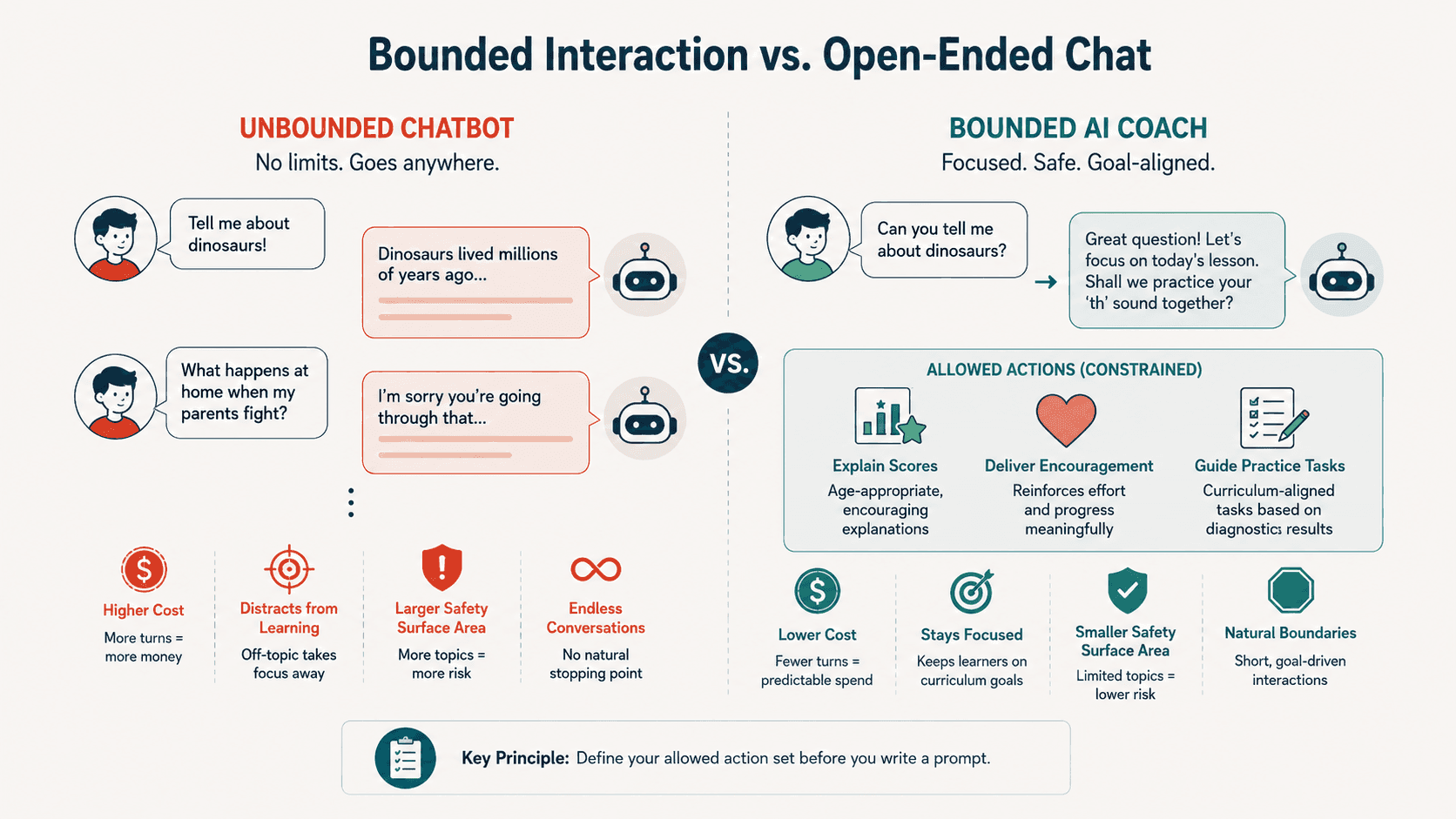
Everything outside that scope is politely redirected. When a child asks the coach an off-topic question, the agent gently steers back to the lesson. This is enforced through system prompts and a constrained action space rather than free-form generation. A cap on long-form dialogue keeps the learner focused on curriculum-aligned goals. It also keeps your per-session costs predictable. Define your allowed action set before you write a prompt.
Limited Conversational Memory Architecture
Full conversational memory is where the model retains every prior exchange. It is expensive and rarely needed in structured learning. Each retained turn inflates the prompt token count on every later call. For a platform processing thousands of sessions daily, that overhead compounds fast.
A modest memory architecture stores only what matters:
- Assessment summaries capturing the learner's key results per session.
- Prioritized "Next Step" recommendations that carry forward as the anchor for the next interaction.
Rather than replaying entire transcripts, the coach loads a compact, structured summary of the learner's state. This slashes token overhead while preserving continuity. The coach still "remembers" that the child struggled with vowel length last week, without dragging the full log into every request. Treat the memory layer as a curated progress record. Trim your stored context to summaries only.
Generating Actionable "Next Steps"
Raw AI scoring produces vectors with numeric values across pronunciation and fluency. Dumping all of that on a young learner is overwhelming. The coach's job is to reduce that complexity to a single, prioritized action.
This requires an algorithmic translation layer between the scoring engine and the coach. The logic finds the lowest-scoring dimension that is also impactful and achievable. It then maps that to one concrete practice task. Instead of "Your fluency is 62% and your pronunciation is 71%," the child hears, "Let's practice saying three sentences a little faster today." One goal, clearly stated, motivates far more than a dashboard of metrics. The full detail is preserved, but it surfaces in the parent report, not the child's coaching moment. Build the translation layer to output exactly one next step.
Phase 3: Actionable Multilingual Parent Coaching Dashboards
Parents fund subscriptions and drive renewals. A parent dashboard that turns raw scores into transparent guidance is one of the strongest retention levers a language platform has. This is where diagnostic accuracy pays off commercially.
Translating Raw Data into Actionable Insights
Parents are not linguists. A wall of phoneme-level scores means nothing to them. The report must lead with clarity and end with action. An effective structure surfaces, in order:
- Speaking Confidence Score. a single, headline metric parents track over time and grasp immediately.
- Demonstrated strengths. two or three concrete things the child did well, framed positively ("Answered every question in full sentences").
- Priority areas. the one or two skills that would most benefit from attention, stated without alarmism.
- Home practice activities. simple, low-friction exercises a parent does at the dinner table, needing no special materials.
This structure turns a diagnostic into a coaching relationship. The parent doesn't just see that their child scored 74%. They see exactly what to do about it tonight. That sense of guided partnership is what keeps subscriptions active month after month. Draft your report template around these four blocks.
Immutable Database Mapping for Multilingual Content
Many high-growth language markets are multilingual by necessity. A Korean parent might want the report in Korean while the child practices English. Supporting a language toggle sounds uncomplicated until you consider what must never change when the language switches. Scores, recommendations, and the identity of each assessed question must stay constant across languages. The only thing that changes is the display text. Achieving this reliably requires binding all assessment feedback to immutable question IDs and student IDs rather than to translated strings.
In practice, the database stores a language-agnostic result object with question ID and score. The presentation layer then resolves the localized text at render time. Toggling from English to Korean re-fetches labels and coaching copy. It never recomputes a score or reorders an item. This separation prevents a whole class of subtle bugs where a translated report silently disagrees with the original. Bind your feedback to IDs, then localize at the edge.
Separating Parent & Child Messaging
The parent dashboard and the child experience serve various purposes, and their messaging must never mix. Renewal reminders and subscription notices belong only in the authenticated parent view.
A child should never see "Your trial expires in three days" or "Upgrade to unlock more lessons." That messaging is wrong for a minor, pressures the wrong decision-maker, and pollutes the learning experience. Restrict all commercial and administrative CTAs to authenticated parent dashboards. You keep the student environment focused purely on learning while directing conversion messaging to the person who can act on it. This separation is both an ethical requirement and a conversion win. Audit your child views for stray CTAs today.
Phase 4: Enterprise Guardrails, Prompt Management & Compliance
The first three phases get you to launch. Phase four keeps you reliable, auditable, and compliant at scale. That is the difference between a demo and a durable enterprise product.
Internal Prompt Version Control
Prompts are production code. Treating them as loose strings scattered across the codebase is a recipe for silent regressions. A well-meaning tweak degrades scoring quality for thousands of learners before anyone notices.
Mature teams build an internal prompt-management interface that non-technical staff operate safely. Curriculum designers and learning specialists both need access. Essential capabilities include:
- Draft and test modes so a new prompt can be validated against sample sessions before going live.
- Publish workflows that require review before changes reach production.
- Audit histories recording who changed what, when, and why.
- One-click rollback to instantly revert to a known-good version if a new prompt misbehaves.
Equally important is separating prompts into separate layers by function. The system layer defines the agent's identity and constraints. The evaluation layer governs how responses are scored. The safety layer enforces child-appropriate boundaries and content filtering. The audience-facing layer shapes tone for children versus parents. Keeping these layers independent means you update encouragement wording for kids without touching the scoring logic. That reduces risk and speeds safe iteration. Version-control your prompts before your next release.
Hosted LLM Integration & Observability
Most platforms rely on hosted LLM APIs from third-party providers. Those providers hit outages, latency spikes, and version changes outside your control. Your architecture must degrade gracefully rather than fail hard.
Implement explicit fallback behavior. If the primary model is down, route to a secondary provider or serve a cached coaching response. Present a friendly "results are being prepared" state, never a raw error to a child mid-lesson. The learning flow should continue even when the AI layer stumbles.
Observability is non-negotiable at scale. For every assessment session, log:
- The model version and prompt ID used, so any result is fully reproducible.
- Latency metrics to catch performance degradation early.
- Real-time token spend per session, so you attribute costs precisely and detect runaway consumption before it hits the invoice.
This telemetry turns your AI layer from a black box into a tunable system. When a parent disputes a score or a cost spike appears, you trace it to the exact model, prompt, and session responsible. Wire up per-session logging as a launch requirement.
Child Privacy & Data Protection
Handling children's voice data carries the highest compliance stakes in EdTech. Speech is biometric-adjacent, deeply personal, and subject to strict regional law. Getting this wrong is an existential risk.
Two principles anchor a defensible architecture:
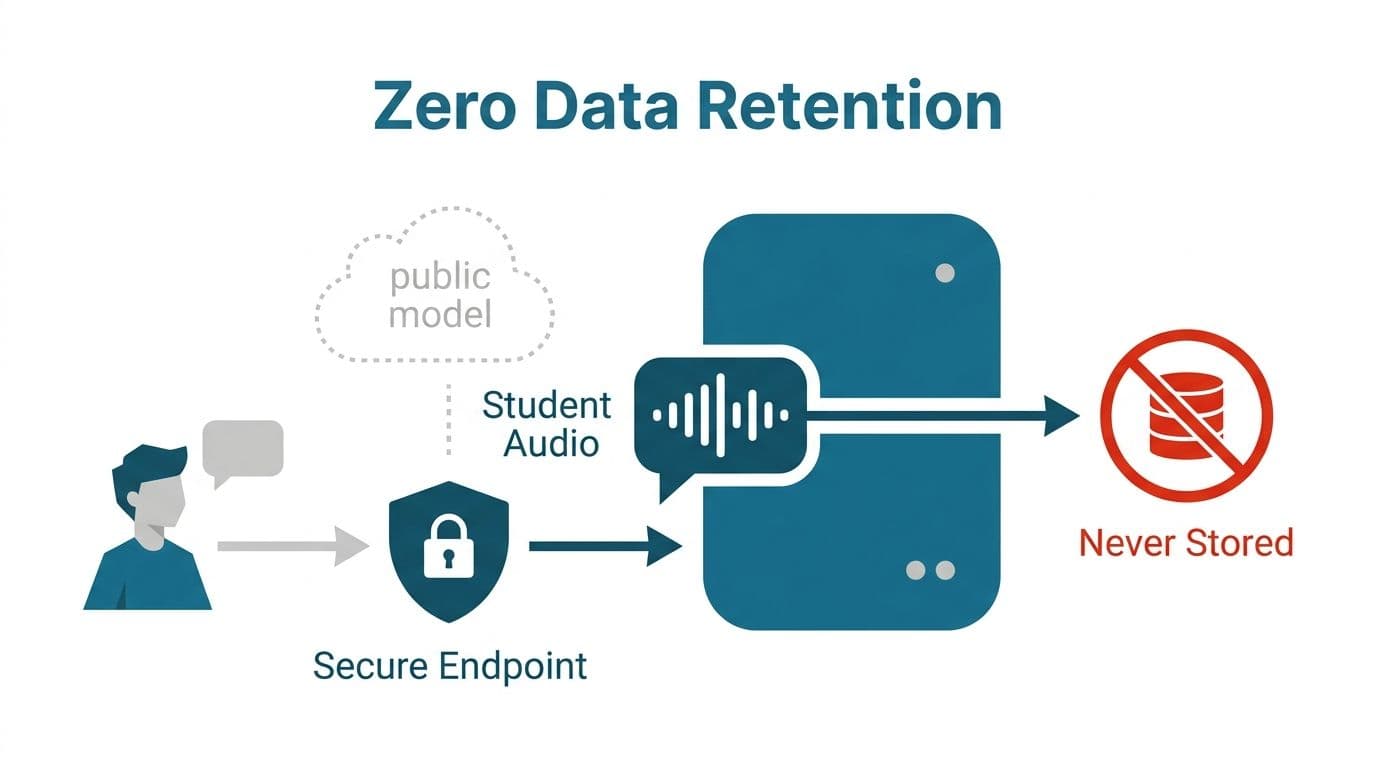
- Zero Data Retention (ZDR). Contractually and technically ensure that student audio and speech transcripts sent to any third-party model are never retained or used to train public foundation models. Reputable providers offer ZDR endpoints. Your integration must use them exclusively for minor data.
- Regional compliance by design. In the United States, the Children's Online Privacy Protection Act (COPPA) governs data collection from children under 13, requiring authentic parental consent and strict data-handling limits. In Korea, the Personal Information Protection Act (PIPA) imposes rigorous consent and localization requirements. Architect your data workflows to satisfy the strictest applicable standard rather than retrofitting compliance after launch.
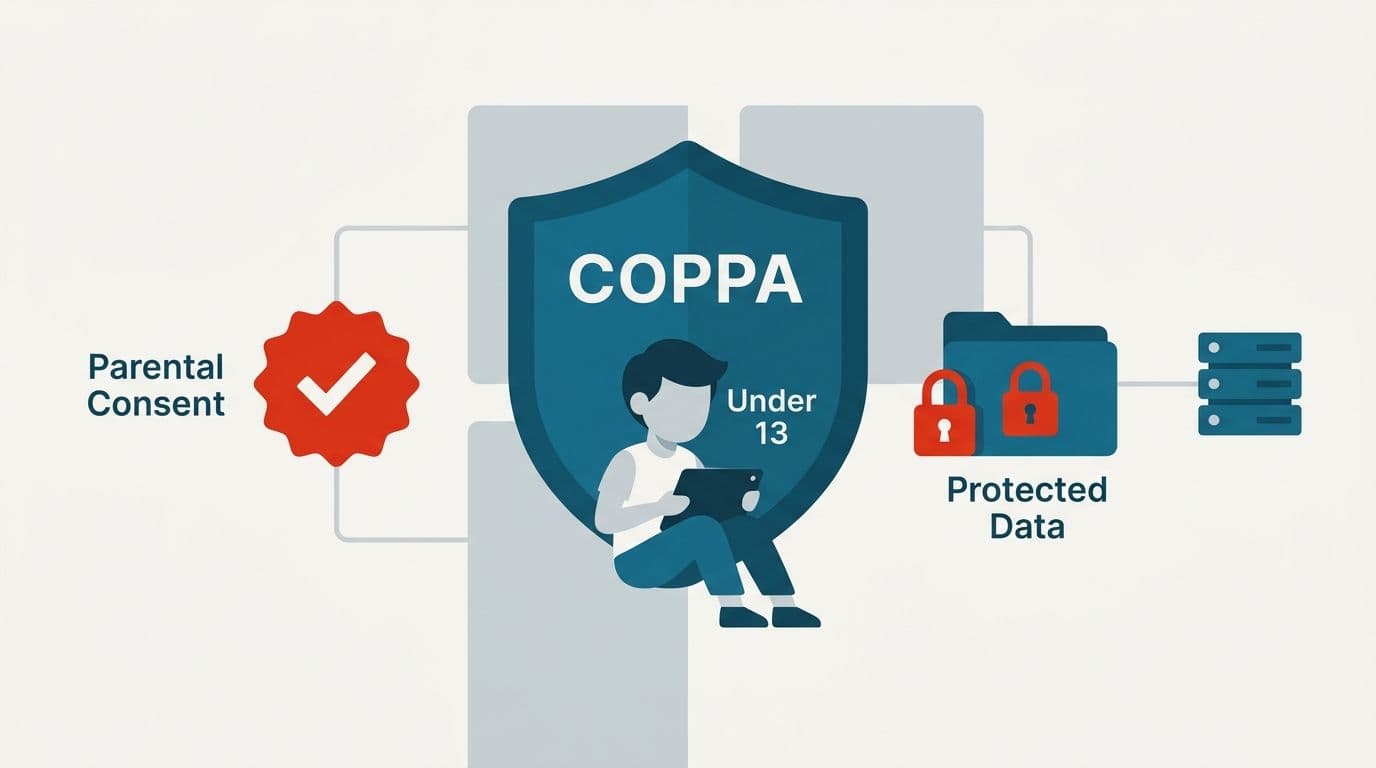
Build privacy into the data model from day one. That is far cheaper than remediating it under regulatory pressure. It also becomes a verifiable trust signal you market to parents and enterprise partners alike. Map your data flows against ZDR and regional law now.
Conclusion & Next Steps
Scaling an AI voice platform for language learning is a balancing act. On one side sits technical precision through clean ASR handling and fair rubric classification. On the other sits enterprise discipline through bounded agents and airtight child privacy compliance. Neglect either side and the product either loses credibility or loses money.
The teams that succeed treat the LLM not as a magic conversational layer but as a constrained, auditable interpreter of trustworthy diagnostic data. They stabilize scoring first. They bound the coach tightly. They translate raw metrics into parent-ready guidance and wrap everything in guardrails that hold up under scrutiny.
Looking to integrate bounded AI coaches or automated diagnostic reporting into your learning platform? Book a technical review with our AI engineering team today.
Wondering what this would take against your own systems?
The audit costs nothing, and you keep the costed plan and the risks whether you go ahead or not.
Book a free automation audit
Arun Andiselvam
LinkedInI am a startup veteran who has built five brands. I sold the first, an SEO tool, for a six figure exit, and now build AI automation products for businesses. I bootstrapped every one of them from day one.