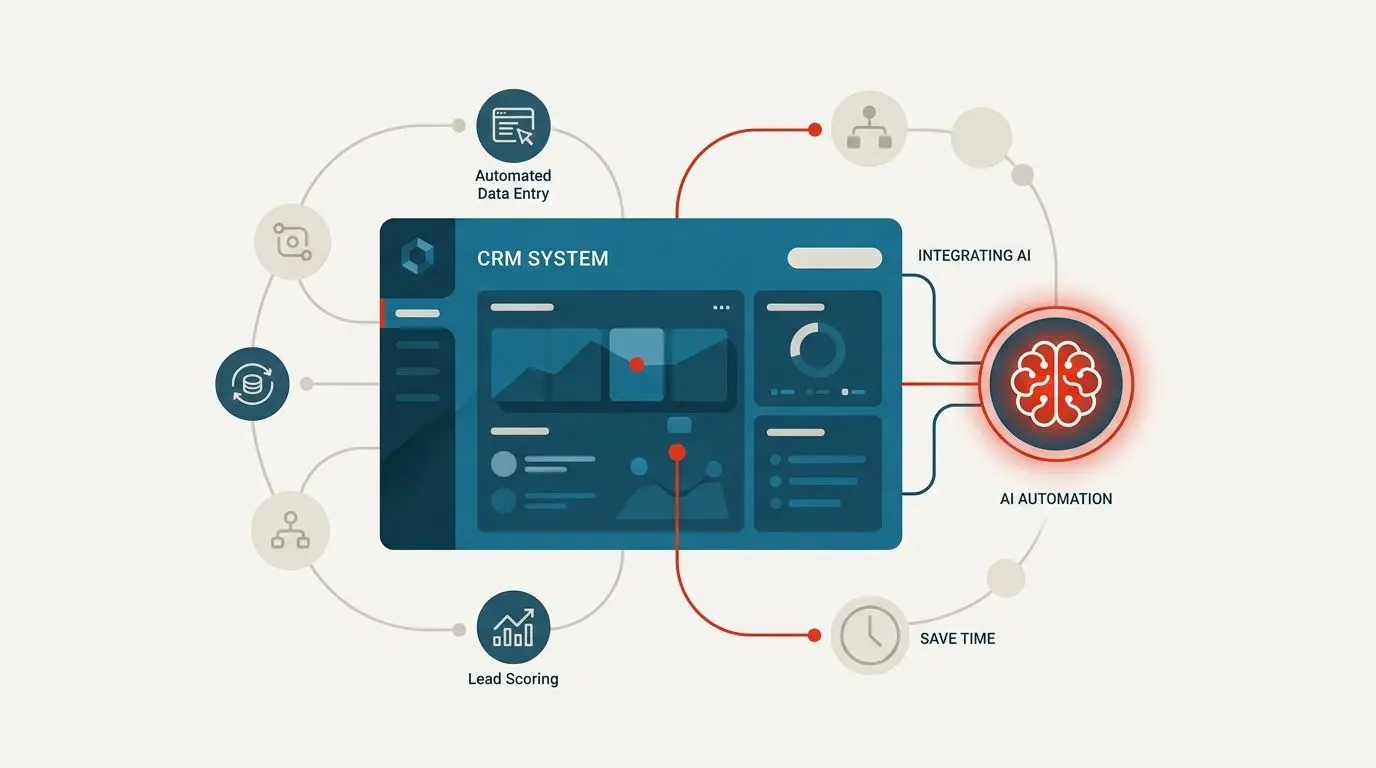
Payments at an early-stage fintech are rarely designed. They accrete. Someone wires up a processor integration in week three because a customer needs to pay. A few months later, an operations hire starts doing reconciliation in a spreadsheet every Friday afternoon. A Slack channel appears where failed payouts get flagged by hand. Someone remembers to retry them. Each piece was a reasonable local decision. Together they form a system nobody drew on a whiteboard. Nobody fully understands it either.
That arrangement works until it doesn't. The trigger is always one of three things. Volume climbs past what a human can watch. A second currency introduces settlement timing you didn't model. An audit arrives and someone asks where a specific $4,000 went and why. The honest starting point for any conversation about payment workflow automation in fintech is stark. At least one system in your chain, very often the accounting system, does not integrate cleanly with the others. Good architecture survives that fact rather than pretending it away.
The stakes here differ from ordinary software. A payment automation failure moves real money. It stays invisible until reconciliation catches it days later. It sits in the category of bug that regulators and card networks ask about. So this is not a tutorial. It describes what a correct system looks like. It also shows what each shortcut costs you when it breaks.
"Payment workflow" isn't one thing
The first mistake is treating "payments" as a single pipeline. It splits into three distinct domains. They fail in different ways.
Collection is money in. This covers charges, subscription billing, dunning sequences, and mandate handling for direct debit. Revenue lives here, so it gets attention. Map your retry logic against soft declines before you widen anything else.
Payouts are money out. This means disbursements to users or partners, batching, and settlement confirmation. A mistake here is costly and hard to claw back. Start by defining who or what triggers each release.
Exceptions are the layer between the two. Think failed charges, disputes and chargebacks, mismatched amounts, and everything else needing a human to decide. Build a structured intake for these before the volume forces it on you.
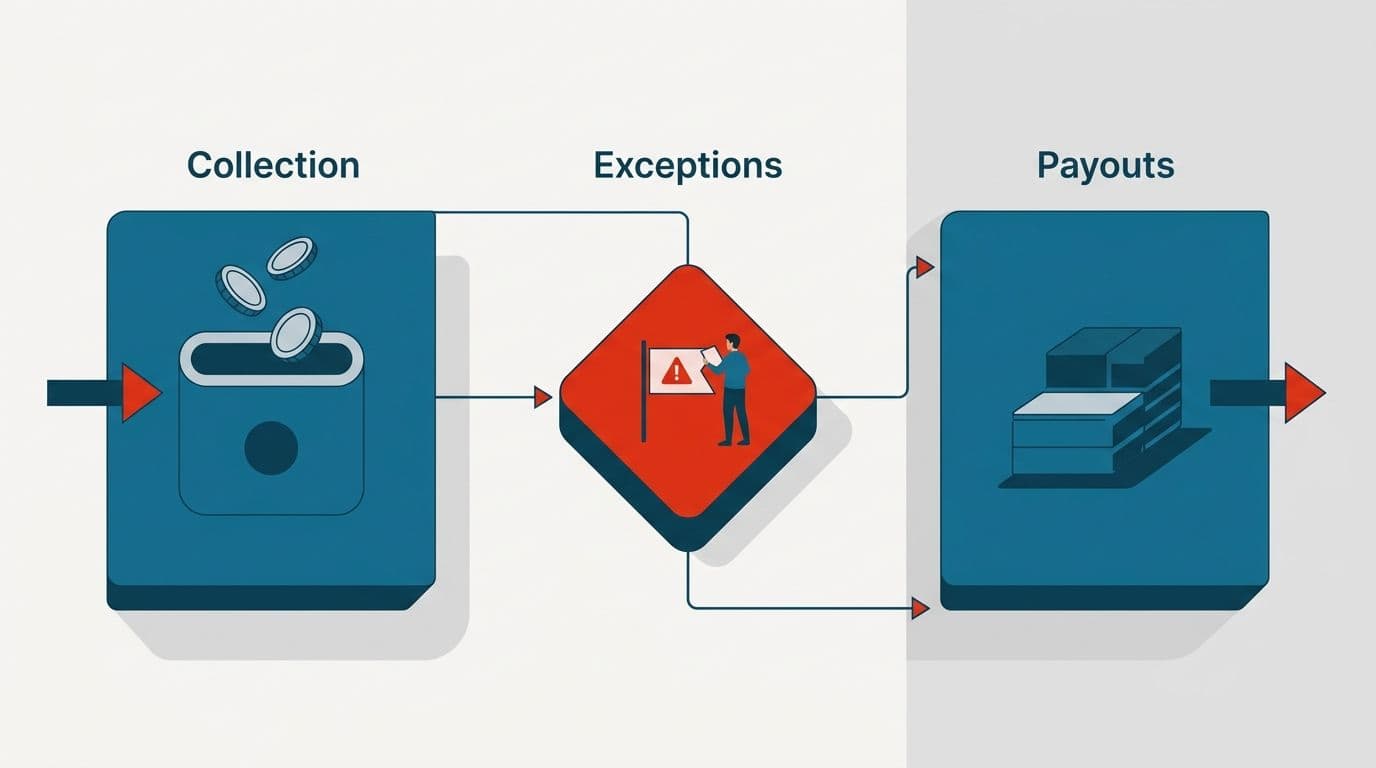
Here is the pattern almost every startup follows. It runs exactly backwards. They automate collection first because revenue is visible and the ROI is obvious. They leave payouts manual because manual feels safer. A person clicking approve seems like a control. And they never build the exception layer at all, because it doesn't map to a feature anyone asked for.
The inversion is that the exception layer makes the other two trustworthy. Automated collection without exception handling means silent revenue leakage. Manual payouts without a structured exception path means errors get resolved in DMs with no audit trail. The layer you skip determines whether you trust the two you built. Decide today which layer you're missing.
The integration layer: when the API doesn't exist
The hardest engineering in payment automation is rarely the payment itself. It comes from getting a consistent view across systems that were never designed to talk to each other.
The pattern that holds up is capture once, submit to many. You take payment intent in through a single intake path. Then you fan it out to N downstream destinations, the processor, the ledger, and a partner bank portal, each with its own independent status. One record of truth at intake, multiple downstream states, and no assumption that all destinations succeed together. This is the core of payment orchestration. The intake is decoupled from the destinations, so a slow or broken destination degrades one path instead of the whole flow.
Where those destinations expose APIs, you integrate against them. Where they don't, and in finance plenty don't, you are sometimes left automating a human logging into a portal. Headless browser automation is a legitimate answer to this, not a hack. It carries a maintenance cost you have to price in honestly. Portal redesigns break your selectors without warning. Credentials rotate and sessions expire. There is no versioning and no deprecation notice. The vendor changes their UI on a Tuesday and your integration is down until someone notices.
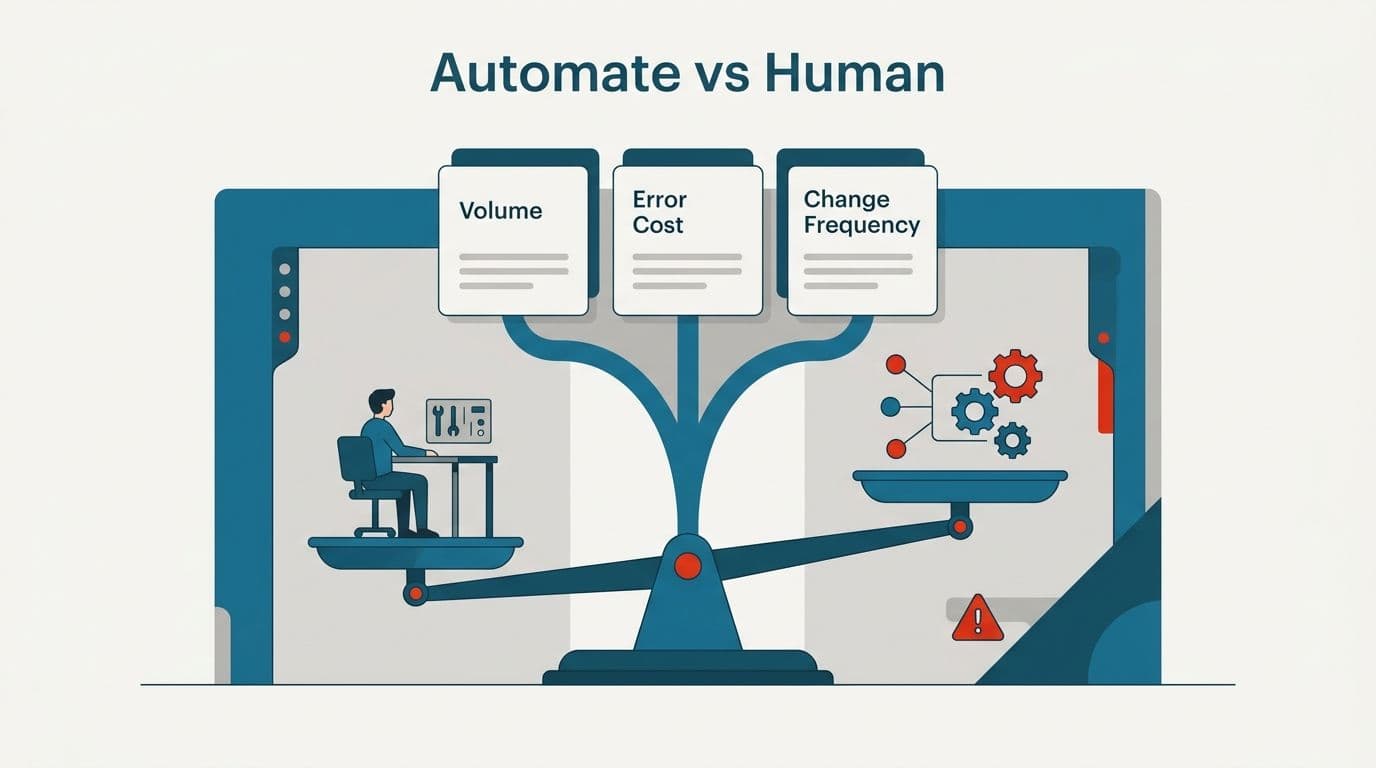
That cost is exactly what makes the next decision a real one. Do you automate the integration, or automate the human? The criteria are worth stating plainly:
- Volume. A portal you touch twice a month does not justify a brittle scraper. One you touch two hundred times a day does.
- Error cost. If a mistake in this path moves significant money or is hard to reverse, the reliability of a maintained integration is worth more.
- Change frequency at the vendor. A stable government portal is a safer automation target than a startup bank that redesigns quarterly.
When volume is low, error cost is high, and the vendor changes often, keep the human and give them tooling. Otherwise, invest in the integration.
The deliverable that all of this produces is status visibility. The business outcome your team recognises is seeing the state of every transaction across every destination without logging into each portal separately. That single pane, where is this payment and which leg succeeded, is worth more than the automation of any separate step. Our work on financial data automation tends to start here, because you cannot safely automate what you cannot see. Map your current blind spots first.
Execution: the four things that break
A note for reviewers: this section is the technical heart of the topic and should get a review pass from someone who has shipped payment infrastructure in your specific stack before it goes live. The principles are stable. the implementation details are not one-size-fits-all.
Four failure modes account for the large majority of production incidents in payment execution. Get these right and most of the rest is tractable. Walk through each one against your own stack now.
Idempotency
Every operation that moves money needs a client-generated idempotency key. The client, your service, generates a unique key per logical operation and sends it with the request. If the request is retried for any reason, the processor recognises the key and returns the original result instead of executing a second time.
The reason this matters is that networks fail after the money moves but before you get the response. Without an idempotency key, your retry logic cannot tell "the charge didn't happen" from "the charge happened but the acknowledgement got lost." So it retries, and you charge the customer twice. Idempotency in payment systems is the difference between a safe retry and a duplicate charge. The cost of getting it wrong is not just the refund. It is the chargeback fees and the eroded trust that follows a customer seeing two identical debits. Add idempotency keys before you touch anything else.
Retries
Automated payment retries are necessary because transient failures are constant. The discipline is knowing what to retry and how.
Use exponential backoff with jitter so that a processor blip doesn't turn into a retry storm the moment it recovers. More importantly, distinguish retryable failures from terminal ones. A network timeout or a processor 5xx is retryable. The operation might simply not have completed. A blocked card or a hard decline is terminal. Retrying changes nothing about the outcome.
This distinction is not just efficiency. Repeatedly retrying a terminal decline gets a merchant flagged by the card networks for excessive attempts, which raises your decline rates and puts your processing relationship at risk. Retry the transient, respect the terminal, and cap the attempts. Audit your current retry ceiling this week.
Webhooks
Processors tell you what happened through webhooks. Webhooks are unreliable by nature. Design for it. Assume delivery arrives out of order. The succeeded event can arrive before the pending one. Assume it will be duplicated. You will get the same event twice. Assume it will be delayed, showing up minutes or hours late.
Always verify the signature on every webhook to confirm it came from the processor. This blocks an attacker who found your endpoint. And never treat a webhook as the source of truth on its own. A webhook is a hint that something changed. You reconcile against the processor's API to confirm the actual state before you act. Systems that trust webhooks blindly ship the wrong outcome whenever one is spoofed or dropped. Add signature verification to every endpoint today.
State machines
The single change that prevents the most incidents is modelling payment state as an explicit state machine rather than inferring it from a scatter of booleans. is_paid, is_refunded, is_disputed as independent flags produce impossible combinations, like refunded and paid, and the code that reads them has to guess.
Instead, enumerate the states a payment can be in and the legal transitions between them. A payment goes created → authorised → captured → settled, with defined branches to failed, refunded, and disputed. Any transition not in the map is rejected, not silently applied. This makes illegal states unrepresentable. It turns "how did this payment get here?" into a readable history. It gives your reconciliation layer a clean model to compare against. Sketch your state map before writing another line.
Reconciliation
Also flagged for review. This section, alongside exception handling, is what separates a payment system you can trust from one that merely runs.
Here is the truth that reconciliation exists to manage. Your internal ledger, the processor's records, and the bank's settlement file will disagree. Timing differences, fees deducted at settlement, and reversals that cross a day boundary make disagreement the normal state. Payment reconciliation automation does not prevent the disagreement. It detects it quickly and tells you which disagreements matter.
The core is a daily reconciliation loop. Pull the processor's transaction records and the bank's settlement file. Match them against your internal ledger by transaction. Classify every line as matched, missing on one side, or amount-mismatched.
Not every mismatch deserves a human. Set tolerance thresholds. A few cents of expected rounding on a foreign-currency transaction auto-resolves. A $500 gap does not. Define what gets auto-resolved, like known fee deductions, versus what gets escalated, like an amount that doesn't reconcile within tolerance. The output is a short, ranked list of genuine breaks for a human to investigate. Not a spreadsheet of thousands of rows they'll never read.
The reason reconciliation is the load-bearing wall is that it is your independent check on everything else. If your idempotency, retries, and state machine are all correct, reconciliation confirms it daily. If one of them is subtly wrong, reconciliation is how you find out in a day instead of at audit. Stand up the daily loop before you scale volume.
Exceptions and alerting
The design principle to hold onto is simple to state and uncomplicated to violate. The system flags failed submissions rather than silently dropping them. A payment that couldn't be processed or a payout that a portal rejected should never vanish. Every one should surface somewhere a human will see it.
On top of that, automated alerts for unusual activity and missed items, like a spike in declines or a settlement that didn't arrive, catch the problems that don't announce themselves as errors.
The trap is alert fatigue. A channel that fires on everything gets muted within a month. Then you have the illusion of monitoring with none of the substance. Good alert design routes deliberately:
- Auto-retry the transient and don't alert a human unless retries are exhausted.
- Route to a person only what genuinely needs a decision, like a dispute or a payout held for review.
- Suppress and aggregate the noise: batch low-priority notifications and dedupe repeated alerts for the same root cause.
The concrete workflow that anchors this is payment and outstanding-item monitoring. A continuous check confirms that expected inflows arrived and expected outflows completed, with anything unresolved past its window escalated automatically. This is the kind of ongoing, judgment-bearing monitoring that autonomous AI agents handle well, triaging exceptions and escalating only what a human needs to decide. Draft your routing rules before you wire the first alert.
Controls on money leaving
Payout automation makes people nervous, and the instinct is to keep it manual. That instinct is right about the risk and wrong about the remedy. The remedy is not human clicking. It is structured controls.
- Approval thresholds. Small, routine payouts flow automatically. Larger ones require review, with the bar set where it reflects real risk.
- Dual authorisation above a limit. Past a defined amount, two people must approve, so no single compromised credential can release a large payout alone.
- Allowlisted destinations. New payout destinations are held for verification before they can receive funds, which closes off the most common fraud path.
- Velocity caps. Limits on how much can leave in a given window, so a bug or a breach can't drain an account before anyone reacts.
- A complete audit trail. Every payout carries who or what initiated it, who approved it, and the full state history, non-negotiable for both incident response and audit.
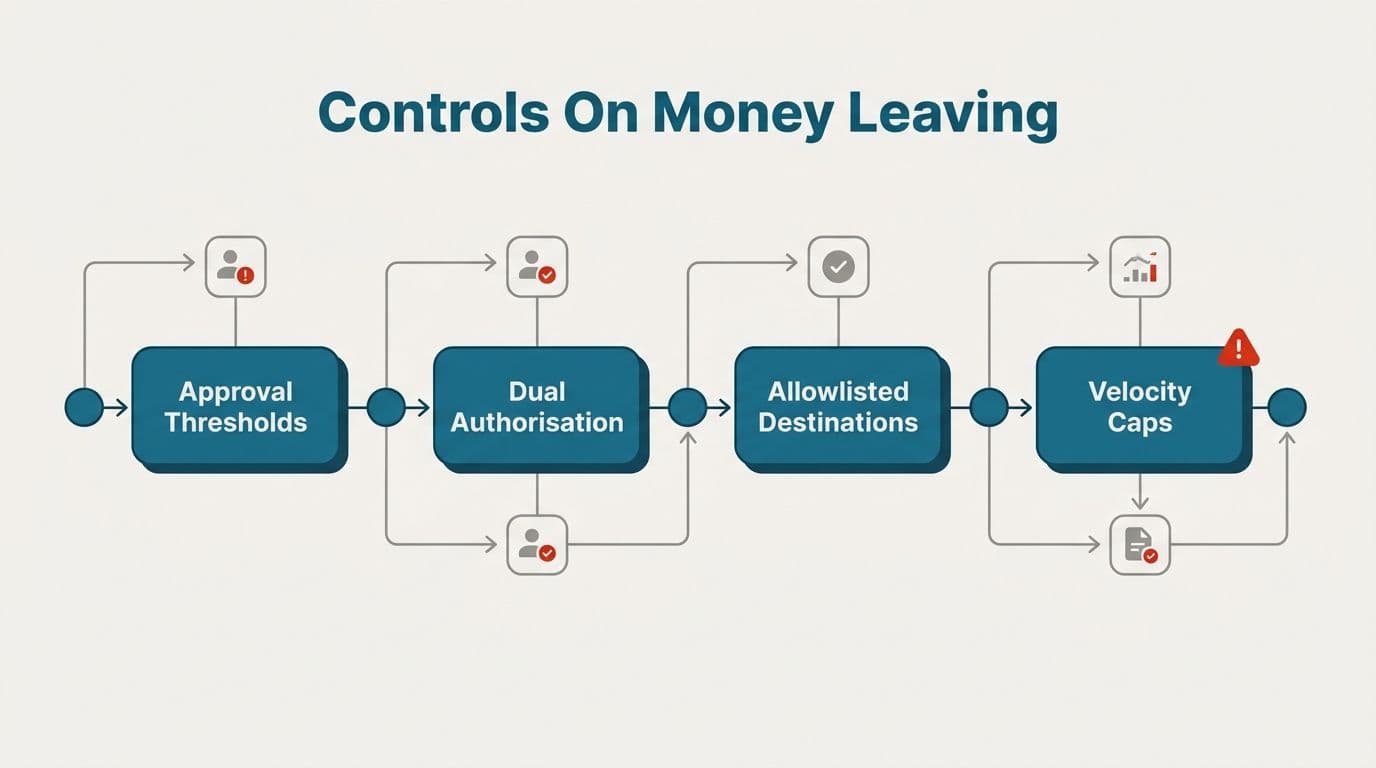
The framing that matters is this. Automation increases the blast radius of a mistake. A manual error moves one payout. An automated error moves every payout until someone stops it. So controls should tighten as automation increases, not relax, the opposite of what teams usually assume. The more you automate money leaving, the stronger the guardrails around it need to be. The same logic applies to more complex internal flows. We covered a related case in automating intercompany loans with AI. Set your dual-authorisation limit before you flip on any automated payout.
Security and compliance
Practices
A handful of practices are non-negotiable and transfer to any stack:
- Encrypt PII in transit and at rest. No plaintext sensitive data on the wire or on disk.
- Never log secrets or full card data in plaintext. Logs leak, get shipped to third-party tools, and outlive the data they contain. Redact at the source.
- Limit retention to what the transaction requires. Data you don't store is data you can't lose. Keep what the transaction and your obligations demand, and no more.
- Keep credentials in a secrets manager, never hardcoded. No API keys in source, no passwords in config files committed to a repo.
Run a quick audit against these four before your next release.
Regulation
The regulatory layer here is general guidance, not legal advice, and needs review against your jurisdictions and licences.
Handle compliance in layers rather than as one undifferentiated wall.
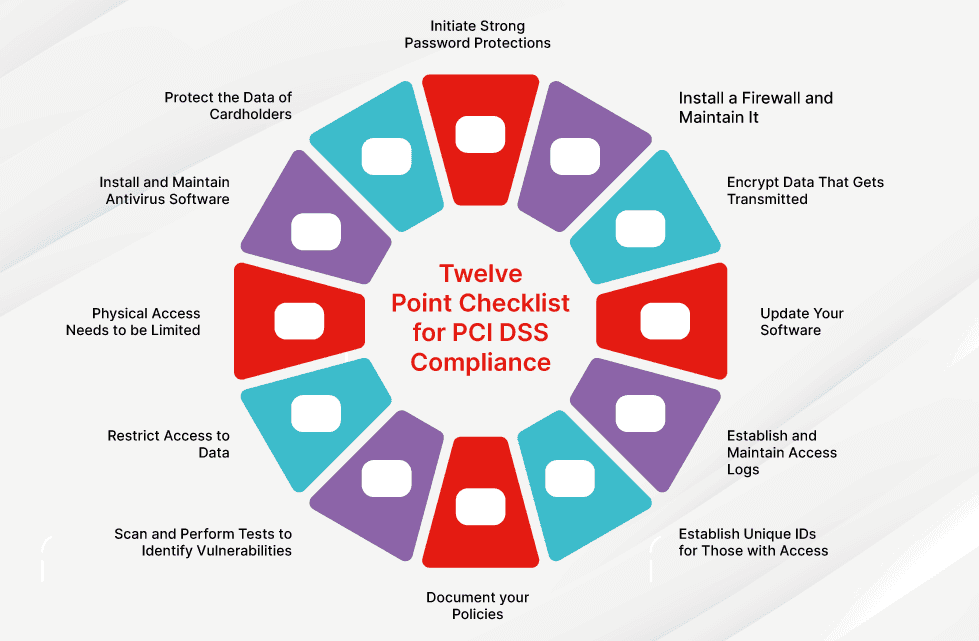
PCI DSS is the genuinely universal one. If you touch card data, it applies. The practical advice is PCI DSS scope reduction. Use tokenisation and hosted fields so that raw card data never touches your servers. The less cardholder data flows through your systems, the smaller your compliance burden and breach exposure. This is the single highest-leverage compliance decision most startups make.
Beyond PCI, almost everything is jurisdictional, and you should not assume a blog post covers your obligations. Strong Customer Authentication under PSD2 shapes flows in the UK and EU. RBI rules and the card tokenisation mandate govern India. State money transmitter licensing shapes what you can do in the US. These are not interchangeable, and getting a licence question wrong is not a bug you patch.
Finally, KYC and AML are workflow steps that automation must accommodate, not route around. Identity verification and sanctions screening belong inside your payment flow as gates. A payout to an unverified party should not be a thing your system can do. Automation that treats compliance as an obstacle to bypass is how startups end up in enforcement actions. Confirm your KYC gates sit inside the flow, not beside it.
Sequencing the build
You cannot build all of this at once, and you shouldn't try. Two disciplines keep the sequence sane.
First, don't automate everything. Identify the five to ten highest-impact workflows and implement those properly, end to end, rather than half-automating twenty. Depth beats breadth. A fully reliable reconciliation loop is worth more than a dozen fragile scripts.
Second, respect the milestones. Move through architecture, then beta, then delivery. Design the state model and the integration boundaries before writing execution code. Prove it against real data in a controlled beta. Then widen the aperture. Skipping the architecture step is how you end up back at the accreted mess you were trying to escape.
And on what to automate first: it is usually reconciliation and alerting, not the flashier execution work. This feels counterintuitive. Reconciliation doesn't move money faster or close a customer. But you need to see the system clearly before you let it move money faster. Reconciliation and monitoring are the instruments. Execution automation is the engine. Build the instruments first, or you are accelerating blind. This is the sequencing logic behind our AI workflow automation approach to fintech and finance systems generally. Pick your first ten workflows this week.
The part that actually matters
The difference between a payment system that scales and one that quietly falls apart is not throughput. It is exception handling and reconciliation, the unglamorous layers that tell you the truth about what your automation is doing. Get those right and you can automate boldly with confidence. Skip them and every added transaction is another chance for a silent failure you'll find at audit.
If you're mapping out payment workflow automation and want a second set of eyes on the architecture before you ship it, talk to us.
Wondering what this would take against your own systems?
The audit costs nothing, and you keep the costed plan and the risks whether you go ahead or not.
Book a free automation audit
Arun Andiselvam
LinkedInI am a startup veteran who has built five brands. I sold the first, an SEO tool, for a six figure exit, and now build AI automation products for businesses. I bootstrapped every one of them from day one.