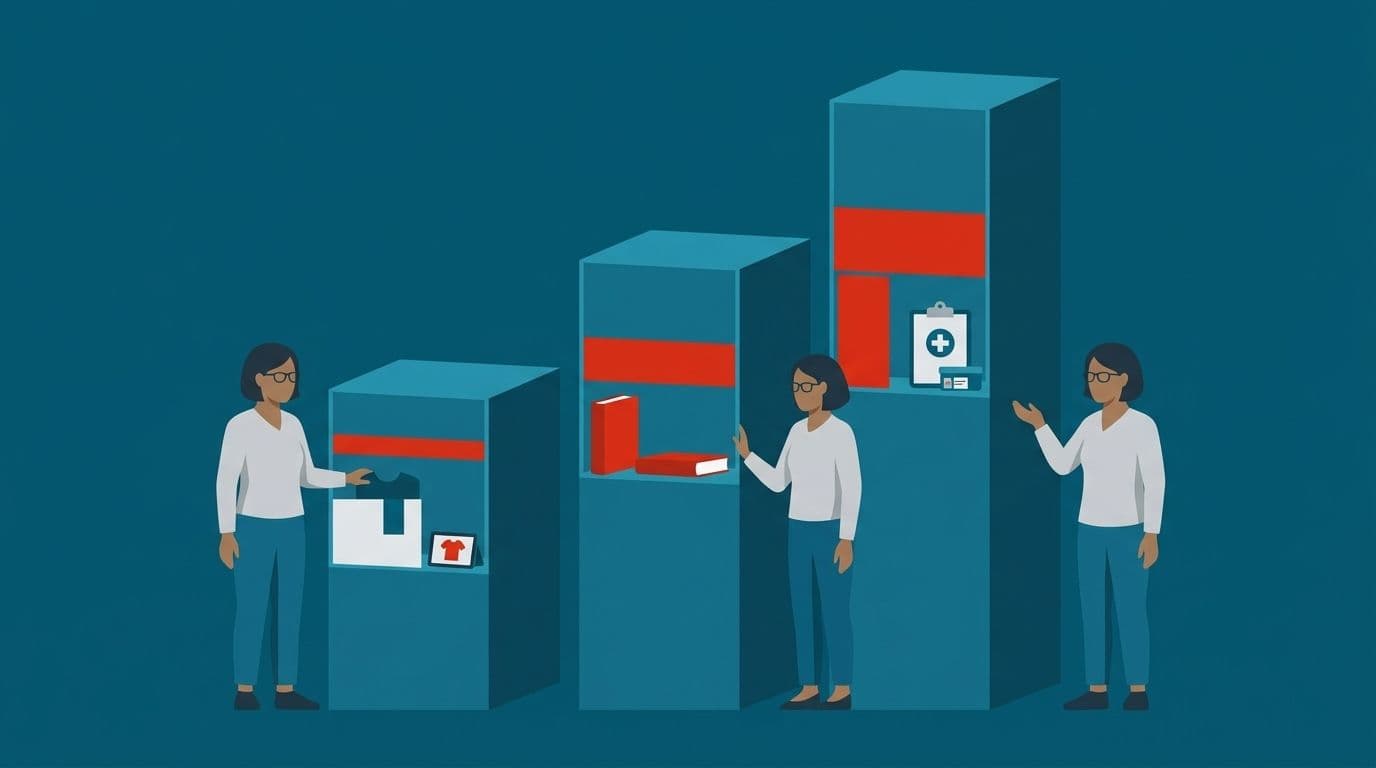
A clinic director called us last spring with a quote in hand. Someone had priced an AI intake assistant for her practice at a number that looked reasonable until she read the fine print. The integration with her electronic health record system was excluded. Compliance architecture was "to be scoped," and the model costs were listed as pass-through. By the time she added the missing pieces, the real figure was roughly triple what she'd budgeted.
That gap between the quoted number and the delivered number is the whole problem with vertical AI app development cost. Horizontal AI tools have published price lists, but vertical ones don't. Vertical apps are the ones built for a single industry's workflow and rules, and the work changes depending on what you're connecting to and what regulator is watching.
So here's the honest version. A production-ready AI MVP in healthcare, edtech, or retail generally lands somewhere between $25,000 and $75,000, covering data preparation, a vector database for retrieval, any model tuning you need, and cloud setup. Full vertical products with deep integrations, compliance architecture, and multi-role interfaces go higher. Anything quoted under $5,000 is a demo, not a product, and you'll pay for it twice.
What Actually Drives the Cost of Building a Vertical AI App
The model is rarely the expensive part. Five things move the number, and they move it a lot.
Integration depth. Connecting to one modern API with good documentation is a week. Connecting to a hospital system running an older interface standard, or a retail chain with inventory systems that disagree with each other, is a month per connection. Ask any vendor how many systems they're touching and what shape those systems are in. That single question explains most of the variance in AI app development pricing.
Data condition. Teams underestimate this constantly. If your historical records are clean, structured, and labeled, preparation is fast. If they're PDFs scanned at an angle in 2019, somebody has to build an extraction pipeline first. Our document processing and OCR work often becomes the first phase of an AI project rather than a separate service, since there's nothing to retrieve from until the documents are machine-readable.
Compliance architecture. In healthcare this isn't a checkbox at the end. Audit logging, access controls, data residency, and encryption have to be designed into the structure from the first sprint. Retrofitting them costs more than building them in.
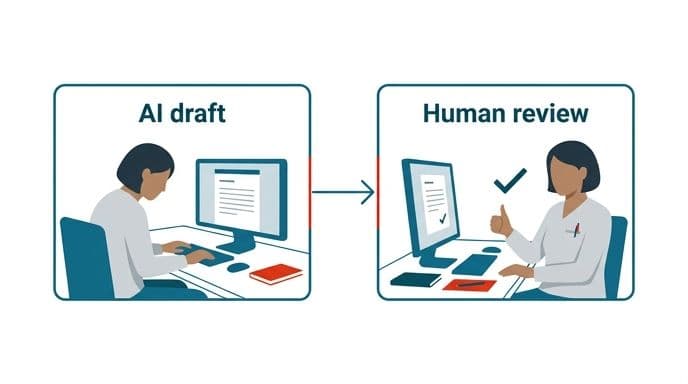
Human-in-the-loop design. Every output that touches a patient, a student record, or money needs a review step. Building that review interface properly, so a nurse or a controller can approve or reject in seconds rather than minutes, is real engineering work.
Who owns what afterward. If the vendor keeps the keys and the accounts, your cost isn't a project cost. It's a subscription with no exit.
Vertical AI ROI and Payback Compared to General-Purpose Tools
The spending case for vertical over horizontal has gotten clearer. Market watchers have pointed to vertical AI approaching the double-digit billions in size during 2025. Vertical AI startups took about 53% of total deal volume even though horizontal AI absorbed most of the capital. That split tells you where practitioners are putting money versus where investors are chasing scale.
The payback numbers follow the same pattern. Teams we've spoken with report that vertical AI tends to hit measurable ROI within six months far more often than horizontal-only rollouts do, with vertical tools returning a noticeably higher multiple compared to general tools. The reason isn't magic.
A general assistant needs your team to supply context every time they use it. A vertical app already knows the workflow and the vocabulary, so the time saved is immediate instead of gradual.
What that means for budgeting: if you're comparing a $40,000 vertical build against a per-seat license for a general tool, run the comparison over eighteen months, not three. The general tool wins on day one and usually loses by month eight. Your people keep paying the context tax on every single query.
Hidden Costs by Industry
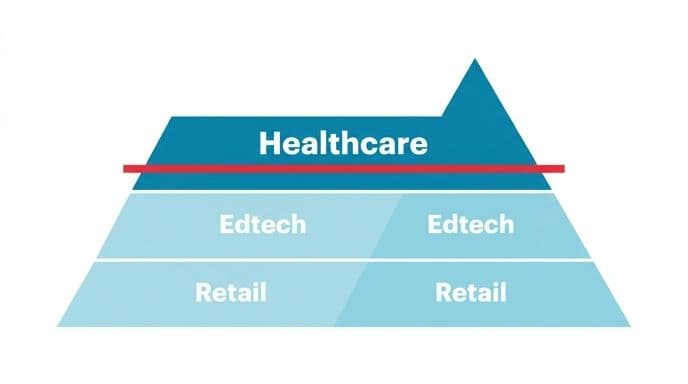
Healthcare is the most expensive vertical, and the reason is structural. The line items behind healthcare AI app development cost are ones that edtech and retail mostly don't carry. Interoperability work with clinical systems and audit trails that satisfy a reviewer sit on top of a clinical review layer on every generated output. We don't build healthcare AI that produces advice without a clinician checking it, and that review interface is part of the build, not an extra.
If you want the full picture of how these systems get structured, our comparison piece on choosing between AI features in clinical products goes deeper into the trade-offs.
Edtech's hidden cost is usually student data protection and the sheer number of roles. A teacher, a student, a parent, and an administrator all need different views of the same AI output. Four interfaces, not one.
Retail's hidden cost is data volume and freshness. Product catalogs change daily. An AI that answers from a stale index gives customers wrong prices, and fixing that means building a sync pipeline nobody quoted for.
Across all three, the cost that surprises people most is the second integration. The first one gets scoped carefully, but the second gets assumed to be similar, and it never is.
Cutting Spend Without Cutting Quality
Smaller models have changed the math. A seven-billion-parameter model fine-tuned on your domain often beats a frontier model running generic prompts, at a fraction of the inference cost and with latency a user actually notices as quick. For classification, extraction, and routing, you almost never need the largest available model.
Three practical levers:
- Route by difficulty. Send simple queries to a small model and escalate only the hard ones. Most production traffic is uncomplicated.
- Cache aggressively. In support work, the same twenty questions come back forever. Cached retrieval answers cost nothing to serve.
- Fine-tune instead of stuffing context. Long prompts are billed per token on every call. A tuned model carries that knowledge for free. Our private LLM fine-tuning and secure hosting exists for exactly this reason, and it solves the data residency problem at the same time.
This matters for the question founders ask most. Will model spend keep climbing as usage grows? It will if you build on a single large model with no routing, but it won't grow nearly as fast if the architecture assumes cost control from the start. That's an engineering decision made in week one, not a bill you negotiate later.
Where Budgets Get Wasted
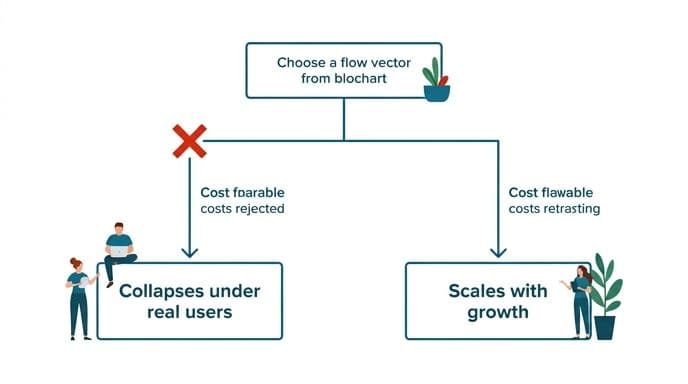
The commonest waste pattern is the cheap prototype. A sub-$5,000 build demos beautifully and collapses the moment real users arrive, because it was never structured for concurrency, error handling, or data growth. The rewrite then costs more than the correct build would have, and you've lost a quarter.
The second pattern is building before validating. Months disappear into features nobody asked for. We'd rather run a short automation audit and tell you a workflow fix solves the problem than take money for software you don't need. That happens more often than you'd expect.
The third is open-ended time and materials contracts. A named figure before work starts, a delivery window measured in weeks, and a code warranty is the structure that protects you with fixed price AI development. Scope creep and surprise integration charges have nowhere to hide when the number was agreed up front. We name the price before we start, every time.
Offshore, In-House, or Hybrid
The cost difference is real and so is the risk. An in-house senior AI engineer in the US or UK carries a salary plus benefits plus recruitment time, and you need at least two for continuity. An offshore team delivers the same work at a different rate, which is why vertical AI software cost varies so widely between quotes.
The honest risk with offshore delivery isn't skill. It's distance from the problem. A team that's never watched your intake nurse work will build something that technically functions and practically annoys. We handle this by sending builders to clients rather than account managers. Eighteen years and 150 people across 1,000+ clients in 50+ countries have taught us that the person writing the code needs to see the workflow.
A hybrid usually works best: one internal owner who knows the domain, paired with an external build team. Your person keeps the requirements honest. Ours keeps the delivery moving.
What You Own at the End, and Why It Lowers Long-Term Cost
The strongest vertical AI products stand beside the people using them rather than replacing them. A radiology assistant that drafts and a clinician who confirms is more defensible than one that claims to decide. The first one earns adoption and the second one invites liability.
That design choice shapes pricing too. Products that augment labor tend to price per seat, which scales with your headcount in a way you can forecast. Products that claim to replace labor get judged against salary, and that comparison rarely survives contact with an error.
Your long-term cost advantage comes from the data your app accumulates. Proprietary records, deep workflow integration, and compliance knowledge built into the structure rather than bolted on are what competitors can't copy cheaply. Every month your system runs, the retraining cost drops and the quality gap widens. That's why owning the code, the accounts, and the keys matters more than the headline figure on the quote. If you rent the system, you rent the advantage.
For a wider view of how these products get designed in the first place, our main guide on building AI into industry-specific products covers the architecture decisions that sit upstream of budget.
Your Next Step
Write down the systems the app must talk to, the roles that need a view, and the one workflow you'd fix first. With those three things, any competent vendor can give you a real number instead of a range. Without them, every quote you get is a guess.
If you're scoping something in healthcare specifically, our work across clinical and consulting platforms includes an ABDM health platform integrated with India's national system, so the compliance questions aren't theoretical for us.
Book a free automation audit and we'll tell you what it costs, or whether you need to build at all.
Wondering what this would take against your own systems?
The audit costs nothing, and you keep the costed plan and the risks whether you go ahead or not.
Book a free automation auditHitasoft
LinkedInHitasoft has built software since 2008, for companies that mostly do not have an IT department. These pieces are written by the people who do the integrations rather than by anybody in marketing.