A founder came to us in September with a forty-page specification for an AI underwriting assistant. Eleven months of planning sat in that document. Nobody had checked whether the model could actually read the loan documents his customers send, documents that are scanned, rotated, and occasionally photographed on a phone in bad light.
We built a stripped-down version in nine days. It read 200 real documents. It got 71 percent of the fields right on the first pass, which sounds bad until you see that the failures clustered in two document types nobody had thought to mention. That finding changed the whole build plan. The forty-page spec had been written around the wrong problem.
That nine-day exercise is what people mean by rapid prototyping in AI. The short answer to what is rapid prototyping in AI: it's building the smallest working version of an AI feature, fast, using real data, to find out whether the idea holds up before you commit a budget to it. Not a mockup, not a slide deck. Something that runs, fails in specific ways, and tells you what you didn't know.
Most of what follows comes down to one habit: testing against real data before anyone writes a line of production code.
What is rapid prototyping in AI, in practical terms
Traditional software prototyping tests whether people want a thing. You build a clickable screen, show it to users, and watch where they get stuck. The logic behind the screen is predictable. If you write code that adds two numbers, it adds two numbers.
AI breaks that assumption. A language model given the same invoice twice can return slightly different output. A classifier trained on your old tickets might handle 90 percent of them and then fall apart on the ones that matter most, the ambiguous ones, the angry ones, the ones with three questions crammed into a single message. You cannot know this from a specification. You find out by running real inputs through a real model and reading the output yourself.
So rapid AI prototyping has a different job from ordinary prototyping. It tests feasibility, not just desirability. Three questions, usually:
- Can the model do this at all? Given your actual data, not a clean demo set, does it produce output you'd be willing to show a customer?
- How often is it wrong, and wrong in what way? A system that's wrong 5 percent of the time at random is a different problem from one that's wrong 5 percent of the time on your highest-value transactions.
- What does it cost per run? Token spend multiplied by real usage volume. Founders are frequently surprised here.
A prototype that answers those three questions has done its job, even if the answer is no. That's true especially when the answer is no.
How a rapid AI prototype actually gets built
The sequence matters more than the tooling. Here's the shape we use, and most competent teams use something close to it.
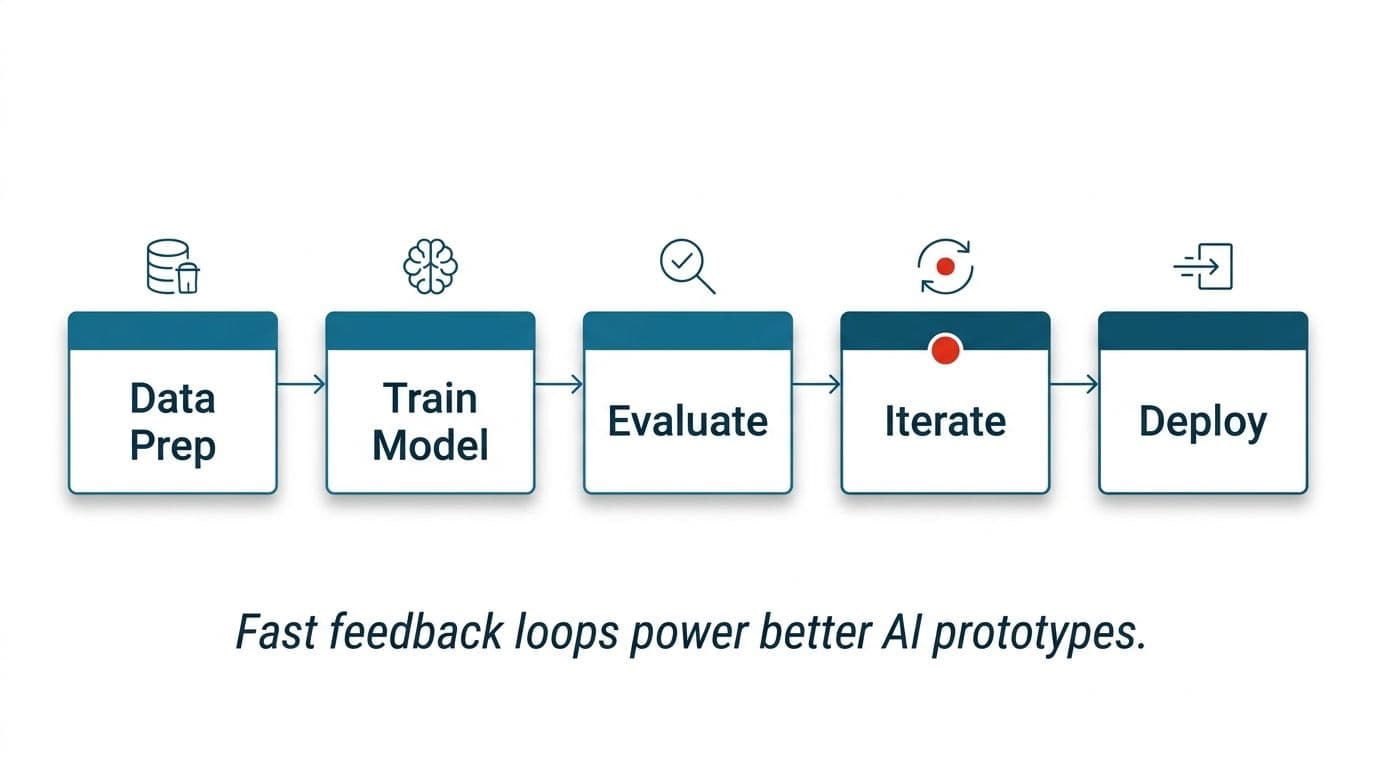
Pick one decision to test. Not one feature, one decision. "Can we extract line items from supplier invoices accurately enough to skip manual entry?" is a decision. "Build an invoice automation platform" is a project. The prototype answers the first and says nothing about the second.
Get real data in the room on day one. Skipping this step wastes the entire exercise, and yet it's the step teams skip most often. Synthetic test data is clean. Your data is not. It has merged cells, missing fields, three different date formats, and a column someone renamed in 2023 that nothing downstream knows about. If you can't share production data for compliance reasons, anonymized extracts work, but they need to keep the mess intact.
Build the thinnest path from input to output. Skip the login. Skip the dashboard. Skip the database schema. Often the first version is a script that reads a folder, calls a model, and writes results to a spreadsheet. It looks unimpressive. It tells you everything.
Run it against a scored sample. Fifty to 300 real cases, with a human-checked answer key. Then you have a number instead of an impression.
Read the failures. This is where the value lives. Aggregate accuracy tells you very little. The pattern inside the failures tells you whether the problem is solvable with better prompting, needs retrieval augmented generation to pull in reference data, needs fine-tuning, or isn't a model problem at all.
That last case comes up more than you'd think. We've had prototypes where the model was fine and the real issue was that two internal systems held contradictory records, so no AI could have produced a correct answer. That's a data governance problem wearing an AI costume.
What a prototype should cost you in time
Weeks, not quarters. If someone quotes you four months for a prototype, you're being quoted for a product.
Our own range for an AI rapid prototyping engagement is typically two to six weeks, depending on how much work it takes to get at the data. Here's roughly how that splits:
- Days 1 to 3: Scoping the single decision, gathering sample data, agreeing what "good enough" means as a number.
- Days 4 to 12: Building and running the thin path. Usually two or three rebuilds as early output reshapes the approach.
- Days 13 to 20: Scored evaluation, failure analysis, cost modeling at projected volume.
- Final days: A written read-out covering what works, what doesn't, what it would cost to build properly, and whether we'd recommend building it.
The data-gathering step is the one that slips. Not because it's technically hard, but because the person who can export the records is busy, or legal needs to approve the extract, or nobody's sure which system holds the authoritative version. If you want a prototype to move fast, assign someone internally who can pull files out of systems without asking three people first.
We name a fixed price before work starts, which keeps this honest on both sides. You know what you're spending. We know what we're delivering. Nobody is billing hours into an open-ended discovery phase.
What rapid AI prototyping can tell you, and what it can't
Here's where most explanations of this topic get optimistic. A prototype has real limits, and knowing them saves you from over-reading the result.
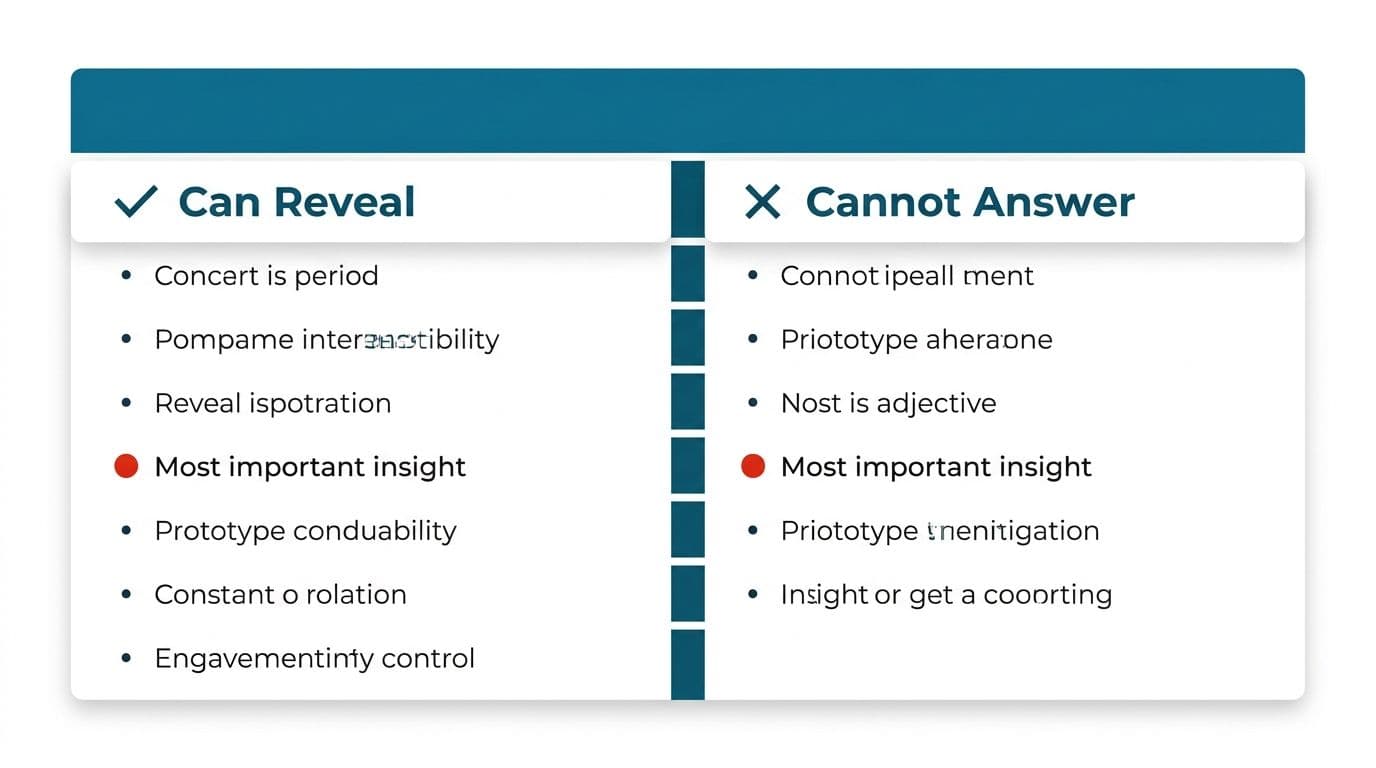
It can tell you whether the core capability exists at acceptable quality on your data, and whether your data is in good enough shape. It can also tell you roughly what inference will cost at volume, where the hard edges are, and whether a human needs to check every output or only the flagged ones.
It can't tell you how the system behaves at a thousand times the volume. Prototypes run on small samples under no load. Latency, rate limits, and queue behavior are production problems, and they're genuine ones.
It also can't tell you whether people will use it. A prototype proves the machine can do the task. Adoption is a separate question, answered by putting it in front of the team who'd use it daily and watching what they ignore.
It can't promise accuracy either. No prototype result transfers cleanly to production, because production data drifts, models get updated by their vendors, and edge cases arrive that weren't in your sample. Any AI system that touches money or a customer needs a person approving output, and we design that in from the prototype stage rather than bolting it on later. If a vendor shows you a prototype and describes the result as a guarantee, that's a sales position, not an engineering one.
One more limit worth naming: a prototype that succeeds brilliantly can still lead to a product nobody should build, because the manual process it replaces takes two hours a month. We've told clients that. It costs us a project and saves them a six-figure mistake.
Where AI and innovation sprints rapid prototyping for digital transformation fits in a larger program
Larger organizations usually encounter this under a different name. AI and innovation sprints rapid prototyping for digital transformation is the phrase you'll see in enterprise transformation programs, and it describes the same practice sitting inside a bigger governance structure.
The difference is scope and politics, not method. In a startup, one founder decides to test an idea. In a transformation program, you're typically running several prototypes in parallel across departments, each sponsored by a different function, each competing for the same build budget next quarter.
That changes two things. First, the scoring has to be comparable. If finance prototypes a reconciliation assistant and support prototypes a RAG agent for the help desk, you need a shared way of saying which one deserves funding. We usually frame that as hours returned per month against estimated build and run cost, with a confidence note attached, because some estimates are firmer than others.
Second, the kill criteria have to be agreed before anyone starts, written down and signed off. Innovation sprints go wrong when a sponsor becomes attached to their idea, the prototype shows it doesn't work, and the result gets reframed as "needs more time." Deciding in advance what a failing result looks like protects everyone, including the sponsor.
What gets undersold about ai & innovation sprints rapid prototyping for digital transformation is the value of a clean no. A program that runs six prototypes and kills four has done excellent work. The four that died cost weeks each. The two that survived go into build with evidence behind them. Compare that to funding all six on the strength of slide decks.
How prototyping differs across the AI problem you're solving
The approach shifts depending on what you're building. A few patterns we see regularly.
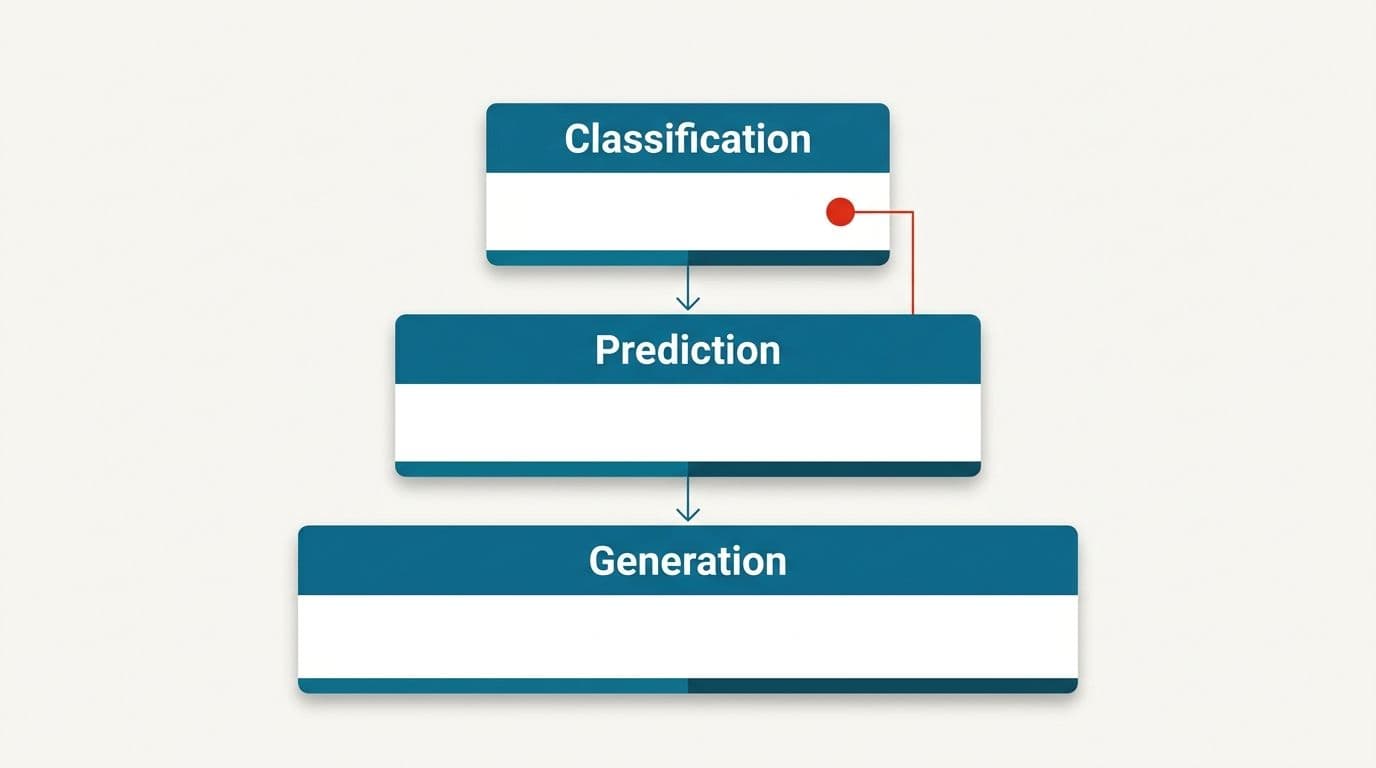
Document extraction. The prototype is mostly a measurement exercise. Run real documents through, score field by field, and find which document types break it. Our document processing and OCR work almost always starts here, because scan quality varies more than anyone expects.
Support automation. Pull your last 500 tickets, let the prototype answer them, and compare against what your team actually said. The useful output isn't an accuracy score. It's the list of questions the model answered confidently and wrongly, because those are the ones that reach customers.
Agents that take actions. This case is riskier, so prototype in a sandbox where every action is logged and nothing executes for real. You're testing whether the agent chooses correctly, not whether it executes correctly.
Private deployment. When records can't leave your infrastructure, the prototype has to run inside it, which adds setup time. Worth saying clearly: on enterprise endpoints with retention switched off, the major vendors don't train on your data. Some sectors still require the model to sit on your own hardware, and that's a legitimate constraint rather than a preference, which is why private LLM fine-tuning and secure hosting exists as its own discipline.
In each case the prototype answers one feasibility question. If yours spans multiple of these at once, it's not a prototype, it's a program, and it should be split.
Prototype, MVP, or production system: knowing which you need
These three get used interchangeably and they are not the same thing. Mixing them up is how budgets get set wrong.
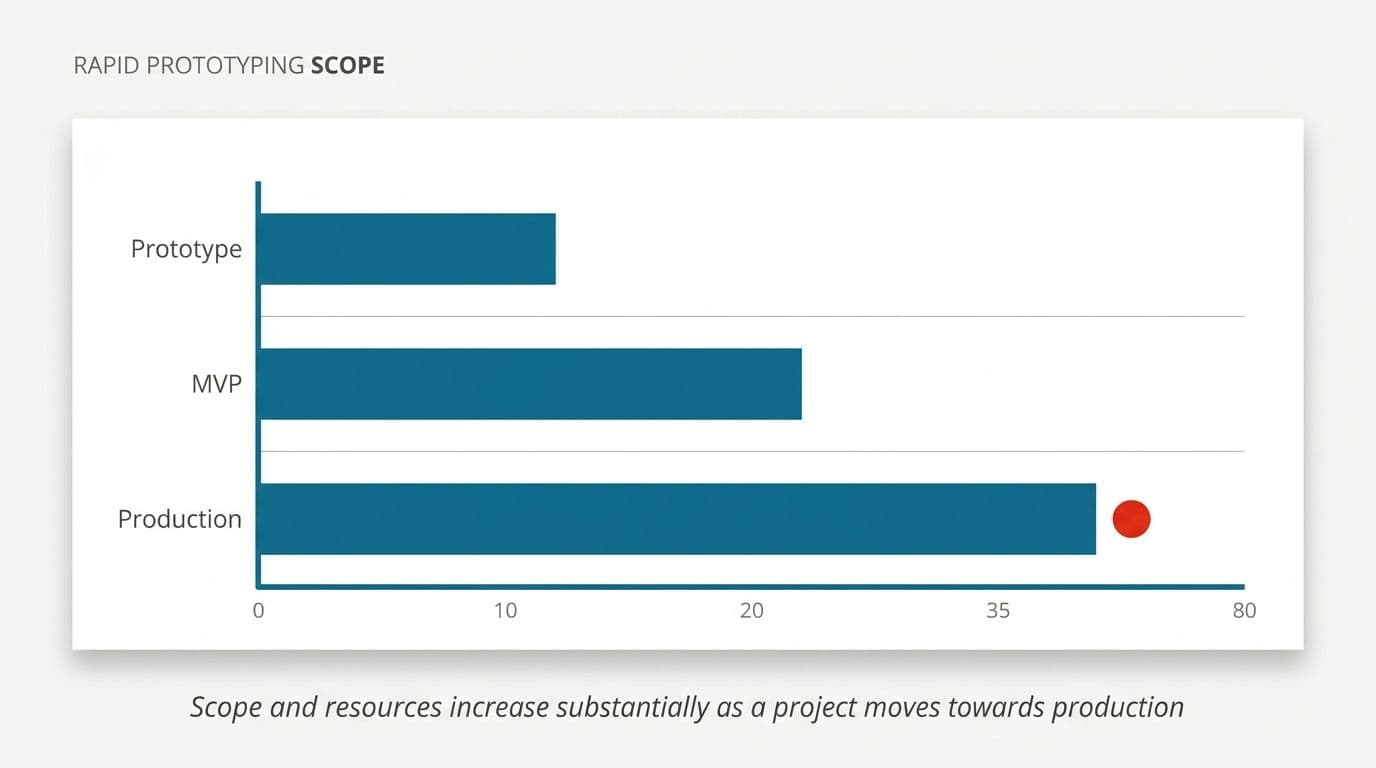
A prototype tests feasibility. It might have no interface, no auth, no error handling. It exists to produce a finding, and its life expectancy is the length of the engagement. Throw it away afterward and you've lost nothing, because the finding is the deliverable.
An MVP is a product with real users. It needs a login, a data model, permissions, logging, and a support path for when it breaks at 11pm. It's small, but it's real. Our custom AI MVP and prototyping service covers both ends of that, and the honest answer to which one you need usually depends on whether you've already proved the hard part works.
A production system handles volume, failures, audits, and compliance review. It has monitoring, rollback, and a person accountable when output goes wrong.
The sequence that works: prototype to find out whether the capability exists, MVP to find out whether people use it, production to make it survive. Skipping the first step is the common failure, and it's expensive, because you discover the model can't handle your edge cases after you've built the dashboard, the admin panel, and the billing integration around it.
Skipping is sometimes defensible. If the task is well-understood, like routing emails into four categories, a prototype could be overkill. Go straight to a small MVP instead. Rapid AI prototyping earns its keep when the outcome is genuinely uncertain.
Questions worth asking before you commission one
If you're evaluating a partner for ai rapid prototyping, these questions distinguish the serious from the plausible.
What's the fixed price and what's in it? Open-ended discovery billing is a bad sign at this stage. The scope of a prototype is small enough to price.
Who owns the output? Code, model artifacts, API accounts, keys. You should own all of it. If the prototype lives in the vendor's account, you're not holding the asset.
What does a negative result look like, and will you tell me? Ask directly. A partner who can't describe how they'd deliver bad news will probably deliver optimistic news instead.
What data do you need, and how will it be handled? Specific answer expected: which fields, where it's stored, how long it's retained, what happens to it afterward.
Will a person be in the loop on anything consequential? For anything touching money, health records or customer-facing output, the answer has to be yes. No absolute security or accuracy guarantee is credible, and anyone offering one is telling you something about their sales process.
What's the read-out? A number, a failure analysis, a cost model, and a recommendation. A slide deck of possibilities isn't a result.
In our experience, the pattern holds across every engagement we've taken on. Clients who ask these questions upfront get better prototypes, because the questions force both sides to agree what the exercise is for.
When a prototype isn't the right spend
Some honest cases where we'd tell you to save the money.
The capability is already proven and commoditized. Transcribing clear audio or translating between major languages are two examples. These work, and prototyping them tells you only what the vendor documentation already told you. Go straight to integration.
The process you want to automate runs a handful of times a month. The math won't carry a build, whatever the prototype shows.
Your data isn't accessible yet. If the records sit in a system nobody can export from, fix that first. A prototype on data you can't reach in production is theater.
An off-the-shelf tool already covers it. We've pointed clients to existing software more than once. The lock-in concern is real, but so is spending four months rebuilding something that costs $80 a month. The question is whether the gap between what the tool does and what you need is big enough to justify the build, and whether the tool holds your data somewhere you're not comfortable with.
Telling a client they don't need to build is part of the job. It costs us a project occasionally, and it's also why those clients come back when they do need something built.
What good looks like when the prototype ends
A prototype has succeeded when you can answer, with a number attached, whether to build. Not "it looks promising." Something closer to: "It read 214 of 300 invoices correctly without help. The 86 failures were almost all handwritten delivery notes, which are 12 percent of volume. Excluding those, accuracy was 94 percent. At our volume, inference runs about $340 a month. Build estimate is eight weeks. A reviewer still checks anything over $5,000."

That's a decision you can take to a board, a co-founder, or a budget holder. It's also a decision you can say no to without regret, because the nine days spent finding out cost a fraction of the eight weeks you'd have spent building the wrong thing.
The practical next step is smaller than most people assume. Pick the single most expensive manual process in your business, find 100 real examples of it, and ask whether a model can handle them. That's the whole starting move, and everything else follows from reading the output.
If you want a second opinion on whether your idea needs a prototype at all, book a free automation audit and we'll look at the process with you. If you already know what you want tested, start a prototype with a fixed price named before anything begins. And if you'd rather see the mechanics first, here's how we run engagements, from first call to handover.
Wondering what this would take against your own systems?
The audit costs nothing, and you keep the costed plan and the risks whether you go ahead or not.
Book a free automation auditHitasoft
LinkedInHitasoft has built software since 2008, for companies that mostly do not have an IT department. These pieces are written by the people who do the integrations rather than by anybody in marketing.