
Does your organization run as a holding company or a group of subsidiaries moving money around? Then you already know the pain. Every month, someone on your finance team exports spreadsheets and cross-references bank feeds. They recalculate interest by hand. They burn days trying to force two ledgers into balance. This is exactly the process that intercompany loan automation AI was built to eliminate.
This guide breaks down how to automate intercompany loans with AI. We cover how the underlying architecture keeps financial calculations accurate. You will also learn how to deploy it securely without ripping out your accounting stack.
What is AI Intercompany Loan Automation?
AI intercompany loan automation blends Large Language Models with deterministic data pipelines. It automatically ingests, categorizes, and reconciles financial transactions between parent and subsidiary companies. This middleware calculates interest instantly. It updates shared ledgers and removes the manual spreadsheet reconciliation that eats up hours across corporate entities.
The distinction that matters most is how the work is divided. The AI layer reads and understands unstructured inputs, such as a scanned transfer receipt or a bank feed. It categorizes those inputs, tags each transaction to the right entity, and structures the data cleanly. A separate, strictly deterministic calculation engine then takes over to run the actual math.
That split is the entire reason the system earns trust. You get the flexibility of AI for messy real-world data. You get the precision of hard-coded logic for anything involving money. This is what multi-entity financial automation looks like when it is engineered correctly. Start by mapping which inputs your team currently types by hand.
The Multi-Entity Bottleneck
Managing finances across a portfolio of legal entities differs sharply from running a single company's books. A holding company with five subsidiaries doesn't have one ledger. It has six. Each intercompany transfer creates matching entries that must reconcile on both sides. Multiply that across dozens of monthly transfers and floating interest rates, and the complexity compounds fast.
Here's how that plays out in practice. Finance teams waste hundreds of hours every quarter exporting CSVs from each entity's system. They cross-reference those exports against bank feeds line by line. They recompute dynamic interest rates in fragile spreadsheet formulas that break the moment someone inserts a row. Then at month-end, they chase reconciliation imbalances that trace back to a single transposed digit entered three weeks earlier.
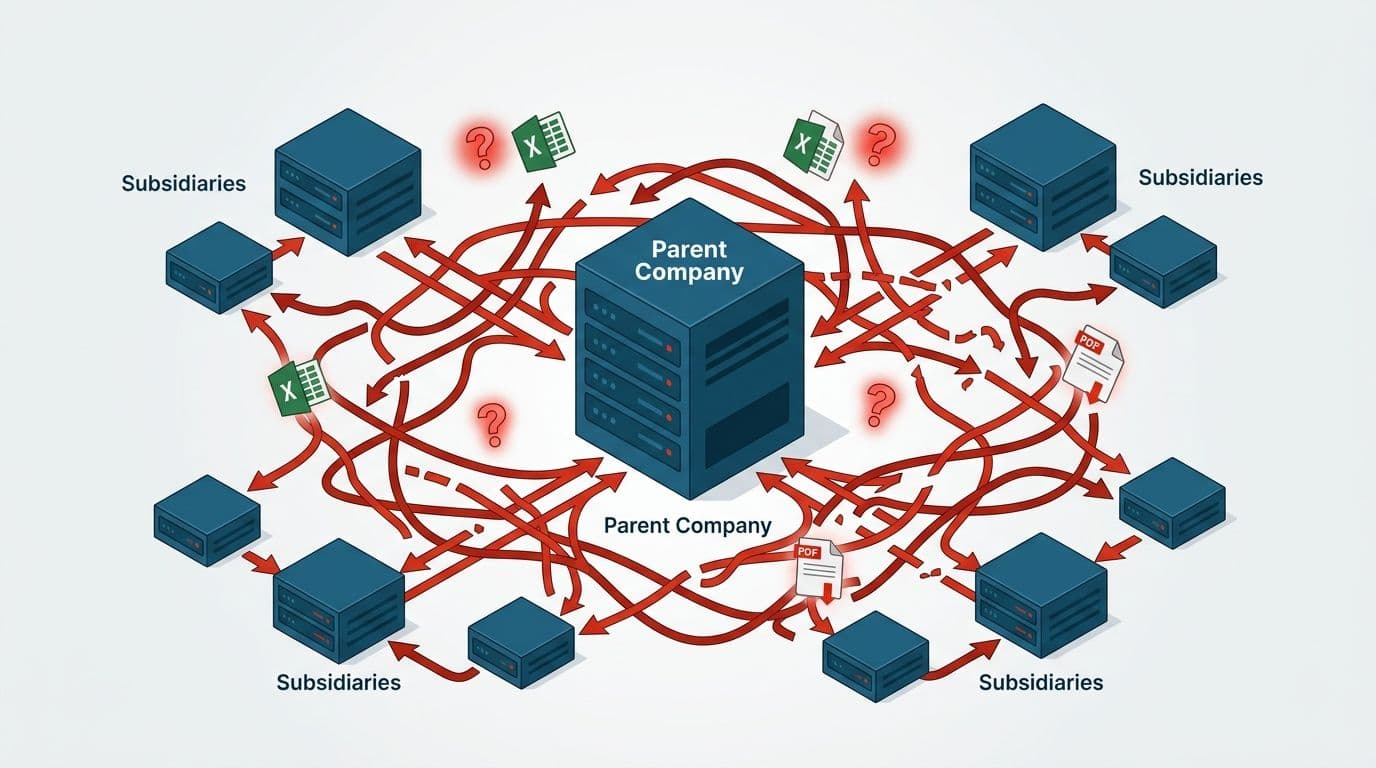
The core tension is simple. Humans need time, but finance needs precision. Ask people to be both fast and flawless across thousands of manual entries, and something eventually gives. Usually it's the close deadline or the sanity of your controller.
The cost isn't just labor. Slow, manual reconciliation traps cash inside the group and delays the financial close. It hides the real intercompany debt position from leadership. Finance automation leaders like HighRadius report that autonomous workflows drive a 30% faster financial close and a 40% increase in productivity for finance teams (highradius.com). Those gains come almost entirely from removing this manual grind. Audit your last quarterly close and tally the hours lost to it.
The Architecture of an Automated Intercompany Ledger
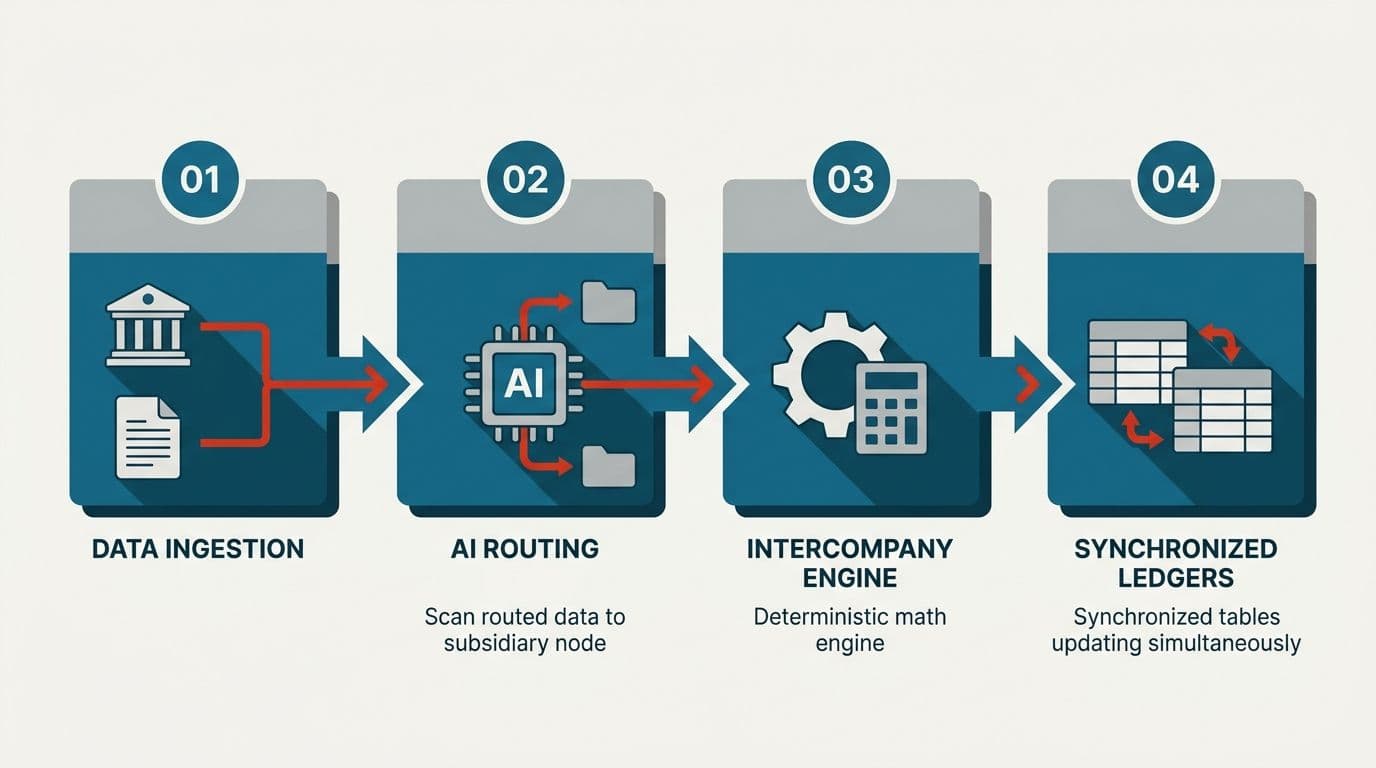
A well-built automated intercompany reconciliation pipeline isn't a single tool. It's a sequence of specialized stages, each doing one job extremely well. Here's how Hitasoft structures it.
Intelligent Data Ingestion
The first stage gets data into the system without human typing. AI vision models and API connectors read unstructured inputs at the source. That includes bank transaction feeds and wire confirmations. An OCR-plus-LLM layer interprets a scanned document the way a human would. It identifies the amount, the date, and the sending account. It does this in milliseconds and never fatigues.
This matters because real intercompany data is rarely clean. One subsidiary sends a formatted CSV. Another forwards a PDF. A third simply emails a confirmation. The ingestion layer normalizes all of it into a single structured format the rest of the pipeline can trust. Start by listing every input format your entities currently use.
Semantic Tagging & Entity Routing
Once data is ingested, the AI classifies it. It identifies which subsidiary initiated the transfer. It decides whether the transaction is a loan drawdown or a repayment, then tags the classification accordingly. It routes each transaction to the correct entity ledger. This semantic layer is where AI shared ledger management earns its keep.
A human no longer decides "this $50,000 belongs to the loan between Entity A and Entity C." The model reads the context, matches it to the right intercompany agreement, and directs it to the correct place. It does this consistently, using the same rules every time. Review your intercompany agreements now so the model has clean rules to follow.
Deterministic Calculation Engine
This is the most important stage. It separates a serious financial system from a novelty. Once the AI has produced clean, tagged data, it hands that data to a strict mathematical engine. This engine is not an LLM. It is hard-coded, auditable logic.
The calculation engine computes intercompany interest rates and applies currency conversions. It allocates debt distribution across multi-entity arrangements. It posts matching entries on both sides of every transaction. Because these calculations run on deterministic code rather than a probabilistic model, there is zero possibility of an LLM hallucinating a financial figure. The number is either mathematically correct or the system flags it. There is no in-between.
Want to see how these ledger pipelines and multi-user debt calculations get built end to end? Our financial data automation services walk through the full architecture. Book a technical walkthrough to see the engine handle your own scenarios.
Manual Spreadsheets vs. AI Pipelines
The gap between the old way and the automated way becomes obvious side by side.
| Financial Metric | Manual Spreadsheet Reconciliation | Custom AI Intercompany Pipeline |
|---|---|---|
| Data Entry | Manual typing (high risk of transposition errors) | Automated API and OCR extraction |
| Interest Calculation | Manual formula updates per entity | Dynamic, deterministic programmatic calculation |
| Reconciliation Speed | Days of month-end auditing | Real-time transaction matching |
| Cross-Entity Syncing | Requires manual dual-entry | Single integration updates both entity ledgers instantly |
| Error Visibility | Errors surface weeks later at close | Discrepancies flagged the moment they occur |
| Audit Trail | Scattered across file versions | Immutable, timestamped log per transaction |
The pattern is clear. Manual processes concentrate risk exactly where money changes hands. They surface problems long after they're cheap to fix. Automated pipelines flip that. They catch discrepancies at the point of entry. They keep both sides of every intercompany loan in permanent agreement. Pick one recurring error type and price out what it costs you annually.
Deploying Secure Financial Automation
For CFOs and founders, the first question about any AI system touching the books is security. And it should be. Intercompany loan data reveals your capital structure and your cash positions. That information cannot leak. It certainly cannot end up training someone else's model.
Zero Data Retention (ZDR)
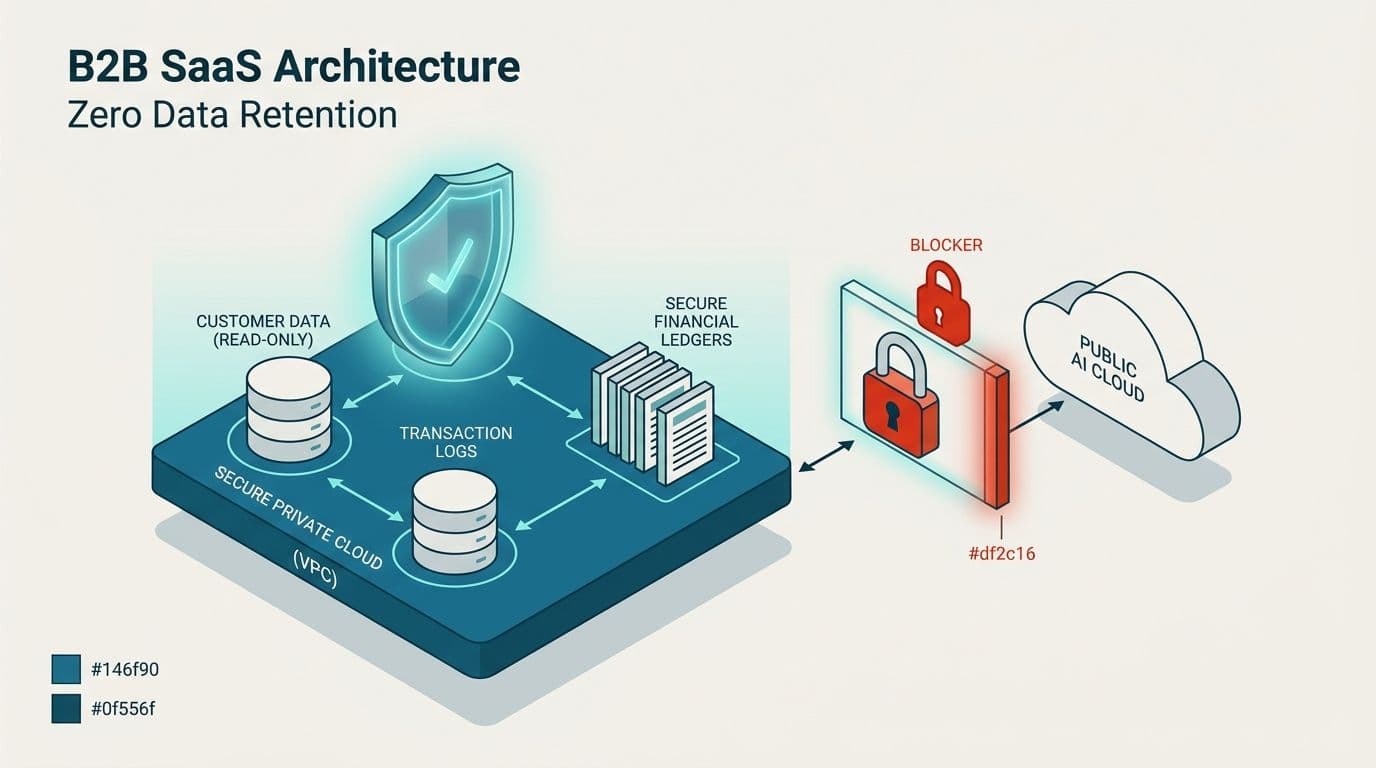
Hitasoft's automation pipelines run under a Zero Data Retention policy. Third-party model providers never store your financial data. It is never used to train public LLMs. The AI processes your documents in the moment, returns structured output, and keeps nothing. Your numbers stay yours. This is a non-negotiable standard for any organization in regulated environments.
It sits at the center of how we approach every project in the fintech and finance space. Ask your compliance lead which retention terms they need before you shortlist vendors.
VPC & Private Hosting
For teams with the strictest compliance needs, the entire pipeline deploys inside your own Virtual Private Cloud. It also runs on dedicated private infrastructure. The ingestion models, the tagging layer, and the deterministic calculation engine all operate within an isolated environment you control. No data crosses a public boundary. Entity ledgers stay segregated, and you meet data residency and financial compliance obligations without compromise.
Private hosting also hands you complete control over access permissions and encryption keys. That is the granular governance enterprise finance and internal audit teams demand. They want it before signing off on any automation initiative. Map your residency requirements first, then decide between VPC and shared hosting.
Stop Reconciling by Hand
Intercompany loan management is one of the highest-effort, highest-risk processes in any multi-entity organization. It is also one of the most automatable. Combine AI's ability to read unstructured data with the reliability of deterministic financial logic. You close faster, free up trapped cash, and give leadership a live view of intercompany debt without adding headcount.
The technology is ready. It integrates with what you already own, and it deploys securely. The only real question is how several more month-ends you want to spend chasing spreadsheets.
Ready to automate your intercompany loans? Explore our financial data automation services or talk to the Hitasoft engineering team about building a pipeline around your ledger architecture.
Wondering what this would take against your own systems?
The audit costs nothing, and you keep the costed plan and the risks whether you go ahead or not.
Book a free automation auditCommon questions
Will the AI make calculation errors with our loan interest?
No. This is the single most important design principle of the system, so it's worth being precise. The AI is used only for data extraction and tagging. It reads documents, identifies entities, and classifies transactions. It never performs the actual financial math. All interest calculations and currency conversions run on hard-coded, deterministic logic. That logic executes the same way every time. Because these are fixed programmatic formulas rather than AI predictions, the financial figures are 100% accurate and fully auditable. The LLM can never "guess" a number, because it is never asked to produce one. Ask any vendor to show you exactly where the AI stops and the math engine starts.
Does this replace our existing accounting software?
No. Hitasoft builds API bridges that feed cleanly into the tools you already use. Whether your entities run on QuickBooks, Xero, or a custom PostgreSQL ledger, the automation layer sits in front of them as intelligent middleware. It ingests and reconciles the data. It then pushes clean, matched entries into your existing systems. You keep your accounting stack and your reporting. You simply remove the manual reconciliation work in between. Confirm which of your current tools have open APIs before you scope the integration.

Arun Andiselvam
LinkedInI am a startup veteran who has built five brands. I sold the first, an SEO tool, for a six figure exit, and now build AI automation products for businesses. I bootstrapped every one of them from day one.