
You bought the tool. Or you are three demos into deciding which one to buy. Either way, look at the exception queue. The items that cost your team the most hours last month are still sitting there, and they will cost the same hours this month. The close is more organised now. The sign-offs are cleaner. But the work that actually hurt has not moved.
That is not a fault in your implementation. It is the shape of the category. Most reconciliation automation software automates the control and sign-off layer, not the matching itself. It routes approvals and timestamps who signed what. It gives auditors one place to look. Those are real and worth paying for. They are just not what the name of the category leads you to expect. The name says the matching gets automated. The product mostly organises the matching you were already doing by hand. That gap is why the queue survived the purchase. It is the thing worth understanding before you commit to a tool or a build.
What the category actually delivers
Look at how the products describe their own strengths. A consistent picture appears. TrustRadius reports that 59% of FloQast reviewers named connecting their Excel reconciliations to general ledger balances as the core benefit. That figure is the platform's synthesis across 22 reviews, not a survey, so read it as a pattern in the feedback rather than a measured statistic. Gartner lists BlackLine's leading strength as aggregating work already happening across spreadsheets into a single place. And in an r/Accounting thread, a preparer describes their own workflow plainly. They build a rough reconciliation in Excel, then upload the finished workbook as support.
Three independent sources describe the same arrangement. Two of them are vendor-facing review platforms. The spreadsheet does the matching. The platform is the wrapper around it.
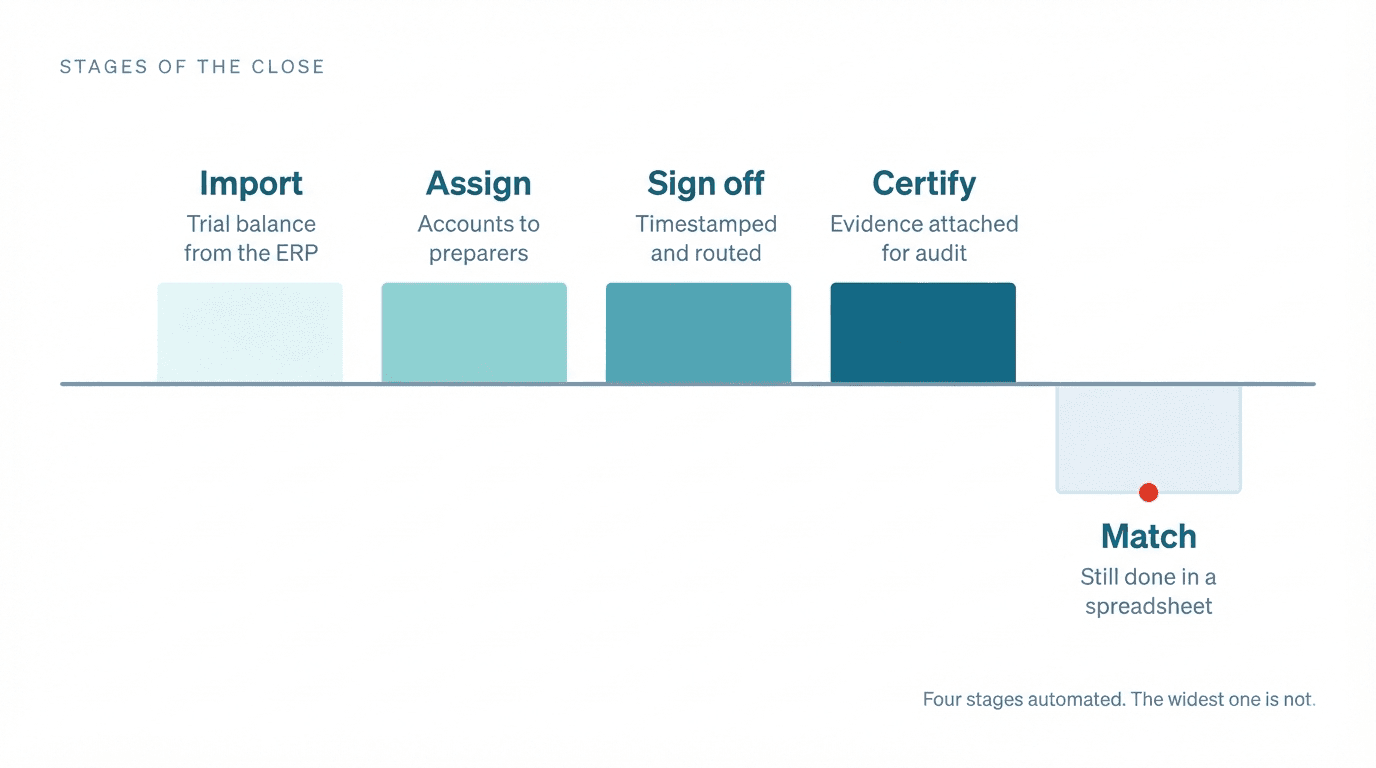
The wrapper is genuinely worth the money. It is important to say so clearly. Approval routing means nothing falls between two people. Timestamped sign-off means the audit trail builds itself. One place auditors look means fewer email chains during fieldwork. The close lead stops chasing status updates. Those are solid controls, and the tools deliver them well. The trouble only starts when a buyer expects the same product to resolve the matching itself and finds that it never claimed to. When teams say automated reconciliation software has not lightened their workload, this is usually the reason. The layer it automates was never the layer that hurt.
What every tool now ships
Set your expectations for a 2026 demo. You want to stop being impressed by things that no longer separate one vendor from another. Every serious product now offers these:
- Trial balance import from any major ERP
- Checklist and task management for the close
- Timestamped sign-off
- Document attachment per account
- Flux analysis on period-over-period movement
- A compliance or SOX module
- Auto-certification for accounts that meet a rule you define, so low-risk balances clear without a human touching them
None of this differentiates anymore. A vendor who opens the pitch with this list is showing you table stakes. They hope the polish reads as capability. It is fine for these features to exist. You want them. But they should not decide the purchase. The questions that actually separate products sit further down. They live in how the matching engine performs on your data and whether the logic survives contact with more than one entity. Everything in this list is assumed.
Where the automation claim thins out
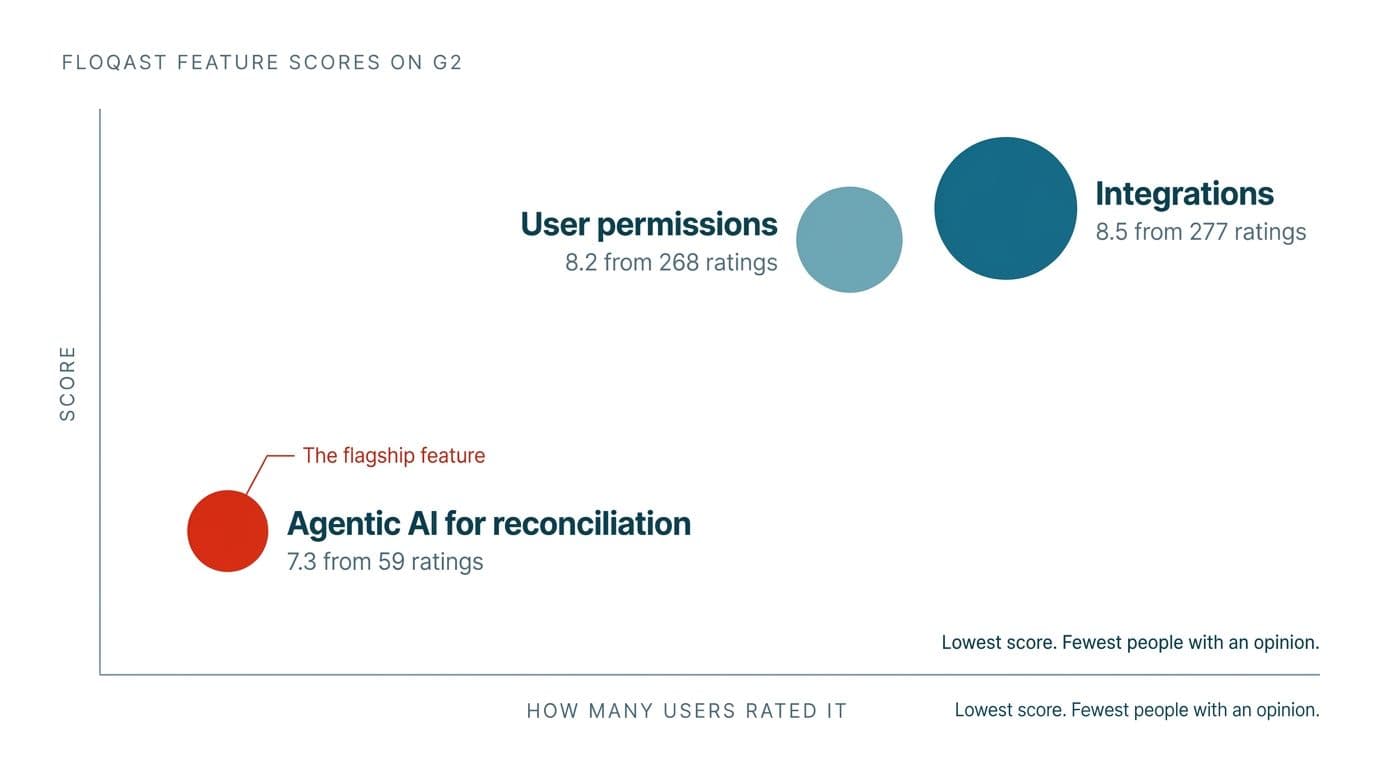
This is where the current evidence gets interesting. G2's comparison data scores FloQast at 7.3 on agentic AI for financial reconciliation, drawn from 59 ratings. On the same product, integrations score 8.5 from 277 ratings and user permissions score 8.2 from 268. So the AI matching capability scores below both of the features it sits alongside, and is the one the fewest users have any opinion about. That is roughly a five-to-one gap in how many people rated it against the features they use daily. The flagship capability is the one being exercised least.
Two other signals corroborate that. An AWS Marketplace reviewer lists, as a dislike, that subledger import and auto-reconciliation are still being designed to rival BlackLine. That is a paying customer describing the headline feature as unfinished. And in the r/Accounting thread, a commenter asks whether anyone uses BlackLine for transaction matching on bank recs, because they want to know whether it holds up. Nobody in the thread answers.
The honest reading is that agentic reconciliation is shipping and real. But adoption is thin. The people who have it rate it below the features they use daily. Treat AI matching claims as roadmap, not delivered capability. When a vendor demonstrates it, do not accept a run on sample data. Ask for a reference customer running the AI matcher on your transaction type, at your volume, and talk to them directly. If the vendor cannot produce one, walk away from the plan they are selling.
The data never arrives clean
There is a failure that no reconciliation vendor discusses. It sits upstream of their product. The matching engine assumes an input it does not reliably receive.
A practitioner reconciling 5,000-line statements notes that bank statement PDFs rarely export cleanly. They insist on pulling CSV downloads straight from the bank instead. Someone at a firm with more than 300 clients describes manually sorting PDF statements into Excel. Sometimes they log into client bank portals to retrieve the statements at all. Replies to both threads point out, correctly, that BAI files and direct Excel exports exist. That only proves the point. The clean feed exists somewhere. Whether you get it depends entirely on the bank.
So the gap is not the tool's matching capability. It is that feed access and file format vary bank by bank. The reconciliation engine assumes a structured input that a meaningful share of your accounts do not produce. No matcher, however good, helps if the data reaching it is a scanned PDF.
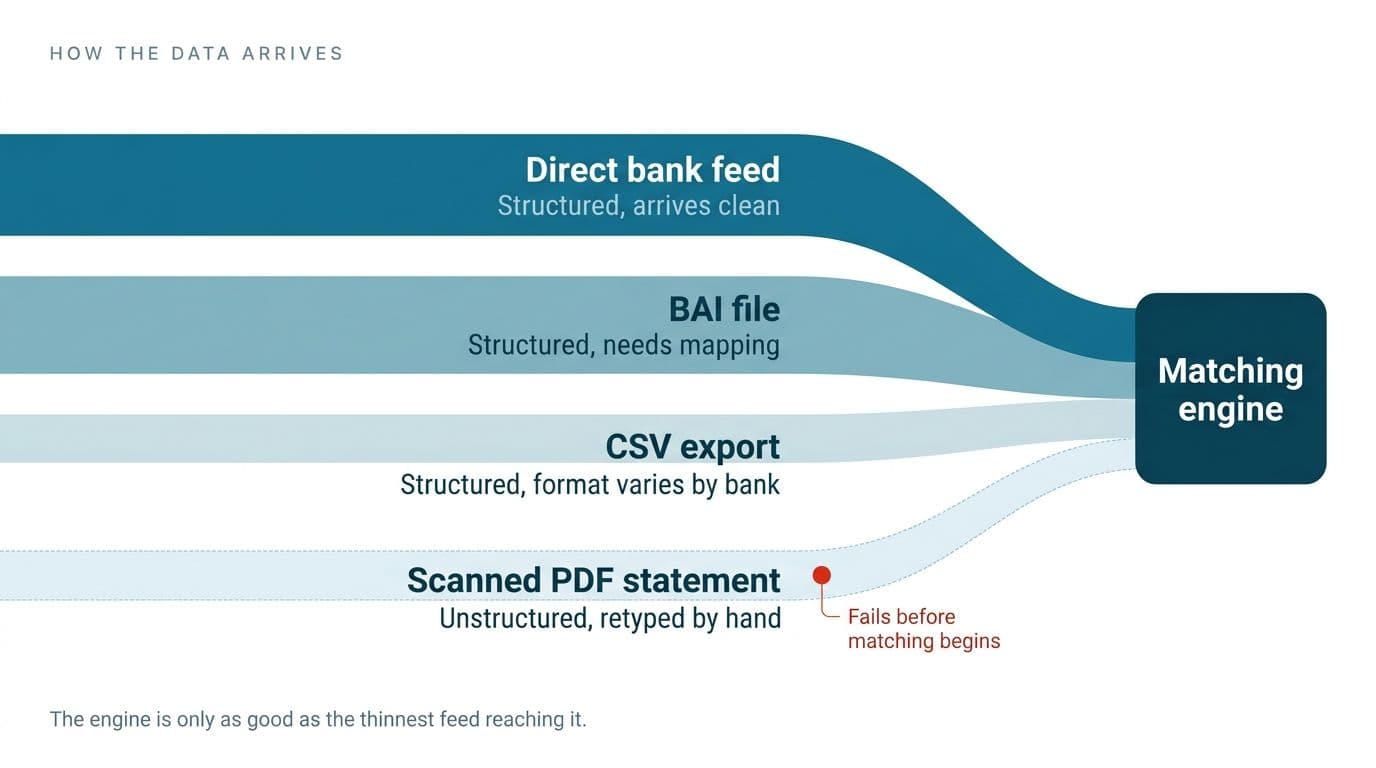
The takeaway is a sequencing one. Audit how your source data actually arrives before you evaluate any matching engine. If a material feed comes in as a PDF or a portal download, fixing that is the first project. It is a separate one, closer to statement extraction and document capture than to reconciliation. Solve the input first, or the matcher inherits the mess.
Where it breaks structurally
Standard tools assume two records that should agree, produced by systems that share conventions. The same currency and the same account structure. Bank-to-ledger fits that assumption cleanly. Multi-entity work breaks it. Different charts of accounts. Separate close calendars. Currency translation. Partial settlements. Timing differences that are legitimate rather than errors. The rule that reconciles a bank feed to a ledger does not carry across a group.
Some reviewers report exactly this limit. TrustRadius lists limited cross-company functionality for intercompany transactions among FloQast's weaknesses. That is a single platform's synthesis of one product's feedback, so treat it as a signal rather than a settled fact. But it matches the structural logic. A tool built around one-to-one agreement will struggle wherever the two sides were never meant to look identical.
If your hardest reconciliations are intercompany, that is a category of its own. It is worth reading how AI handles intercompany loan matching across entities before you assume a general-purpose close tool will cover it. The problem is not that the vendors are weak here. It is that cross-entity matching is a different problem wearing the same word. Scope it as its own project before you buy.
The question your CFO is about to ask
Here is the freshest thing in this whole discussion, from a June 2026 r/Accounting thread. A senior accountant had built an Excel automation that cut a bank reconciliation from roughly a day and a half down to about an hour. Their company, in the middle of an AI push, asked them to rebuild it in an AI tool. The later update was the telling part. The CFO now wanted the entire month-end close automated the same way, with the existing Excel automation used as the baseline to validate the AI's output, and the finance team repositioned as testers.
The reply that anchors the thread asks the obvious question. What is the benefit of using AI to automate something already automated? It argues the company should be able to state both that benefit and the shortcomings of the current solution. It concludes that AI for its own sake is not a reason to rebuild a working process. A second reply is blunter. Put a monetary value on it and treat it like any other project.
That is exactly the right question, and we would say so plainly. Any vendor unwilling to answer it should be declined. AI belongs where the existing rule set genuinely cannot express the cases. Those are the exceptions that resist any rule you can write down. It does not belong on top of a process that already works, replacing a validated automation with one your team now has to babysit. Modernising a working thing is not a benefit. Solving a case the old logic could not is.
What to establish before you decide
You are not filling in a vendor checklist here. You are choosing between buying a tool and commissioning a build, so the inputs are different. Establish these before you weigh either:
- What proportion of last month's items would a tool have matched automatically, tested against your own data, not the vendor's sample set
- Which specific transaction types the engine hands back unmatched, named individually rather than counted
- What happens to an unmatched item, and precisely who touches it next
- How your source data reaches the system today, and what breaks when a bank changes its export format
- Whether your matching has to cross entities or only ever runs inside one
None of these is a commercial question, and that is the point. The answers are useful whichever way you decide. If they push you toward buying, you will buy the right tool and configure it against reality. If they push you toward building, you will scope it against the same reality. Either way you have replaced impressions from a demo with facts from your own ledger. That is the only basis on which account reconciliation automation is worth the spend.
When a build is worth scoping
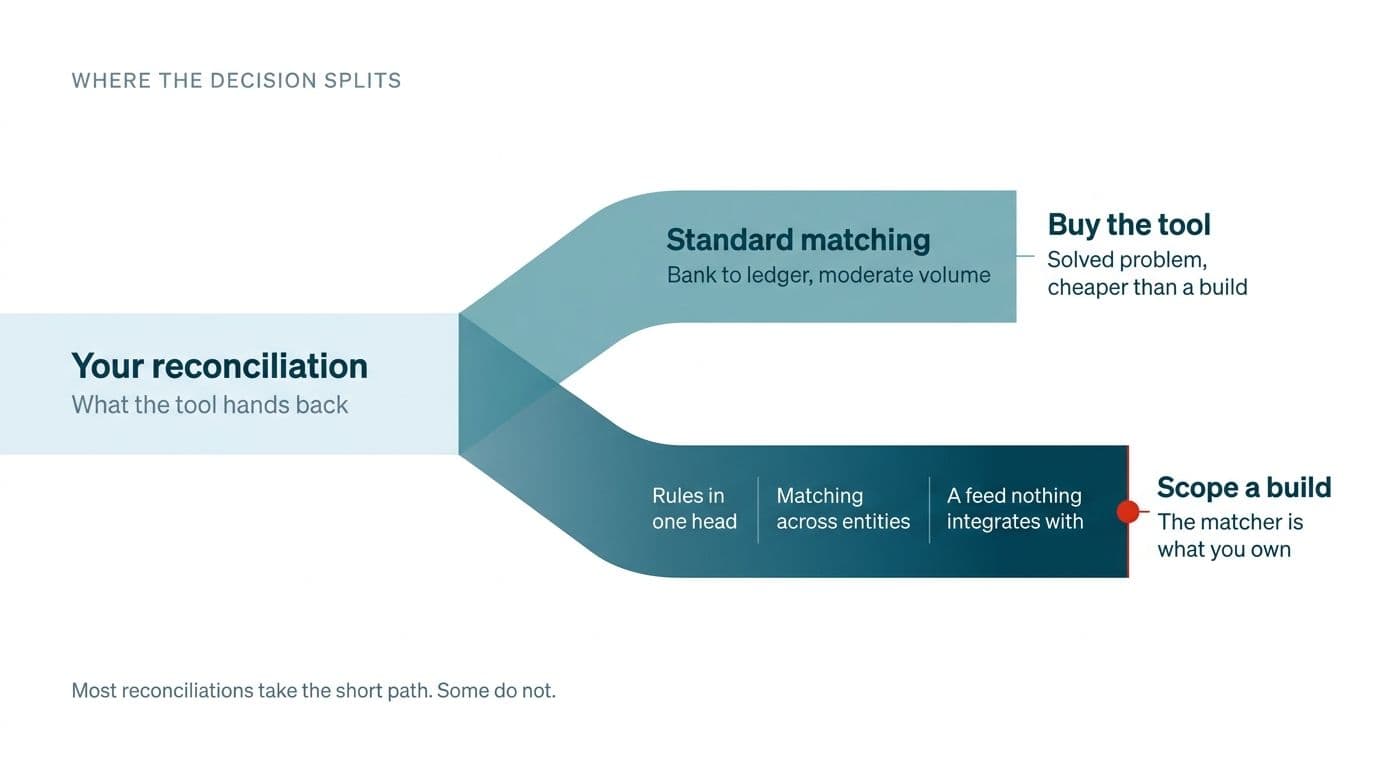
Start with the concession, because it is true more often than not. If your reconciliation is standard bank-to-ledger or AP-to-statement at moderate volume, buy the tool. Account reconciliation automation of that kind is a solved problem. The products do it well and cost far less than a build. The audit trail comes included. Building your own would be paying more for something you can license.
The build case applies in one situation. The match logic is the problem, not the workflow around it. Rules that live in one person's head and have never been written down. Matching that has to reconcile across entities with varied conventions. A feed that nothing off the shelf integrates with. An exception share large enough that clearing it is the actual job rather than the occasional edge case. Where automated reconciliation software keeps handing the hard items back, the matcher is what you need to own, not the wrapper.
On cost, think in a range rather than a single figure. A custom matcher pays for itself faster the larger your exception volume and the more expensive the people currently clearing it. That is the same break-even logic that governs any finance automation platform decision. Model it across a spread of build costs against a year of recovered hours. The answer usually becomes obvious in either direction.
So here is the offer, and it is deliberately narrow. Bring us the transaction types your current tool hands back. We will tell you whether custom matching logic is worth building for them. That is a scoping conversation, not a sales pitch. It is the honest thing we can actually promise. See what a custom matching engine would involve on our financial data automation page.
The layer is the decision
Go back to that exception queue from the opening. It survived the purchase because the purchase was aimed at the control layer, and your problem lives in the matching layer. That is not a mistake anyone made in bad faith. The category is named in a way that blurs the two. But naming which layer your own problem actually sits in is the real decision here, and it is the only way to judge if reconciliation automation software will actually solve your matching pain. Make that distinction before your next demo. Every conversation after that gets shorter and more honest.
Wondering what this would take against your own systems?
The audit costs nothing, and you keep the costed plan and the risks whether you go ahead or not.
Book a free automation audit
Arun Andiselvam
LinkedInI am a startup veteran who has built five brands. I sold the first, an SEO tool, for a six figure exit, and now build AI automation products for businesses. I bootstrapped every one of them from day one.